Powered By Blogger
Showing posts with label Biography. Show all posts

Friday, January 30, 2026

Ummo Luebben of Sutton Invented the Round Baler

 Ummo Luebben, Sutton Inventor

Ummo Luebben of Sutton invented the round baler. The initial purpose was to wrap straw into tight bundles useful to burn in stoves where wood was scarce. When the design was used on hay, the stems were parallel to the ground repelling water better than square bales (actually rectangular but we called ‘em square). 

Ummo and his brother Melchior began working on the machine in the 1890’s. Ummo was the engineer, and Melchior was the businessman (also president of a Sutton bank). After differences in opinion about the design, Ummo continued on his own and is generally given credit for the invention. Ummo sold the rights to the baler to Allis-Chalmers in 1943. Allis built about 77,700 Roto-Balers in production runs from 1947-1964 and 1972-1974. 

In a 2017 article at agupdate.com, Melchior’s great-grandson Eric Luebben of Fullerton, California said he had found six Luebben balers in the U.S. and Canada, in museums and fields. He managed to buy two of them and wanted to get one working and find a vintage tractor to pull it.


Ummo Luebben, inventor of the round baler, was born August 15, 1867, in Sheboygan, Wisconsin and died April 19, 1953, in Omaha. He manufactured his baler in Beatrice where he continued modifying it, eventually selling the rights to the patent to Allis-Chalmers in 1943.


Ummo Luebben of Sutton used this drawing for his patent of the round baler issued on Oct. 18, 1910. (Personal note: my memory crutch to remember the date of Luebben’s patent is that it was issued on the day my father was born.)


Thursday, July 18, 2024

Arnold Ochsner, Sutton Cobbler - 1945-1974...

This article about Sutton cobbler, Arnold Ochsner appeared in The Clay County News on July 11, 1974.


Friday, June 17, 2022

Thursday, April 7, 2022

1932 Burlington Rail Pass Found Blowing Around Town

This 1932 Burlington rail pass was found in a plastic zip-lock bag blown up against the fence of a dog run in Sutton this week (early April 2022). 


Among the fun consequences of being associated with a local historical society is that this kind of thing finds its way to our attention. Our learned,  and developed curiosity then kicks into gear.

William Chandler was born in Smith County, Kansas on 24 Oct 1904 and died in Harvard on 27 Nov 1969. He is buried in the Harvard cemetery.

William Joseph Chandler appears in the 1920 census as the 16-year old son of Vern and Rosa Chandler in Clay Center. He was in Harvard in 1940 with his wife Lottie and two children. He identified himself as an assistant welder for the Burlington railroad. 

The rail pass has been well preserved and from all appearances, has been kept for almost 90 years as some kind of memorabilia. So how did it come to be blowing loose on the streets of Sutton in 2022?

I dunno. Contact us if you lost this item, or have information about how or why it is still around.

Thursday, February 17, 2022

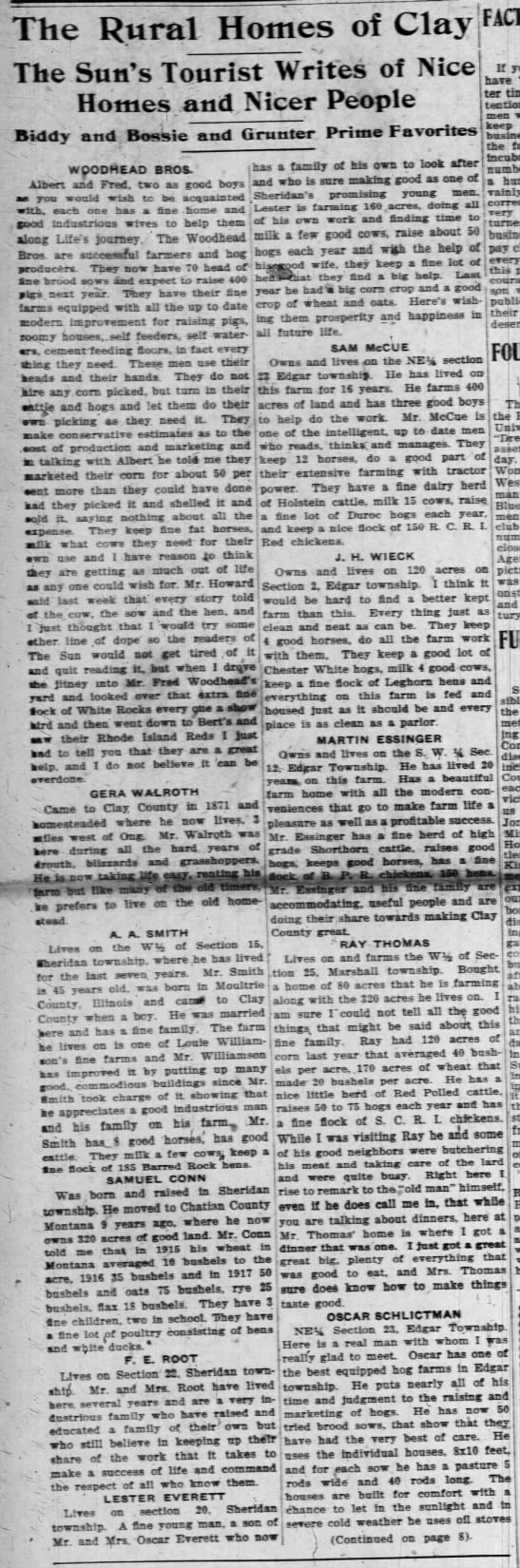
1922 Clay Co Homes and Mini-Bios

The Clay County Sun newspaper in Clay Center sent one of their fellows out to visit the good people of the county 1922 and to report their stories to the readers. 

These first two clippings were from the Sun on February 9, 1922 and the next two were published two weeks later on the 23rd of February.


The first article by Mr. Hall went over so well that the Sun did it again publishing this article on February 23, 1922.


Wednesday, July 14, 2021

Stella's Brother, Admiral J.J. "Jocko" Clark

There is a Sutton connection, close enough for our purposes, with one of the more fascinating heroes of Naval aviation.

Admiral J.J. "Jocko" Clark was an older brother of Stella (Clark) Olinger, wife of LeRoy (Roy) Olinger, Sutton residents who owned farms northwest of town. The Sutton story appears at the end of this article.


Joseph James Clark and Stella Clark were born on a farm near Chelsea in Oklahoma Indian Territory, J.J. in 1893, Stella in early 1900. Their parents were William and Lillie Clark. An older brother died in infancy, eight Clark children survived.


This photo of William Clark's family appears in Chapter 1 of "One the Warpath in the Pacific" by Clark G. Reynolds. The farmhouse was near Alluwe, Indian Territory in 1906. Left to right Joe, 12 with his dogs; "Papa" Will Clark, 45; Mary, 8; Stella, 6; "Mama" Lillie Belle, 33; twins Bill, Jr. and Dollie; and Lucy, 11.  

Joseph Clark received an appointment to the U.S. Navy Academy in Annapolis and in 1917 became the first native American to graduate from the academy. Tradition calls for plebes to receive a nickname, Midshipman Clark became "Jocko" a name that stuck with him throughout his career in WWI, WWII, to the end of the Korean War. 

He was assigned to one of the earliest aircraft carriers and immediately was attracted to flying becoming a Naval Aviator in 1925. 

Early in his career, he was the only aviator assigned to an inspection team evaluating new carrier aircraft and procedures for carriers and their aircraft. He was involved in developing carrier tactics until the end of his career, tactics that are key to naval carrier operations today.

Jocko developed a well-earned reputation for his aggressive nature and leadership. He became known as "Patton of the Pacific." Several videos about the admiral live on youtube.

Patton of the Pacific from Cherokee Nation Archivists. 

Admiral Jocko Clark and the Battleship New Jersey - The New Jersey was Admiral Clark's flagship in the Korean War.

After the Yorktown (CV-5) was sunk at Midway, a carrier that was under construction on the east coast was renamed the Yorktown CV-10). Then-Captain Clark was assigned as the new commander and he picked up the carrier before all interior work was done. Crews completed the ship as Jocko drove it through the Panama Canal and to the war in the South Pacific. He was launching aircraft into combat six months later.

A movie production crew accompanied the Yorktown filming what became an hour-long navy promotional movie called "The Fighting Lady." The narrator (Robert Taylor of Clay Center fame) purposely did not name the Yorktown to honor all carrier crews and airmen in the flick.

The Fighting Lady - an hour-long movie by 20th Century Fox.


The film is illustrated by navy combat film. A commentator pointed out that the Yorktown was the only ship with color film so all color photography in the film came from Jocko's ship. Jocko gets good coverage especially of him chewing out the crew and directing traffic on deck. The original film had no sound so we enjoy Jocko's words in a voice-over.

Back to the Sutton connection. Jocko's sister Stella Clarinda married LeRoy (Roy) Olinger in Oklahoma in 1918. Roy and his sister Bertha (wife of Dr. Fred Figi) were Sutton High grads in 1914 and 1913. (Dr. Figi in '12). 

Roy and Stella's daughter Jody married Paul McBeth and farmed an Olinger farm northwest of town. (I scooped corn with Paul many a time on our neighborhood corn-shelling crew.) Their daughter Paula was my classmate, class of '61. Second daughter Jody ('65) lives in Omaha - we had a great conversation about her great uncle Jocko and the books. Elizabeth was in the class of '72 and Dr. William McBeth in '74. 


Clark G. Reynolds assisted Jocko with his autobiography. Reynolds was the nephew of Admiral Clark's personal aide and snagged the gig when he was 19. Writing the book had to wait until Reynolds had his PhD from Duke years later. 

Reynolds was upset that the editor cut the story of Jocko's early years (including all mention of Stella) so that the autobiography concentrated on the admiral's career on carriers. So, we now have a full-fledged biography that does include the admiral's formative years in Indian Territory, hi-jinx at Annapolis (oh yeah), and pretty robust genealogy coverage of the admiral's various lines, including the Cherokee ancestry.


Jody and I captured the last copies of "Warpath" at amazon, so if you're interested (I recommend it) you'll have to wait or find another source.


Thursday, May 13, 2021

Arlene (Kessler) Reighter WWII Red Cross Volunteer - 1946

Arlene Kessler, Sutton High Class of 1936, came home in May 1946 from Red Cross service in Europe during WWII.

Her parents were Arthur Sr. (1887-1975) and Zella (Lamb) (1896-1974) Kessler. Arlene was born 25 Nov 1919 and died 23 Sep 2009 in Lincoln at the age of 89. She is buried in the Reighter plot in the Sutton cemetery.


Arlene Kessler was listed in the 1940 census at age 20 living with her parents in Sutton and teaching grade school in "public school" - likely Sutton Schools (or in a rural school?)

This article appeared in The Sutton News on May 23, 1946.


Sunday, May 9, 2021

Sarah (Brening) Everett - Founder of Runza Restaurants


Sarah Edna (Sally) Brening was born on 12 Aug 1912 near Sutton. In 1920 her parents Alex and Katherina Sophia (Sophie) (Leur) Brening were farming in Momence Township in Fillmore County east of Sutton. Sarah Brening married Wilbert T. Everett on 1 June 1938 in Lincoln.

She started the Runza business with her brother Alex (b. 1 Jan 1916).

Alex Brening (Sr.) arrived in New York on 18 Nov 1907 on the ship Caronia with his brother David. Ship records identify Sutton, Nebraska as their destination and Hy Reifschneider as their contact person. Alex Brening listed his home as the village of Popofka, Saratof (Saratov), Russia. The Saratov origins survive on the Runza Restaurant Wikipedia entry where the recipe is attributed to German Volga immigrants.

Sarah Everett died 23 Jan 1989 at the age of 76 and is buried at Lincoln Memorial Park.


Tuesday, May 4, 2021

Hosea Gray & Party arrived May 4, 1871

Hosea Wilson Gray


Colonel Hosea Wilson Gray, his son John M. Gray, his son-in-law George W. Bemis, and W. Cunning and his wife arrived at the Luther French dugout on May 4, 1871. 

The Gray party's arrival marked the beginning of the 1871 growth spurt that took Sutton from one farmer on the banks of School Creek to a bustling community on the Burlington Railroad by the end of the year.

Hosea Gray was born in Tioga County, Pennsylvania, spent some time in Indiana and came to Marion, Iowa in 1837. He practiced law in Marion for several years, was the first sheriff of Linn County and served for four terms.

He left Iowa for Nebraska in 1871 arriving in Clay County along the expected route of the Burlington Railroad. His wife Nancy, daughter-in-law Emma, and daughter Ada shortly joined their husbands in their new home.

W. Cunning's wife Kate has been credited with being the first married woman onto the land that became Sutton. I'm unsure why there is the distinction that she was married. Does that imply there may have been a single woman here? Where? Unaccompanied? The only inhabitant was Luther French. Surely not.

Hosea Gray was active in politics helping to form the Republican Party in Iowa. He served in Iowa's Constitutional Convention in 1856 and his portrait hangs in the state capitol.


When the Civil War broke out, Hosea Gray organized Company A of the 6th Iowa Volunteer Infantry and was commissioned a Captain serving nearly three years before sickness forced him to leave the army as a Lieutenant Colonel. He was promoted to brevet Colonel at the end of the war.

Hosea Gray practiced law in Sutton with his partner A.A. McCoy engaging in land deals in the new community. He was the senior partner with son John in the Gray lumber company located to the northwest of the intersection of Maple Street and Way Avenue on the Hunzeker property and on the grounds of the Sutton Museum. Two houses built by John Gray house the museum. 

Hosea Wilson Gray died on April 28, 1885 and is buried in the Sutton cemetery.

Sunday, January 31, 2021

Dr. John W. Thompson - Biography

Dr. John  W. Thompson was a doctor in Sutton in the early 1900's. His daughter-in-law wrote this biography of him which was serialized in The Sutton News in early 1946.


Tuesday, January 12, 2021

Lillian King, Wife and Mother of County Newspaper publishers

Lillian King was the wife and mother of the long-time publishers of The Clay County News. She died in 1971


Tuesday, December 22, 2020

Griess Name & Sutton was Featured in 1922 Lincoln Paper

This article in a 1995 issue of The Clay County News told the story of a 1922 article in The Lincoln Sunday Star about the Griess family of Sutton. 

The original 1922 article follows.


-------------------------

The headline banner of the Lincoln paper on July 30, 1922 surely caught the eye of Sutton locals.


This collage of photos was the centerpiece of the 1922 Lincoln Sunday Star article.


Saturday, August 15, 2020

Obituary of Henry & Alice Vauck - Killed 11 Nov 1957 at Sutton Downtown RR Crossing

 The automatic railroad crossing guards in the middle of downtown Sutton were installed after this accident.

Henry Vauck served as Clay County Judge for several years. His brother in law, Roy Oakley served as County Clerk for 33 years. Both men had lost a leg in childhood accidents, both turning those losses into the opportunity to receive an education, teach in rural schools, and serve as county officials. 

Henry and Alice Vauck were highly valued members of the Sutton community and their tragic loss that afternoon hit the town of Sutton hard.

Sunday, March 31, 2019

H. C. King Lamenting the Saturday Evening Post - with mention of Herbert Johnson

This 1969 article by Clay County News publisher emeritus, H. C. King describes the demise of the national magazine, Saturday Evening Post. He mentions Sutton's own Herbert Johnson who drew cover cartoons for this magazine, Country Gentleman and other publications. 


Herbert Johnson also produced hundreds of political cartoons during the 1930's. We have a book of 90 of those cartoons in the Sutton Museum.


This 2017 article on the blog tells the Herbert Johnson Story.


Wednesday, March 20, 2019

Francis M. Brown Died 100 Years ago - March 20, 1919

Our lead entry in the 1919 section of the museum's newspaper column today, March 20, 2019 was the account of the death of Sutton pioneer Francis Marion Brown:

Long-time Sutton publisher Francis M. Brown died March 20, 1919 at the age of 78. He’d worked at his desk until February 24. He and three brothers homesteaded on Section 10 of School Creek Township in the spring of 1871. He was the first county clerk and the first clerk of the district court when Clay County was formed in October 1871. He purchased The Sutton Register newspaper in 1886 later operating it with his son Charles. Francis Brown was Sutton’s first mayor, or chairman of the board of trustees serving three terms and was police judge for 18 terms. 


He enlisted in Co. B, 14th Indiana Infantry at the beginning of the Civil war serving until the unit was mustered out in Indianapolis at war’s end. The pall bearers were Mayor Jacob Bender, Samuel Carney, Melchoir Figi, A. W. Clark, C. E. Wieland and Fred Hanke. Those familiar with Sutton history recognize this list of the Town Fathers of that era. 


Friday, March 1, 2019

Nathan A. Tyler - Confederate Soldier - Sutton Cemetery


Nathan A. Tyler is one of at least two Confederate soldiers buried in the Sutton cemetery (Leonard Jarrett).


He advertised his tree business in The Sutton News in early 1919.


Nathan Tyler's grave flies a Confederate banner on memorial occasions. He enlisted as a Sergeant in Company D, North Caroline 1st Infantry Regiment on 13 June 1861, two months after the attack on Fort Sumner. He was mustered out 6 April 1862, early in the Civil War.


Tyler's tombstone does not indicate the date of his death. He appeared in the 1920 census, but not in 1930. Other research puts estimates of his death around 1928.


Nathan Tyler listed his occupation in the 1920 census as janitor at the telephone company. His entry for 1910 was "monuments" suggesting that he sold, and/or inscribed monuments, likely tombstones, for instance. Do you suppose that he continued that business into the 1920's and may have still been the local monument supplier at the time of his death? If so, could that be the explanation of why the date of his death did not get inscribed on his own tombstone?


History is not an exact science.