Saturday, December 12, 2009

George Bemis's poem, "Grafton to Sutton"

Sutton’s first struggle to survive was a struggle against the Burlington and Missouri River Railroad. The story ended when a few Sutton settlers quietly purchased all but one of the buildings in Grafton, the railroad’s choice for the local town, and towed the depot to Sutton one night with a couple of teams.. This Grafton was just four miles east of Sutton; the present town of Grafton was settled later further to the east.

George W. Bemis celebrated this event in 1872 with a poem that was published in the State Journal the next year.

GRAFTON TO SUTTON.

"What a clanking of hammers and ringing of saws;
 How they sound through the valleys and ring in the draws;
 Oh! Sutton is growing, in the midst of the fray,
 With the city of Grafton only four miles away.

"How the B. & M. engines shriek, whistle and squall,
 And send forth the order that Sutton must fall;
 How they thunder and mutter and groan night and day,
 With the city of Grafton only three miles away.

"Then came Mr. Marthis, and thus he did say,
 'I am tried of Grafton; if only I may,
 I'll come down to Sutton, without delay.'
 Soon Grafton will be only two miles away.

"Then started the wagons and horses and men,
 The steeds, how they foamed, as a whip now and then,
 Came down on their sides, near the close of the day,
 With the city of Grafton only one mile away.

"Then rushed down the hill the black and the gray,
 Close followed the crowd to have sport on the way,
 And the shout that went up at the end of the fray,
 Said 'The city of Grafton is in Sutton to-day.'"

Sunday, November 15, 2009

Sutton Museum on Twitter

Check out   Suttonnehistory   on twitter.com

Sunday, October 4, 2009

OPEN COMMENT

Open comment for any discussion....

October Membership Meeting - Tuesday October 6

The regular monthly meeting of the Sutton Historical Society will be held at 7:30 p. m. at the Historic House at 309 N. Way Avenue on Tuesday, October 6th.

Tuesday, September 29, 2009

When Sutton had an Army

The Andreas’ History of the State of Nebraska by A. T. Andreas in 1882 is a great source for information about the early days of Sutton. The book was published but 12 years after Luther French dug his hole in the bank on School Creek making Sutton’s first decade perhaps its best documented.

Deep in the chapters on Clay County and Sutton is Part 8 including “Orders and Societies”. Here we learn that the early Sutton folk, at least the town folk, were a clubby bunch. There were several lawyers, doctors and businessmen (yes, mostly men) who came from established communities in the east where they had been active in the “orders and societies” so they naturally created new chapters of old, familiar organizations.

Andreas lists the Freemasons plus a Lebanon Chapter, IOOF plus an additional IOOF higher order, Grand Army of the Republic, Knights of Honor, a Military Company and Scientific Association. The same names appear in multiple organizations, but for a few hundred adult men, these guys were social creatures.

But what does it mean for a 1880’s small town to have a “military company”? Andreas spelled it out very well.

Company B of the First Regiment of the State Guards was formed on November 15, 1878 with forty members: “…Sutton’s sons whose proclivities bent in the direction of the chivalrous and heroic…” Officers were W. J. Keller, Captain; J. S. LeHew, First Lieutenant; and G. W. Bemis, Second Lieutenant. At the time Andreas wrote the piece, Keller was Lieutenant Colonel of the First Regiment and LeHew was Judge Advocate General on the Governor’s staff. The company was supplied with uniforms, guns, etc. and was the first such uniformed and equipped company in Nebraska. The company had its own armory for munitions storage.

So, what did they do? Actually, they were twice activated.

The company was ordered to arms in the summer of 1880 in response to a riot at the smelting works in Omaha. After three days the situation subsided and the company discharged.

On March 8, 1882 the First Regiment was activated to put down the strike among graders on the Burlington & Missouri Railroad again in Omaha. This time the duty lasted twelve days as the company guarded the graders’ camp. There were no open hostilities. The company seems to have acquitted itself well as Andreas reports that, “as an indication of the merit of this body of men, they were specially appointed to remain in the suppression of the strikers, and were the last company to be discharged for duty”.

As of the writing of the Andreas book the officers were: W. D. Young, Captain; F. C. Matteson, First Lieutenant; George C. Roys, Second Lieutenant; J. H. Johnson, First Sergeant. The company met for drills each Saturday evening and held target practice once a month.

It would be interesting to dig deeper into the nature of such military companies. The general concept suggests a relationship to earlier citizen forces or to the National Guard structure. It even is consistent with the famous phrase, “well-regulated militia”. A quick and limited search for corroborating, or further information was unsuccessful. I’d appreciate hearing from anyone familiar with these military companies.

John R. Maltby, Sutton Pioneer and 19th Century Adventurer

There have been a number of “characters” in Sutton’s past but drawing on almost 138 years of local history a few real Doozies stand out. My favorite Doozy is probably Mr. John Roger Maltby. Again, we are indebted to Nellie and Anne Sheridan for preserving this story in their book, “Along the County Line”.

John Maltby was born in Maine in 1830 but his father, Reverend John Maltby moved the family to Sutton, Massachusetts in 1834 where the elder Maltby served the First Congregational Church for 26 years. Yep, the younger John later gave Sutton its name. At age twenty-two, Maltby departed on a fifteen-year adventure that included seven unsuccessful years in the Australian gold fields, auctioneering in India, working on the first trans-Atlantic undersea cable and a bit of wandering about the United States.

While in London on the cable gig, John met and married Matilda Mary Cooke, a convert and very devout Catholic. After two years of faith-based difficulties John returned to the US, sans Matilda. After stays in San Francisco and New Orleans Maltby tried selling washing machines in Mississippi, Louisiana, Texas and Arkansas, IN 1865! He learned that the war-torn Confederacy was a poor market for high-ticket consumer products.

Meanwhile, back in London, Mary decided to join John and not finding him in Massachusetts, tracked him down in Louisiana in 1866. A year later their Boston hardware business flopped. John then left Matilda with his sister and went to Omaha where he built a track and organized horse races (you can’t make this stuff up). He dabbled in some land deals, cattle deals and fur trapping before poking around School Creek in May, 1871.

Maltby’s next adventure is well documented in Sutton’s history and we’ll save it for another day. Briefly, he and William Way “jumped” the claim of Mr. J. C. Vroman to organize much of today’s Sutton real estate. Vroman disappeared and we have Maltby and Way Avenues.

In September, 1872 Maltby took a business trip back east, ostensibly as part of the Sutton-Burlington depot dispute but actually to see Matilda and offer her a new life in the West. She agreed. London to Boston to Sutton. Quite a “Life Story”. But there was more to come.

Maltby was an early mover-and-shaker in Sutton: judge, school superintendent and in the midst of the social circles. But in 1877, just six years after finding School Creek, John, this time with Matilda, moved again but only a few miles to Fairfield. They were now both pioneers in organizing the town and the Catholic Church.

John died in 1895 and Matilda, almost penniless returned to Sutton and became the town’s librarian. She died in 1912 and is buried in Calvary Cemetery.

The Sutton Museum is proud to display several items of Matilda Mary Cooke Maltby include dresses and her wedding gloves and shoes thanks to Regina Leininger and others with the foresight to preserve these artifacts from our history. See them at the museum Sundays from 2 to 5 PM or by appointment. Contact Jerry Johnson at 773-0222 or jjhnsn@windstream.net for more information.

The Boar's Nest

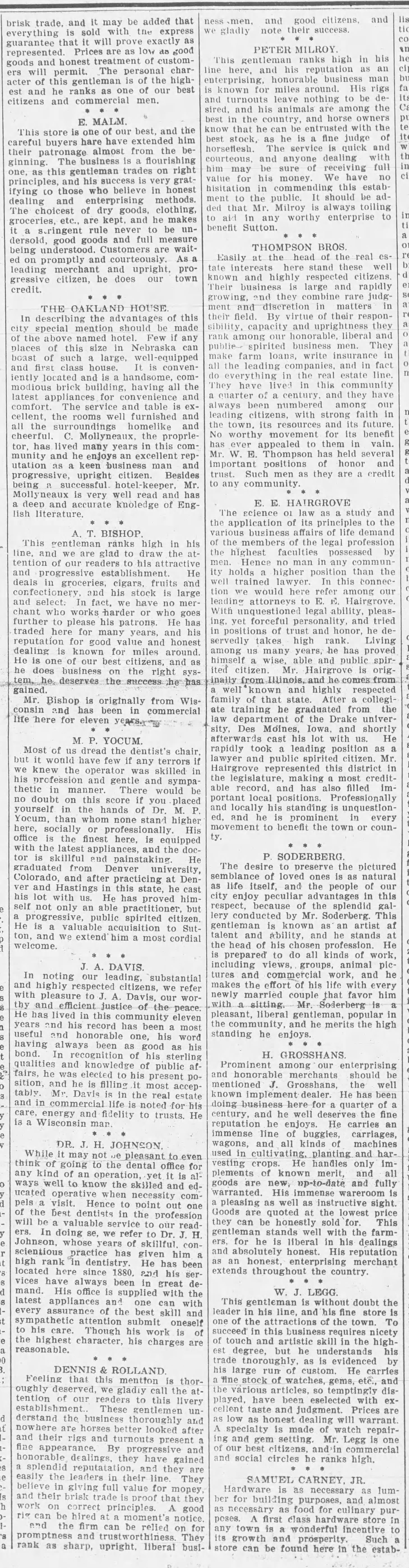
We have been researching the names, ownership and locations of business enterprises throughout the history of Sutton and recently came across the story of the “Boar's Nest”. The story appeared in the Sutton Register newspaper in 1902. The Register is one of five newspapers that we know to have been printed in Sutton.
The other four papers are The Clay County Globe, the Sutton Advertiser, the Sutton News and of course, The Clay County News. These papers did not all exist at the same time, but they did overlap providing multiple news sources over the years.

Out interest here is in the Sutton Register. This newspaper was founded in 1880 and purchased by Francis Marion (F. M.) Brown in 1886. Brown was the brother of Robert G. Brown, another Sutton pioneer who is connected to the founding of Clay County. F. M. Brown edited the Register until his death in 1919 when his son, Charles M. Brown took over the paper.

The Register in 1902 was a four page weekly. The advertisements are of particular interest in identifying numerous businesses with certain clues as to their locations. The paper carried a variety of items including a generous allotment to international news with datelines from all over Europe, South America and Asia. Each issue included a column of local tidbits under the title of “Local and Personal”. It appears that the locals did a lot of traveling that did not escape the eye of the editor. Typical entries were, “Henry Elfring went west on No. 5 Monday”, “F. J. Hoerger went to Omaha Tuesday on business” and “Burr Longstreth went to St. Joe Tuesday”. St. Joe seems to have been a popular destination. On January 9, 1902: “M. Figi will start for Switzerland in a few days, to visit his mother”. These folks got around.

The various lodges and organizations received attention including a note about The Lady Maccabees, Hive No. 42 spending a “delightful social evening with Mrs. Hennessey Tuesday”.

These old newspapers provide a hint about life in Sutton over 100 years ago. The Clay County News office has a collection of these papers but unfortunately, newspaper tends to deteriorate over time. The Nebraska Historical Society has preserved many of these papers on microfilm and the Historical Society plans on reviewing that collection to ensure that our history is preserved in that format.

But back to the “Boar's Nest”. The first issue of the Sutton Register in 1902 contains an article of the type that makes this kind of research entertaining. We learn there that: “The fact that a gambling joint has been in operation in Sutton for years is well known to everybody in this vicinity. Formerly the business was located on the south side, but afterwards moved into rooms on the north side, where it was known as the “Boars Nest,” where sports and congenial souls met to open bottles and jack-pots unmolested. New Years’ morning about 3 o’clock the city police decided to raid the “Boars Nest;” besides the proprietor, he found six men celebrating the arrival of the new year as only gamblers can. He pulled the whole gang, consisting of four Sutton men and three from other places, but afterwards allowed the men to go at liberty upon their own recognizance. The visiting sports lost no time in getting out of town on the first train. The REGISTER withholds the names of the parties on this occasion on account of their friends, but will not promise to be so lenient in the future under similar circumstances.”

It is hard to list all the things that article tells us about Sutton, 1902.