Powered By Blogger
Showing posts with label Sutton Life Magazine. Show all posts

Tuesday, June 2, 2026

Ted Wenzlaff Connected Sutton with Distant Places and Events


A military career offers a wide variety of opportunities beyond that of most civilian jobs. The career of Sutton’s Col. Theodore C. Wenzlaff is one illustration. How else could Sutton be linked to a post-WWII dispute between Britain and Russia over coal deliveries, to a girls’ high school in Seoul, Korea and to John F. Kennedy’s funeral procession? 

Captain Theodore C. Wenzlaff on Milly Russell
The historical society acquired a copy of Wenzlaff’s 1967, 24-page Autobiographical Highlights from his son Bill of Wichita. The document concentrates on the colonel’s nearly 33 year military career describing those distant events and many others.

Ted Wenzlaff graduated from Sutton High in 1921 and attended one semester at the University of Nebraska before his father pulled the purse strings shut. He applied for and received an appointment from 5th District Congressman Andrews to West Point where he was commissioned as a cavalry officer in 1926.

His early army career was a parade of cavalry assignments in Wyoming, Kansas, South Dakota, Fort Robinson, Nebraska, Vermont and Texas until he was assigned to Fort Reno, Oklahoma in the quartermaster corps reporting on November 22, 1941. Military opportunities broadened a few weeks later but he was able to spend several months at Fort Reno.

In June, 1942 Wenzlaff as assigned to a unit near Seattle and moved there with his family. Only when he arrived did he learn that his unit would be going to Europe out of New York City in just a few days. He had to locate and turn around his household goods shipment and get his family back to Sutton.

He worked in logistics and transportation in offices England earning his promotion to “temporary” colonel and “permanent” major. (Don’t ask. It makes sense, but takes a long time to explain. It’s why General Custer was really a Lieutenant Colonel. Again, don’t ask.) In early March, 1944 he became part of the Control Office that planned the Normandy invasion. After the invasion he served as a transportation officer in France working in a wing of the palace of Versailles for a time – that had to be cool.

Col. Wenzlaff was in Berlin after the war and became involved in negotiations between the Russians, British and American occupation forces. He described in detail an episode involving the trading of “brown” coal and anthracite coal between the Russians and British. He was not impressed with Russian negotiating techniques or their trustworthiness.

Col. Wenzlaff found himself in a state of army limbo after the war as he was still technically a cavalry officer though there was no cavalry. He found a home in the quartermaster corps eventually returning to Fort Reno, Oklahoma in 1952 taking command of the Remount Station where he found himself again in the horse business and in charge of finding some 10,500 cavalry riding and artillery draft horses plus 6,000 pack mules for a foreign military aid program to the Turkish Army.

While scrounging around the Southwest finding horses for Turkey, he received a more modest request from Fort Myer, Virginia for a small number of grey artillery draft horses and one grey cavalry riding horse. He went to some length to locate seven grey draft horses and the riding horse shipping them east in 1952 where they were to support funeral details at Arlington Cemetery.
The Kennedy funeral caisson, November 25, 1963. Three of the six horses were acquired by Col. Wenzlaff for this duty
as was the riding horse, tail just barely visible on the left.

During the televised funeral of President John F. Kennedy in November, 1963, Col. Wenzlaff noticed that the caisson bearing the casket was drawn by six grey draft horses and the section chief rode a grey horse. He inquired and learned that three of the draft horses and the riding horse were ones he’d sent several years earlier. He had ridden the cavalry horse several times but found it to be too lazy for his own taste, but as it turned out, that was a perfect trait for funeral duty.

Horse duty completed, Col. Wenzlaff assumed command of the 23rd Quartermaster Group of 100 officers and 2,000 enlisted men in Seoul, Korea for sixteen months beginning in July, 1953 – as that war was ending.

His group was quartered in a girls’ high school building which had been abandoned by the school early in the war as people fled to the south end of the Korean peninsula to evade North Korean troops. When the faculty and students returned they found their school occupied by Col. Wenzlaff and his command. Our hero shuffled his troops around, took over nearby buildings and built temporary structures providing space for the school. School enrollment grew from 750 to 1,250 as the military unit and the school worked closely together.  The school principal became a good friend entertaining Col. Wenzlaff and his officers in her home introducing them to Korean cuisine and customs. The Mayor of Seoul thanked the colonel for his unit’s help for the school in a scroll of appreciation.

Col. Wenzlaff retired from the army on June 30, 1955 returning to Sutton where he taught freshman and junior English at Sutton High for one year (he didn’t care too much for that.) He served on the city council and took up golf.

He began to research the story of the Germans from Russia traveling to Russia and Germany eventually writing “Pioneers on Two Continents: The Ochsner-Griess History and Genealogy” in 1974.

Col. Wenzlaff’s Autobiography was written in 1967 before he was elected to the Nebraska Senate. He died in 1988 at the age of 85 and is buried in the Sutton Cemetery.

This article first appeared in the August, 2011 issue of Sutton Life Magazine. 

Col. Wenzlaff was appointed to the Nebraska legislature in December 1968. The story appeared in The Clay County News on Dec. 5th.


Friday, May 8, 2026

We Don't Want No Stinkin', Rottin' Food


Years ago, we wrote about Sutton’s pioneer Bemis family. We retold a story that Mrs. Bemis, the former Ada Gray had told on her husband, attorney George Bemis, a story that shows up in early Sutton accounts.

It was early in that first spring when only a few dozen people had found and settled in Sutton. George had bought a cow and that evening much of the community gathered to observe the milking of what may have been the town’s first milk cow.

The next morning George was sitting at the table after breakfast when Ada asked him if he was going to milk the cow. His response was, “Why? Are you out of milk already?”

Ada may have told Sutton’s first joke, at least its first lawyer joke. But the story triggers a more serious thought about those early days. How did Ada take care of that fresh milk to keep it from spoiling at a time before refrigeration? How did people store and protect their perishable foods generally?

The food preservation problem goes back a long way, to ancient times when people discovered that salt helped to keep food edible preventing bad tummy aches. Mark Kurlansky published a book in 2002 he called simply, “Salt – A World History” describing how much of the world’s history was driven by the search for sources of that edible and useful rock.

The Romans had numerous sources but when they settled in Britain, they found salt mines all over that island. Town names ending in “-wich” are, in almost every case, a town with a salt mine in its history.
 
This icebox from the 1920's illustrates one style with the block of
ice in the left compartment. Our icebox from the '40's had a bottom
compartment for the ice. 
Way before that, the city of Jericho in the West Bank of Palestinian Territories was founded almost 10,000 years ago as a salt trading center. And a more recent fun fact is that the early village of Lancaster where its 30 residents were engaged in gathering salt from the marshes along Salt Creek was designated as the state capitol and renamed “Lincoln” partially on the expectation that salt mining would be the basis of a local booming economy.

The lure of spices from the east contributed to the Columbus adventure in 1492 having a certain and large impact on history.

Salt helped preserve food by absorbing water from the food making an environment too dry for mold or bacteria to develop. Spices such as vinegar, garlic, cinnamon, cloves, etc. keep food fresh by inhibiting the growth of bacteria, though cynics may say that it makes food taste so bad you don’t notice it’s rotten.

Before the Bemis family came to Sutton, people wise to the ways of preserving food roamed the area. Native Americans had pemmican. You may have had the misfortune of stumbling upon online videos advertising a book called “The Lost Ways”. The book supposedly describes 150 lost ways to live in the woods. The impetus behind the book is the survivalist movement and you’ll need to wade through the politics on this one.
 
Native Americans made, and lived on pemmican; mountain men and settlers copied the recipe and today,
today it belongs to campers and survivalists. 
The pemmican video describes how to make the product by drying lean meat and berries in a low-heat oven, grinding the meat and berries into a powder, and then mixing that concoction with melted beef tallow or fat. The result is a supposed to be a high-energy, tasty, and long-lasting food. Ten pounds of the stuff will sustain you for a month in the woods, etc.

The mountain men and early settlers learned about pemmican from the Indians and adapted that and many similar Native American food and food preservations secrets.

The problem of keeping food safe was widespread, far beyond that of the Bemis family and their neighbors in those early Sutton years.

Those people moving west in wagon trains had to know how to keep food fresh. Sailors needed to bring along food and water for their entire trip, plus a safety margin. Have you ever had hardtack and grog?

Generals understood well that an army moves on its stomach, that is, no amount of the latest in armaments will do any good if the general can’t keep the men fed and healthy.

Emperor Napoleon Bonaparte gets credit for one of the major breakthroughs in food
Napoleon had a hand in the invention of the
canning process when he held a contest to find
a way to keep food safe for the troops. 
preservation that the settlers used and we depend on today. Military officers knew that tainted food was a huge risk to their army. A soldier in his tent doubled up with a bad stomach ache is as useless to the general that day as the comrade who was shot in the head yesterday.

Napoleon offered a cash prize of 12,000 francs in the late 18th century to anyone who could develop a reliable method of food preservation. Nicholas Appert came up with the idea of preserving food in bottles, like wine. After 15 years of experimenting, he figured out that if food was heated enough and sealed in an airtight container, it would not spoil, and the process of canning was invented. We don’t know what he did with the prize money.

Canning food was a simple process that anyone could do at home providing safe food for long periods of time.

But back to Ada Bemis. What did she do in 1871 to keep the milk safe? The tried and true approach at that time was to keep the milk in a cool place, usually in cool water. School Creek was handy. Maybe that’s where she kept the milk.

Entrepreneurs on the frontier stepped up to offer ice through much of the year. Sutton’s ice man was I. N. Clark followed by his son, Bertie. Their source was the winter ice in Glen Lake, now called Clark’s Pond. They would cut blocks of ice out of the lake in the winter storing the ice in their ice house. The elder Clark put up 5,000 tons of ice each winter in the early 1890’s. Ice houses were usually dug a few feet deep into the ground and a solid roof built overhead. Ice was layered with straw, a good insulator, and would keep through most of the summer.

Several farmers in the northeast corner of the county built their own ice house, or ice cave stocking it with ice from the Blue River during the winter and sharing the ice in the summer.

Even the nobility had food storage issues. This
partially sunk ice house is in the Boboli Gardens
behind the Pitti Palace in Florence, Italy, home of
the ruling Medici family from about 1550.
Ice storage was a world-wide problem. The “coolest” instance I found was the ice house in the Boboli Gardens in Florence, Italy, behind the Pitti Palace. That palazzo was the Medici home from the mid-16th century and, of course, was used by Napoleon for a time.

Several years ago, we found a newspaper clipping about a fellow near Glenvil who had a large ice business on the banks of the Little Blue River. His storage facility was a way up the bank of the river with an elaborate pulley system to transport the blocks of ice up the hill.

Later, now within my memory, the Sutton Mill just west of downtown on the north side of the Burlington tracks had an ice business. This was during the years before electricity came to the farm and the “icebox” was the answer to cold storage. The icebox was an insulated cupboard, looking much like a refrigerator, but with a section to hold a large block of ice. There was a pan to collect the melted water that you wanted to empty often. My memory is that the blocks of ice we purchased from the mill were about 1 foot cubes, the last purchase in town before heading home.

Another handy cool place was a well. Foodstuffs could be lowered on a rope into the bottom of the well where the temperatures would be considerable cooler than above ground and food would keep for several days.

One farm wife’s story at the State Historical Society’s website describes using tanks in the farm’s milk house to keep milk cool. The water in the tanks needed to be changed daily, or more often, but it worked.

Root cellars were, and still are, another structure dug into the ground, roofed over and stocked with potatoes, turnips, carrots, etc. all layered with straw. Straw layers hold trapped air which makes a good heat insulator protecting cool food from the heat.

When electricity service came to the house, the refrigerator was high up on the wish list of new appliances. It’s hard to overestimate the impact the refrigerator had on the quality of life after literally thousands of years of making do with barely adequate ways to keep food fresh and safe.
 
Meals Ready to Eat (MRE), modern C-Rations, may be the current high-water mark for technology to preserve and store
food. Military needs come in large sizes and DoD has the resources to make things happen.
The technology and the methods to keep food safe continue to develop. And as often happens, the military has the biggest need and the largest incentive to address it. My last active duty assignment was at the Defense Logistic Agency’s depot in northern California. That facility was tasked with producing Meals Ready to Eat for use by the army and marines and for long-term storage. A relatively small workforce produced millions of these food packs incorporating the food processing and preservation techniques developed over time.

And finally, there is a question that bothered me a lot recently. We typically store about 10 dozen eggs for the historical society’s pancake breakfast on the first Saturday of the month and the Allegro Wolf’s third Saturday waffle breakfast.

We were keeping the eggs in the refrigerator when I remembered that back on the farm in the 50’s we collected about 30 dozen eggs at a time before taking them to town and we certainly did not refrigerate them – we never had that kind of capacity.

After inconclusive discussions, I consulted the ultimate authority, the internet. In part of the world, the U. S., Japan, Australia and Scandinavia, we prefer clean, even pristine eggs so we wash our eggs. Washing removes a natural protective film the chicken puts on the egg. That coating resists bacteria, salmonella and the like. So, without that coating, we need to refrigerate our eggs.

In the rest of the world, most of Europe, Asia, Africa, etc. the egg production and delivery system does not wash the eggs so with the protective film intact, there is no need to refrigerate the eggs. Apparently, those people are less squeamish about buying eggs with chicken poop stains.
 
After some time with a nagging question about the proper way to store eggs, a bit of research came up with not one
preferred way, but two completely different answers, both equally valid. Case closed.
Both systems work equally well in keeping eggs safe for consumption. The rule is that the system must be consistent and a supporting array of regulations ensures that.

Since you have lasted through this entire article, I commend you. This is another example of our attempt to learn some details about how people have lived in Sutton’s past. If there is some aspect of the past that interests you, let us know as eight years of this series eaten up almost 100 topics. Coming up with another topic each month gets increasingly difficult.


Tuesday, October 31, 2017

Did Sutton Once have a Chinese Laundry?

It is unlikely that anyone has set out to find out if Sutton once had a Chinese laundry. That’s something you have to stumble onto.

And stumble onto it we did.

Check out Figure 1. There on the east side of Saunders Avenue, two doors south of Bender’s, just past the harness shop, is (was) a Chinese laundry. Show of hands. Who knew?

Figure 1. This map from the Sanborn Fire Insurance Maps shows the north end of downtown Sutton in 1889. Cool, isn't it?

And look catty-corner from Bender’s where the four-story Oakland Hotel is depicted in a crude floor plan showing where the kitchen, dining room and stairs were in the building.
Key to the map codes

What are we looking at?

We are looking at maps of downtown Sutton in 1889! The Sanborn Map Publishing Co., Ltd. developed Fire Insurance Maps of towns across the country. The maps were targeted at insurance underwriters who needed to know something about their markets.

These maps are color coded – yellow are wood frame buildings, red are brick and others are identified on the key. The cryptic identification on each building tells how many stories there were, the type of business and other special features of interest of insurance people.

There is a photo of a livery stable on the south wall at Astra Bank. We’ve made guesses where it was. No more guessing. There it is on the south bank of School Creek, just east of Sutton’s famous early Iron Bridge – the Lewis and Jarrett Livery stable. (Leonard Jarrett was the father of librarian Sibyl, and he was a Confederate cavalryman from Virginia.)

Figure 1 shows the north half of the north end of 1889 downtown Sutton to mid-block. Figure 2 picks up at a hardware store and tin shop on the west side and a confectionary and cigar store on the east. That would have been the Carney hardware store and the tin shop would be of interest to the insurance folks – fire is involved.
 
Figure 2. This is the 1889 map of downtown Sutton just north of the Railroad tracks. 
Smokehouses at meat markets are also marked including a blue one, stone.

Street names as well as block and lot numbers help locate the buildings. Most locations only list the type of business but lumber yards, elevators, livery stables and meeting halls are more fully identified. The red (pink) buildings on the west in lot 1 of block 5 and lot 10 of block 23 shows the Opera House to be upstairs over a grocery store. Neat, huh?

How did we find these?

We didn’t. Credit goes to my cousin Ken Nelson of Manassas, Virginia. Ken grew up on a farm near Clay Center though began life near Sutton. He worked for the Dept. of Ag in Washington, D. C. He is a champion of the Library of Congress. These maps are on the library’s web site.

Follow this link:  Sanborn maps for Sutton
A big shoutout to Sanborn Maps for these priceless looks at
Sutton 128 years ago. 

Or a search for “sanborn fire insurance maps sutton Nebraska” will return several links within www.loc.gov. You should see “Sutton” in a few of the urls – look around. 

There are seven entries, those for 1884, 1889 and 1897 are online with links. We’re looking at 1889 here. Maps for ’02, ’12 and ’24 are not online. Could you bring back a copy of those next time you’re in D. C.?

Figure 4 shows the south end of downtown. Note the Central Block. Remember the date on the building? 1887. The building was two years old when his map was drawn. The businesses were a hardware store (with tin shop), a grocery and bakery, a gentleman’s store and a saloon with a “Hall” on the 2nd floor. The building is red (brick) and is two-stories. The id near the back of the grocery/bakery seems to read “IR OVEN BST” which sounds like an oven in the basement, another good item for insurance folks.

The abbreviations can be challenging. You’ll find lots of “Dwg” which are houses, residences, “dwellings”. Milly is a millinery shop. You’re on your own for the rest.
 
Fig. 4 Downtown Sutton - South of the tracks. 
Figures 1, 2 and 4 are on Sheet 1 of the web site. Sheet 2 is a composite of other locations. Be careful, north isn’t always on top.
Figure 6. Site of today's Sutton Museum.

Figure 6 is of interest to the historical society. It depicts the location of our museum. Note that the little creek in mid-block is labeled “School Creek”. And the J. M. Gray Lumber Yard is shown in detail. The office was on Maple across the street from the railroad tracks. Note the “Dwg” on Cedar. That is the current middle museum building, once the Schinzel House. The drawing is a crude floor plan quite unlike today’s structure in the rear.

Figure 7 across from today’s Post Office with a vacant building where the American Legion now is. The Occidental Hotel stood there within the memory of many mature Sutton residents. It is identified on both the 1884 and 1897 maps suggesting the Occidental Hotel may have had a false start.

In the northeast corner of Figure 7 is “Wind Mill & Well, w. Tank on Trestles” – another piece of information of interest to underwriters.
Figure 7. The American Legion is now in the southeast corner of this map.

Having fun yet?

Figure 8 should spark a discussion. We’re looking just north of School Creek and west of Saunders Avenue. The Federated Church would be at the north edge of the image. Text may be fuzzy here, but check the web site. That is a U. P. R. R. depot with a platform and supposedly railroad tracks heading east into … well, …. into the park???
 
Figure 8.What the heck is this? This 1889 map seems to be telling us about a Union Pacific Depot just north of School Creek on the west side of Saunders Avenue and more than that, there would be railroad tracks past that depot... Tell me more.
What do we make of this? I found instances in the Harvard maps where a building was marked “to be…” something indicating that the map drawer was indicating a planned building at that location.

Research into Nebraska railroads led to a House of Representative’s document about railroad incorporation filings for the St. Joseph and Grand Island Railroad (today through Glenvil, Fairfield, Edgar, Davenport, etc.) for a spur through Sutton to York.

And, as part of the Jim Griess estate, the Sutton Museum received several pre-1900 Sutton Register newspapers. The October 11, 1888 issue had a small item that read, in part: “Union Pacific Route – The new line between Alma, Wilcox, Minden, Fairfield, Sutton, York, David City, Lincoln and Omaha. Trains No. 11 and 12, mail and express, run solid between Alma and Lincoln…”

I’d have put those trains on the tracks that ran from Fairfield through Clay Center, Verona, Sutton, Lushton and on to McCool, tracks that carried the little grain-mover we called “The Pook-Eye” back in the ‘50’s and ‘60’s, the one that dragged box cars of grain from Lushton and Verona into Sutton to ship out on the Burlington.

But in these Sanborn maps we have a suggestion of railroad tracks and a second Sutton depot where I never suspected there might have been. Where was that track’s bridge over School Creek? And other questions. Or, never mind.

Anyhow, moving on.

Figure 9. Sutton businessmen signed off on these maps.
Figure 9 is the certification signatures for the map. Several “undersigned agents” of Sutton certified these maps as “…correct as far as they can see…” The names are Martin Clark, I. N. Clark, Bemis & Hairgrove attorneys, (unk), Theo Miller, E. W. Woodruff, J. B. Dinsmore, E. P. B??? and Thurlow Weed. That is, these distinguished early Sutton businessmen were fine with a map showing a railroad and depot north of School Creek.

Anyone else surprised? Or is it just me?

Our initial intent for this article was to plow through 1888 newspaper ads and other business information and identify the specific businesses in each downtown storefront. Clearly, that would have been (will be?) a much longer article.

So, did Sutton really have a Chinese laundry in 1889? There was also one in Harvard on Oak Street. Maybe laundries were just called “Chinese” because… Or there really were Chinese entrepreneurs following the railroad locating new markets.

And back to the north end of downtown to the Oakland Hotel. We have pictures of that building before it burned in 1902. It was a serious hotel, lots of rooms, a restaurant, a landmark well-known along the Burlington from Lincoln west to Denver. But we lost it.

Consider these downtown buildings, especially the Central Block, listed here at two-years-old in 1889 and still standing today, still in productive use and still on the shortlist of Sutton’s main attractions. Our downtown buildings are our primary distinctive community treasures.

There is positive movement by the city and several concerned citizens to once-and-for-all get behind a plan and action to take small steps to spruce up the downtown, then to stop the deterioration of these treasures, then to do more. Restoration? Revitalization? Prevent the buildings from falling down around our heads and shoulders – call it what you will.

But if you agree that downtown Sutton is worth saving and sprucing up, then consider joining in and supporting this action. Take another look at these Sanborn maps from 1884, 1889 and 1897. Sutton has a history. Sutton has a heritage. Both deserve a future.

And what the heck is it with that U. P. depot and tracks???

Addendum in February 2020:


Our research for the weekly column in the county newspaper uncovered this item in The Harvard Courier newspaper on March 6, 1895:


This item confirms that there were Chinese businessmen operating laundries in Harvard and likely also in Sutton in the 1890s. Want. To. Know. More.


Sunday, October 22, 2017

Johnny Bender, Sutton Football Hero


Who is Sutton’s Number One individual sports figure?

About five years ago, we suggested that the 1922 Sutton High basketball team was Sutton’s No. 1 sports story, and no one has questioned that assessment. This month we suggest that Johnny Bender was the top individual sports figure of our community.

Johnny Bender left a broad legacy across the world of sports. He was an outstanding collegiate athlete but his bigger impact was as a coach.

He was a graduate of the Sutton High Class of ’00 and as much as we’d like to detail his high school career, we lack details to tell that story. 
Johnny Reinhold "Johnny" Bender was born in Sutton in 1882 and was in the
Sutton High School Class of 1900.

Let’s move on to college.

Johnny Bender was one of the first Nebraska football stars. The pertinent entry on the all-time list of Nebraska lettermen reads, “Bender, Johnny, 1900-01-02-03-04. Yes, you saw that correctly. Johnny Bender was a 5-year letterman the University of Nebraska football team. He was one of only two players to have that record. John Ringer from Lincoln did it one year earlier, 1899 – 1903. That is a record that will stand for all time, unless the NCAA makes some major rule changes.

Johnny Bender arrived on the Nebraska campus in 1900 along with the new coach, Walter C. “Bummy” Booth who had graduated from Princeton that spring. Booth compiled a 46-8-1 record in his six years at Nebraska, five of those years with Johnny Bender as his star halfback. One Husker recruiting website states that Bender arrived at Nebraska on a scholarship to play quarterback.

That 1900 season was also the first year Nebraska played as The Cornhuskers.

Nebraska was undefeated through the 1902 and 1903 seasons ripping off 24 consecutive wins until a 6-0 loss to Colorado in the third game of the 1904 season. That record stood until the Tom Osborne led Huskers won 26 in a row, ending with the 19-0 loss to Pat Tillman and the Arizona State Wildcats in the second game of 1996.

The 1902 team was not scored on; the 1903 team gave up 5 points to Knox College though Lincoln High did score 6 points on them in an exhibition game. Johnny Bender was the captain of the 1903 team. He held the Nebraska career scoring record when he left the Huskers.

His Wikipedia entry claims that he balked at playing against Minnesota one year until the school made good on his pay demands. Could be.

John Reinhold Bender was born in Sutton on May 14, 1882, the son of Jacob Andrew Bender and Eugenia “Jennie” Reuss. Jacob Bender was from the Russian village of Balzer along the Volga River, his wife was from the nearby village of Moor. Their arrival in Sutton in 1875 was as part of the migration of Germans from Russia after 1872.

The oldest Bender child was Henry who became a Sutton auctioneer. Emilie Bender married Elmer Trabert; Theresia Bender was the wife of Dr. Herman Bening. John Reinhold “Johnny” was the fourth child in the family. Nathaniel Gustave “Gus” followed Johnny and Irmengarde Bender was married to Joseph Hash.

Eugenia Bender died in 1898 within a year after Irmengarde was born. Jacob married Amalia Heinz in 1902; she died in 1912. He then married Pauline Leonhardt in 1913. Jacob died in 1928.

The Bender business was the John Deere Implement dealership
that operated in Sutton for about 125 years. Johnny's father
Jacob built this building in 1906.
Jacob Bender began business with Mr. Zimblemen with the Bender & Zimbleman implement dealership. The partnership ended and the business was soon named Jacob Bender & Son with Gus Bender as the partner. The business operated for about 125 years, later in the hands of the three sons of Gus Bender and Clara Henrietta Landmann, Paul, Fritz and Wally. (Paul Jacob, Frederick Gustave, and Wallace Niel). It was a large John Deere franchise earning performance awards from that company regularly.

But back to Johnny.

Johnny Bender’s first coaching job was at Washington State University where his 1906 team went 6-0 and the next year posted a 7-1 record. He also had the head basketball coaching gig where his team was 12-3, the schools best mark so far, by far. And he was the baseball coach.

His next job was at the Haskell Indian Nations University where his 1908 and 1909 teams were 3-6-1 and 7-2.

Then onto Saint Louis University in 1910 and 1911 where Johnny Bender entered sports folklore.

A St. Louis sportswriter thought that Coach Johnny
Bender looked like the Billiken doll leading to the
Saint Louis U. sports teams becoming the Billikens
and they still are.
There was a doll on the market in those days, designed by a Kansas City art teacher that was called the Billiken. Wikipedia describes the doll as, “…elephant-like with pointed ears, a mischievous smile and a tuft of hair on its pointed head. His arms were short and he was generally sitting with his legs stretched out in front of him. Billiken was known as ‘The God of Things as They Ought to Be.’” The doll was associated with good luck. A St. Louis sports reporter also thought it looked a little like Johnny Bender.

Locals began to refer to the Saint Louis football team as “Bender’s Billikens” and the name stuck. It is still the nickname and mascot of teams at Saint Louis University St. Louis University High School.

The cultural reach of Sutton history stretches far and wide.

Bender’s next move was rare among coaches. He returned to Washington State for the 1912-1914 seasons giving him five seasons with that school divided into two separate appearances. Did any other coach, and school, do such a thing?

Next was a one-year stop at Kansas State and a mediocre 3-4-1 season but Johnny Bender did have two lasting contributions to that institution. He started the annual homecoming event and named his team the “Wildcats”.

We come to a singular event in collegiate coaching history with Bender’s next move, at least, I can’t find another like it. Coach Bender swapped jobs with Tennessee head football coach Zora G. Clevenger between the 1915 and 1916 seasons. Coach Bender was at Tennessee from 1916 through 1920 posting an 6-0-1 record in 1916, 3-3-3 in 1919 and 7-2 in 1920. The school did not field teams in ’17 and ’18 as the nation had a distraction for its young men during those years.

John Bender served in the 360th Infantry during World War I. He was a captain when he filled out his WWI draft registration card listing his wife’s home address in Knox, Indiana and his employment at Ft. Bliss near El Paso, Texas. He attained the rank of major in the army.

Tennessee had a lousy football program in those years. Bender’s team shocked the southeast, including Tennessee fans with an upset of Vanderbilt one year. A book called “Legends of the Tennessee Volunteers” by Marvin West illustrated the weakness of the program by pointing out that Coach Bender resigned at UT because Knoxville High made him a better offer. Maybe. Could be. Anyhow, Robert Neyland arrived in the mid-1920’s fixing things for the Volunteers.

Coach Bender’s contribution to football strategy while at Tennessee was the short punt formation.

And our coach had the Tennessee basketball program in 1917, 1920 and 1921 with a 29-15 record; and was coach of the baseball team in ’17 and ’20.
 
Sutton's Johnny Bender was the first star running back for
the Cornhuskers and made his name in collegiate coaching.
Johnny Bender’s career in coaching major college football ended at Tennessee. He took a job as a physical education instructor at a small college in Houston where he coached a squad of volunteer football players. He named them the Cougars after his Washington State team. The college newspaper picked up “The Cougar” name. The small college grew into the University of Houston still using that name.

Johnny Bender had married Pearl Josephine Cassell in Knox, Indiana in 1909. They had three children, John Jacob, Margaret Josephine and William Cassell and were living in Houston when John Bender died on July 24, 1928.

He is buried in the Sutton Cemetery where the flagpole was dedicated by Pearl in 1933 in memory of Major Bender.


Pearl Cassell’s name had a personal interest for me. Cassell was my mother’s name. The Cassell surname has at least two separate origins. Ours is Scotland where the Cassels clan is a sept of Clan Kennedy. The German Cassell name originates in the city of Kassel. Spellings in both branches became innovative.

 
Johnny Bender is buried in the Sutton Cemetery


While we are talking about individual sports figures, we’ll briefly mention one more, not a Sutton story, but an area story.

Clarence Mitchell was born in Franklin, Nebraska on February 22, 1891. He was a baseball pitcher in the major leagues from 1911 to 1932 playing for the Detroit Tigers, Cincinnati Reds, New York Giants, Brooklyn Robins, Philadelphia Phillies and the St. Louis Cardinals. He was a spitball pitcher.

For the youngsters in the crowd, the spitball was an especially effective pitch that was enhanced by placing a foreign substance on the ball affecting the balance of the ball. The most readily available substance was expectorate, yes, spit. The subject still comes up when an umpire detects evidence – there are rules.

The rule against the spitter went into effect in 1920. A number of spitball pitchers, 8 to 17 depending on your reading choices, were allowed to continue to throw their spitter through the end of their careers – they were “grandfathered”. Clarence Mitchell was a left-handed pitcher. He was the “Only Grandfathered Left-Handed Spitball Pitcher” in the major leagues. A singular distinction.

But after Mitchell retired and was running a bar in Aurora, Nebraska, his spitball pitching distinction was not what he capitalized on.

Mitchell was with the Brooklyn Dodgers (aka Robins) in the 1920 World Series against the Cleveland Indians. In Game 5, Clarence Mtichell came up to bat with men on first and second and hit a line drive to Cleveland second baseman Bill Wambsganss who then stepped on second base and then tagged the oncoming runner from first completing the only unassisted triple play in World Series history. A big enough deal, but in Mitchell’s next at-bat, he hit into a double play accounting for five outs in two consecutive at-bats, in a World Series game – a serious record.

Clarence Mitchell’s post-career Aurora bar featured a swizzle stick stamped with the account of his ignominious World Series batting feat.

Oh, yes, game 5 of the 1920 World Series also saw the first World Series grand slam home run AND the first World Series home run by a pitcher – not Clarence Mitchell. And Brooklyn outhit Cleveland in that game but lost 8-1.


Clarence Mitchell is buried in the Aurora Cemetery where his tombstone has to make the short list for "most interesting". 


Remembering the Pritchard Family


Grave 10 of Plot 09N-12-01 at the Sutton Cemetery has a stone inscribed, “GWLADYS PRITCHARD JONES” with the dates “1883-1928”.

Should you have noticed that stone, I’m guessing that among your first thoughts was something along the lines of, “How did a monument carver make such a typo with his chisel?”

Misspelled? Or was this woman's name actually G(w)ladys?
The volunteer who created the findagrave.com memorial for this person likely took a few minutes before stepping up to correct the mistake. The memorial lists the lady as “Gladys Pritchard Jones”.

I vaguely remember noticing the name four years ago while I was photographing Sutton Cemetery gravestones as a volunteer for findagrave.com at a time when fewer than 25% of the cemetery had been photographed for that robust website. But I was trucking right along with the project and did not investigate that grave inscription.

We uncover many mysteries, big and small, and some get passed over or forgotten while we are working with stories about the Sutton community. But sometimes a situation falls into our laps driving us back to a mystery.

This 20" X 30" framed needlepoint triggered our
interest in the David Pritchard family, early settlers
near Sutton.
Such a situation was in a recent email from the senior curator at the Nebraska State Historical Society who offered to transfer a framed needlepoint to the Sutton Museum. The item came from the estate of Miss Maude Pritchard of Sutton in 1956, given in memory of David and Mary Ann Pritchard of Sutton.

I was familiar with the Pritchard family; they were once near-neighbors. We accepted the curator’s offer, retrieved the item from the state museum and it is now part of our Sutton collection.

The item deserved proper documentation so we immediately delved into the story.

My recollection from about 1950 was that three people lived on the Prichard farm, one mile west on the DLD and a quarter-mile north, west side, and that two of them were blind. I knew I could check with the Answer Ladies who sit at the back table on our Pancake Saturdays. Sallie Barbee straightened me out – there were only two people there and both were blind. She remembers her family stopping to check on the Pritchard’s.

Sallie believes her family did errands for the Prichard’s. I think we, and others probably did too.

Brother and sister Bertram and Maude Pritchard were the two blind residents. Bertram died in 1950, Maude in 1955, fitting the 1956 date for the gift of the needlepoint to the museum in Lincoln.

David and Mary Ann (Davies) Pritchard immigrated from Wales in 1888 with five children: John David, age 17; Maude was 13; Bertram, 8; William Davies Pritchard was about 8 and may have been Bertram’s twin and the baby of the family was Gwladys, age 5.

The family left census records, marriage records and other traces where they sometimes identified their origin as Wales and other times as England. They likely saw Wales as part of England, or at least a lesser part of the United Kingdom.

Although the younger daughter was sometimes called Gladys, formal documents, her 1908 Lancaster County marriage license and her tombstone included the “w” in Gwladys. What kind of a name is that? What kind of a word?

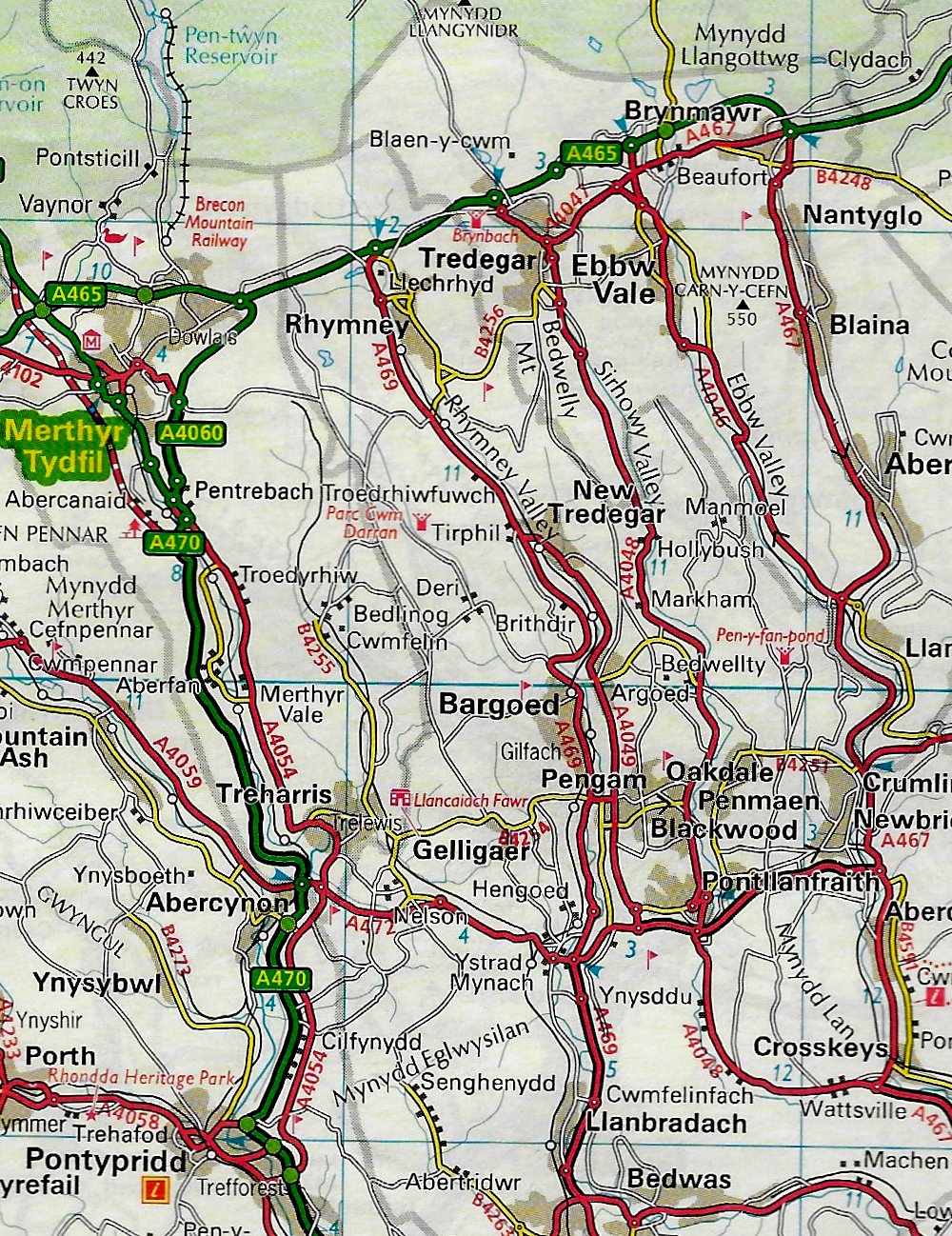
Have you ever looked at a map of Wales?

The Welsh do some particularly peculiar things when assembling letters into words.

The Pritchard family came from Breconshire in Wales. The -shire suffix refers to an area that corresponds to our counties. But it’s squishy. The Brits have occasionally merged counties, changed boundaries and changed names of counties as recently as 1965 and 1974. And they have different kinds of counties. It’s complicated.

But back to Welsh names.

Penkelly Castle near the boyhood home of David Pritchard.
David was born in Penkelly also called Pencelli. Mary Ann was born in Beaufort, which is near where Sir Thomas John Woodward grew up before he changed his name to Tom Jones, perhaps the only Welshman many know of.

The Pritchard offspring were born in the tiny village of Bedwellty.

The village of Bedwellty in Monmouthshire, Wales. Ever been to a pub in the UK?
You'd love it. There is nothing like it in the U.S. They are not bars, or snack shops,
or restaurants, or coffee shops or donut shops but they do all of those things better
and all in one place, early morning to late at night. 
These are not unusual names, but in the surrounding area you find Ebbw Vale, Cwnbran, Ynysybwl, Mynydd Eglwysilan, Troedrhiwfuwch and the shire’s largest town, Ystradgynlais. It is our good fortune that the Welsh were not predominate in settling the New World.

More to our point, there are towns called Capel Gwynfe, Gelin gwm Uchaf, Gwernesney and Gwyddgrug and a mountain called Gwaun Rhudd. Now the Pritchard girl’s name of Gwladys makes more sense.
 
The Welsh have more fun than most when collecting letters to create their words. Perhaps the Welsh
language is nothing more than a huge joke they play on the rest of the world.
But where did the name come from?

Saint Gwladys ferch Brychan was the queen of the saint-king Gwynllyw Milwr. Saint Gwladys died in the year 500, or maybe 523. Her feast day is the 29th of March.

So, the name Gwladys Pritchard Jones in the Sutton Cemetery is no misprint.

John, Maude and Bertram never married and lived out their lives on the N ½ of the SE ¼ of Section 33-8-5.  Leonard Johnson farmed and purchased the 80. It was part of the 400+ acres that were sold at auction by the Douglas family a few years ago.

The Pritchard farm, show here belonging to Mary, was a mile west of the park corner
and the second 80 to the north.. The C. Johnson farm to the north was that of Charley
Johnson, my great, grandfather. That quarter passed to his son Albert and in turn to
his son Leonard. F. Johnson was Charley's son Fred; that farm later to Clarence Johnson
and is still in the Johnson family, farmed by the Jasnochs. 
William Davies Pritchard left Sutton and was married to Katherine Frantz in Denver in May 1918. Later that year he filed his WWI draft registration and noted that he had a physically disqualifying condition, stating “has lost one eye”. As Bertram and Maude were later blind, the family may have had some genetically connected eye disorder. William died in 1964. He is the only family member not buried in Sutton Cemetery.

Daughter Gwladys married Harry Jones in Lincoln on the last day of 1908. She died in 1928. Neither William or Gwladys had children.

We’ve told about the demographics of Sutton often during the lifetime of the historical society, telling of Germans, Germans from Russia, Swedes and Danes, the Irish and even a few Scots. Many of the U. S. residents who settled in this area were from “back East” – Iowa, Illinois, Pennsylvania, New York, etc. but with deeper roots from England. I’m not sure we’ve mentioned the Welsh before.

When we speak of the United Kingdom, the U.K., we usually think of England, Ireland (at least Northern Ireland), Scotland and ... finally Wales. The history of Wales was closely blended into the history of England early to the point that they tend to lack a distinctive story.

Well, we hope that the story of the Pritchard family adds a tiny sliver of proud Welsh history to the Sutton story.

We do not know of a second Welsh family in Sutton's story, but the Pritchard family
does connect the name of a Sutton Welsh girl with a Queen, and a Saint.
Another thing the Pritchard story does is illustrate how a single artifact or a single piece of information often offers a clue to a little piece of Sutton history. That clue may have been laying around for a long time. Old newspapers, an item on a census from 100 years ago, scrapbooks, letters and other attic treasures, or even an unusual spelling on a tombstone can lead to new knowledge and understanding of our vague or forgotten collective memory.

Our museum has become the depository for literally hundreds of Sutton artifacts and clues that could unravel vague and forgotten memories. Les Bauer’s collection of WWII photos, journal entries and letters that we wrote about last month is an example. Paintings by the Ebert sisters and their art students likely are clues to people and events. Military uniforms, old photos, family histories, the Sutton depot cart, our incubator and other artifacts have interesting and important stories to tell, if someone just takes a bit of time and effort to delve in. It takes little more than a healthy dose of curiosity.

We’ve made this pitch several times. The success of the Sutton Museum will very soon hang on our success in attracting a new people to step forward and join us, the sooner the better. We’re calling on your curiosity this time.

There are many things about the Sutton story that are not known today, in mid-2017, but they are knowable. It just takes someone with a bit of curiosity and resourcefulness. It need not take much time or heavy lifting. Most of the research for the story of the Pritchard family was done online and in a few hours (not counting some real interesting distractions that popped up in the process.) The always-handy Sutton High Alumni Directory told us that Maude was the only Pritchard grad, Class of 1893.

The online resources were findagrave.com (free), Google searches (free) Google Earth (free), ancestry.com (subscription needed, but there are similar and adequate free sites), census records (available on ancestry.com plus other sites, some free – and that’s about it.

Essentially the only information we found that relied on collective memories was that Bertram and Maude were blind and that the family had lived on that 80. Otherwise, the information was sitting there waiting to be found.

The Pritchard family of seven immigrated in 1888 leaving family and friends in Wales. We don’t know how long or often they corresponded with those people. The family lived out their lives, only two of them ever leaving Sutton, had no offspring to remember them. They died and were slowly forgotten.

The Pritchard name survives in a major family plot in the Cemetery, on plat maps and land records, in one line in the school directory and possibly a few mentions in old newspapers. Probably the only physical item from the Pritchard family is the framed needlework now in the Sutton Museum. And there is this article, the product of a few hours research.

How difficult is it to conduct this kind of research? It can be difficult, the first time. It can be tricky the second and third time, but the time and effort from beginner to journeyman doesn’t take long.

Want to have some fun and satisfy your curiosity? Just say “Hi!”

This article first appeared in the September 2017 issue of Sutton Life Magazine.