Powered By Blogger

Monday, October 24, 2011

Nellie Stevens: Pioneer & Fictional Heroine


Hawaii has James Michener; Red Cloud, Nebraska has Willa Cather and Grafton, Nebraska has Alida Curtiss.

Alida Curtiss wrote “Mother Wanted a Son – A Prairie Tale” in 1964. In her historical novel, Captain Xerxes Stevens brought his wife Elisabeth and young daughter Nellie to a homestead near Grafton not long after the Civil War. Nellie’s little brother was born there, the son Mother wanted, but the story is Nellie’s.

The author tells us that all the characters in her book are fictional except Xerxes, Elisabeth and Nellie plus Ora Keepers who we meet later in the book. The actual Stevens homestead was about two or three miles southwest of town and Nellie really did grow up to become the school teacher.

Ora Keepers (1881–1905) and Nellie Stevens (1866-1926)
Xerxes died before establishing the farm and Elisabeth moved her family to town where she became the postmistress – we’re in the novel now, pay attention.

Nellie’s finds a male role model when her father’s war buddy Rev. Hiram Curtiss comes to Grafton with his wife Hannah and brood of little Curtiss’s including Horace, a boy about Nellie’s age. That’s the fiction of the novel; however, there was a real Rev. Hiram Curtiss, a Methodist preacher in Grafton and in Sutton about that time with a son named Horrice though the real Hiram’s wife was Fanny. The real Curtiss family also included a daughter seventeen years younger than Nellie named Alida – the author of the novel. Are you paying attention?

Alida Curtiss chose Nellie Stevens as her protagonist and through her, we learn about the Stevens homestead, living in Grafton and growing up on the frontier. The characters appear real - they were real and the relationships are believable. This was the first and only novel by Alida Curtiss so don’t expect fine literature. But for an enjoyable picture of the early days of our area, this book fits the bill quite well.

Fictional Nellie’s mother sent her to Vermont to school and she returned to become the Grafton school teacher, just as the real Nellie did. Ora Keepers, the fourth “official” real person in the book is one of Nellie’s students. Ora becomes an orphan and Nellie raised her. The fictional Ora is only a few years younger than Nellie. The real Ora was much younger, closer to the same age as Alida.

Spoiler Alert: The novel moves on with Nellie and Ora enjoying a life together, moving to Colorado to a “happily-ever-aftering” kind of conclusion.  The real life story of Nellie, Ora and Alida went in a different direction.
This photo, likely from about 1920 shows a millinery shop on the
extreme right at the location we'd determined to be where the
Curtiss & Stevens shop was locate. The next door "Lyric" was
the town theater still operating through the '60's.

Ora Keepers, the real one, died in 1905 at 23 of tuberculosis as her fictional mother had and maybe as her real mother did. The real Nellie Stevens and Alida Curtiss were the long-term companions. Alida gave Ora the gift of a long life in her book inserting Ora into her own place in Nellie Stevens’ story.

Rev. Curtiss' family moved to St. Joseph but by 1910 Alida was back in Sutton living with Nellie Stevens on Maple Street and partners with Nellie in a millinery shop about where Bill Bottorf’s office is now located. Then Nellie and Alida moved to Colorado where Nellie returned to teaching just as Nellie and Ora do in the novel.

The 1920 census lists a Grafton household of Nellie Stevens, age 56; Lida Curtis, 37 and Fannie B. Curtis, 70. Nellie’s business was “poultry and dairy farm.” Do not know how that happened. Was it on the Stevens homestead?

Ad in 1912 Sutton High School Annual for
Curtiss & Stevens Millinery Shop.
Nellie Stevens died in 1926. Alida Curtiss moved back to Rocky Ford, Colorado and probably lived much of her remaining life there. She left a few tracks in the public record, attending weddings of nieces and other relatives, returning from a European trip in October, 1947 and other Google hits.

Alida answered a surprise letter from Sutton, Nebraska on the day after Christmas in 1969. She remembered Eva Weikum who had worked for their next door neighbors, the Luebbens. Eva’s son Lawrence Trautman had tracked Alida down in Oxnard, California. Alida’s sister Victoria Schell was helping with the letter – Alida had suffered a stroke – and she was remembering Sutton, sixty years earlier.    

Alida Curtiss died in Ventura, California on May 11, 1972. Nellie Stevens is buried next to her parents in the Grafton Cemetery. Ora Keepers’ parents are not far away and records show that young Ora Keepers should also be in the Grafton Cemetery. I did not see a marker.

Alida Curtiss (1883-1972) with Nellie (1866-1926), her friend and main character in her novel.
I thank Lawrence Trautman for bringing this story to my attention and lending Alida’s book to me. The novel tells a good story about Nellie and Ora but the real story of Nellie and Alida could have been a better book with more drama, tragedy and pathos.

The Sutton museum has a copy of “Mother Wanted a Son – A Prairie Tale” and I ordered a copy from amazon.com that is now in the Sutton Library. I may need another copy for my own library.

Thanks to Diana Thompson and Cherie Baudrand, genealogists of the Stevens and Curtiss families on ancestry.com for the photos of Nellie, Alida and Ora.
    
by Jerry Johnson and the Sutton Historical Society
 This article appeared first in September, 2011 issue of Sutton Life Magazine. For information about this local Sutton publication, please contact Jarod Griess at neighborhoodlife@yahoo.com or at 402-984-4203 or at 501 West Cedar St., Sutton, NE 68979.
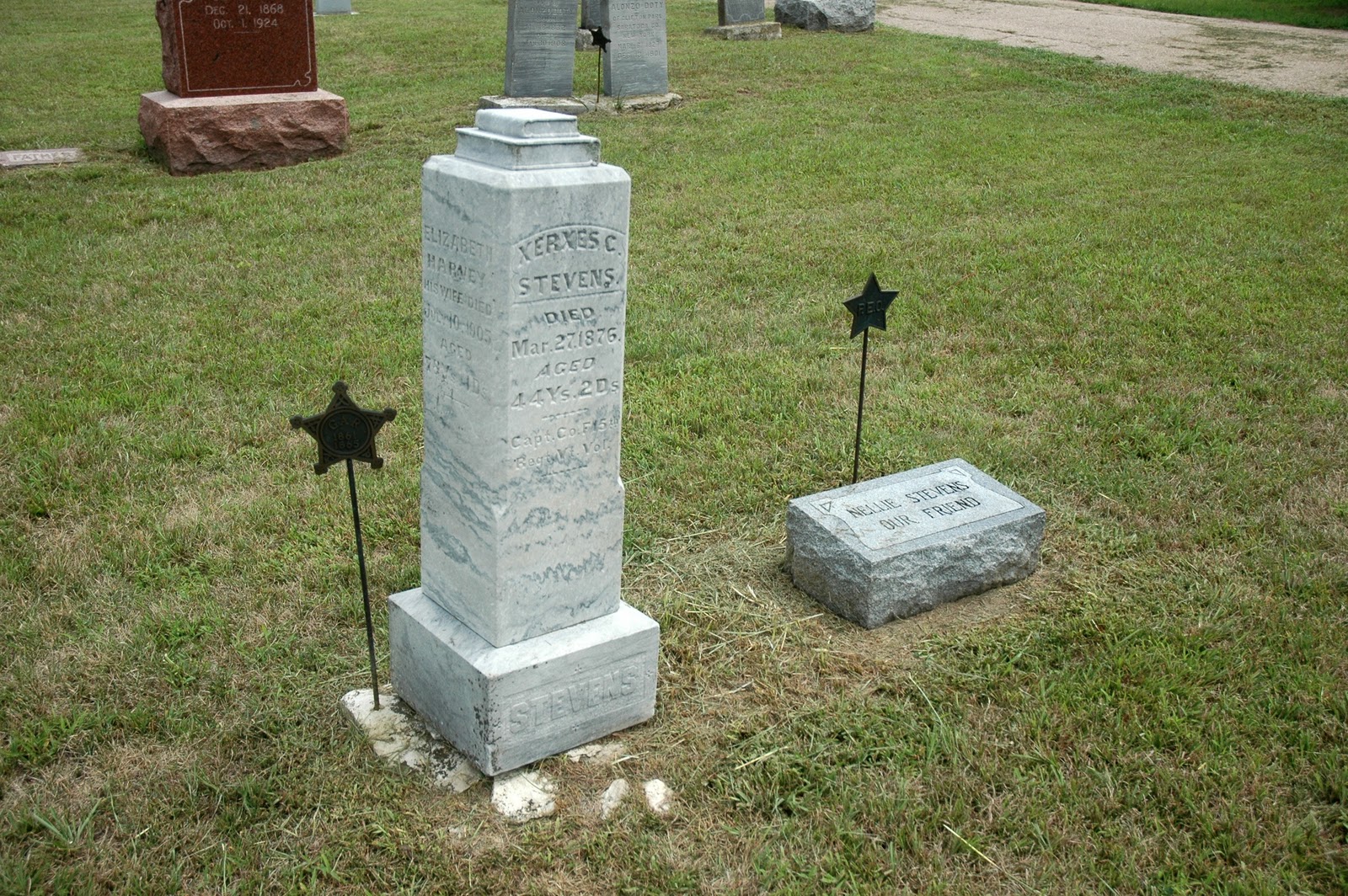
Grave of Nellie Stevens in the Grafton Cemetery

Stevens Family plot: Xerxes and Elizabeth (Harvey) Stevens on the left;
Nellie Stevens on the right - Grafton Cemetery.


Sutton in the Census

From the U. S. Constitution, Article I, Section 2: “The actual Enumeration shall be made within three Years after the first Meeting of the Congress of the United States, and within every subsequent Term of ten Years, in such Manner as they shall by Law direct.” That is the only specific tasking the founders gave us and it is time for the Twenty-Third Census of the United States.

The purpose of the census is to provide population statistics to adjust the boundaries of Congressional districts but data collection has grown as has the usefulness of the information.

Sutton’s first appeared in the 1880 census having just missed the prior edition. Enumerator James E. Marsh found 1631 people in Sutton Township. Mr. Jacob Steinmetz counted noses in School Creek Township.

Each census has asked a different set of questions beginning with early years when little more than the name of the head of the household and the number of persons was asked. By the beginning of the twentieth century the census bureau was collecting a wealth of information including age, place of birth, immigration date, number of years married, parents’ birthplace, literacy, occupation, etc. Recent forms have shrunk. The 2010 form has only 10 questions asking for name, sex, age, date of birth, racial and home ownership information.

Analysts use census data to learn how the country has grown and developed but no group has benefited from this resource more than genealogists. Great-grandparents seem to come to life as you see their family listed in the census and imagine the interview with the local enumerator. There are surprises lurking in these records: children who died young and were not remembered, in-laws who lived in the house, servants, boarders and gaps – people who should be there but aren’t.

We can’t fully trust everything found in the census. My great-grandparent’s family appears on the first page of the 1880 School Creek census where we’re led to believe that Anna Johnson gave birth to twins in Sweden at the age of 14. Possible, but her achievement probably would have been part of our family folklore. Family records indicate Anna was born in 1841 and would have been 38 years old when she met with the census taker, not 28 as he recorded. Curiously, he also listed his own wife as being 28 years old that year with 18 and 13 year old daughters. He might have had trouble with arithmetic, or maybe he was married twice – the census provides clues, not always complete answers.

Mr. Steinmetz illustrated another point in his own entry. He tried to record his wife’s birthplace and that of her parents but he re-wrote it a couple of times making a mess of the page. It appears he wrote “Prussia” and he clearly wrote “Hesser Castle”, probably meaning the Prussian province of Hesse-Kassel. Again, clues, not always complete answers.

I learned two things about my great-grandmother in the 1900 census. It reports that she had seven children but only six were living. My grandfather must have had a brother or sister who likely died in Sweden before the family emigrated. Also, the enumerator recorded that Anna could read and write, but did not speak English. Quite a number of older people, especially women were getting along just fine in their native language according to the 1900 and 1910 census.

Did you notice that I skipped over the 1890 census? If you research census records, you will too. That census was lost in a fire. So our Sutton research begins in 1880, then skips twenty whole years to the 1900 records followed by 1910, 1920 and you are finished at 1930, for now. Census records are “closed” for 72 years as a privacy consideration. The 1940 census will become public in just a couple more years. I am anticipating that one as my father was the School Creek enumerator starting the task on April 2nd and finishing on April 17th. It will be in his handwriting – and a good hand it was. That was not always the case.

Just a few years ago census records were only available on microfilm at Mormon libraries at temples and in the largest stakes. Many of us spent hours and hours in darkened rooms at the library just west of Temple Square in Salt Lake City poring over film after film. Now, it is almost too easy. Census records are online and indexed. What used to take multiple sessions can be done in minutes. The genealogy web site www.ancestry.com is a robust and easily accessible repository. There is a modest subscription fee, but when compared to traveling to spend hours or days in a library, it’s a fair price.

This article appeared in the January, 2010 Sutton Life Magazine. Information about the magazine is available at neighborhoodlife@yahoo.com or Mustang, Inc., 510 West Cedar, Sutton, NE 68979.


Who Was Woodruff?

Activity in one of the store buildings on the west side of the north end of Sutton prompted the question, “Who was Woodruff?”
The Woodruff nameplate - edward Woodruff's lasting legacy in Sutton.

The name Woodruff appears high up on the face of the building along with the date “1891.” Several of the old and historic buildings on the west side of both ends of town are marked with the names: Clark, Carney, and M. T. Burke on the north end and Merrill, Griess, Hoerger, Honey and R. G. Brown on the south end. We’ve mentioned some of these fellows in the past but Woodruff was an unfamiliar name and needing research.

Turns out the fellow was once mayor. E. W. Woodruff is listed in George Burr and O. O. Buck’s History of Hamilton and Clay Counties as the second ward councilman in 1888, 1889 and 1890 and mayor in 1891, the same year as appears on the building. William Griess and J. C. Merrill succeeded him as mayor, both fellows immortalized on west side buildings. Let’s guess that E. W. Woodruff is who the building was named after. But can we be sure.

Edward W. Woodruff is listed on the county land records for downtown lots in Block 23 of Sutton Original Town in 1890, 1905 and 1908. That certainly is good supporting evidence for our hypothesis.

E. W. Woodruff appeared in Sutton records in the 1880 census at age 21 and as boarder at the hotel run by J. T. Mollyneaux, probably the Oakland Hotel although Mr. Mollyneaux also owned and operated the Occidental for a time. Woodruff listed his place of birth as Vermont. That census listed his father as being born in Connecticut and his mother in Rhode Island.

Edward Woodruff next shows up in the 1885 state census where he had mysteriously aged nine years in the prior five listing his age as 30. Perhaps he was hiding his youth from his 31-year old wife Emma. They had a two year old girl, Lena M. He listed his occupation as “Loans Money” and had decided that he had been born in Illinois and both parents were born in Massachusetts.

If we were working with a larger community, we would be suspicious that the E. W. Woodruff of 1880 was not the same man as Edward Woodruff in 1885 due to the age and birthplace discrepancies. But such discrepancies really are common in these records and in small town Sutton our confidence approaches certitude. Sometimes people thought they had a reason to hide some detail in their past.

Emma Catherine Barnhart and Edward William Woodruff were married in 1881 in Sutton. Emma Barnhart was the daughter of Jacob and Mary Barnhart. Jacob Barnhart listed his occupation as “butchering” in the 1880 census. The Barnhart family was from Pennsylvania. Emma was 25 in 1880 and had a three year old brother, Harry, born in Pennsylvania indicating the Barnhart’s came to Sutton between 1877 and 1880.

Five year old Fred Woodruff was buried in the Sutton cemetery in 1890. He could be Edward and Emma’s son and would have been born after the 1885 census taker visited.

The 1910 Census found Edward W. Woodruff, age 55 in Washington, D.C. listing his occupation as “Clerk” in the Public Debt Treasury. He still listed his birthplace as Illinois and parents as Massachusetts. Emma C., age 55 and Lena M., age 27 were still living with him.

An item in a 1911 Sutton Register newspaper tells us that Edward Woodruff had written to F. M. Brown changing his mailing address for the Register to Portland, Oregon.

In 1920 Edward W. Woodruff, age 65 was retired and living in Pasadena, California with his wife Emma and daughter Lena, single, age 37 and a stenographer at a school. Edward was still in Pasadena in 1930, the last census that has been made public. Lena was then a stenographer at City Hall.

There was a second Woodruff in Sutton early on. John Woodruff appears in the 1900 census at age 72, a widower, born January, 1828 in Illinois. John Woodruff listed his occupation as “Capitalist.” He may have been Edward Woodruff’s father or uncle or other relative. There are some John/Edward father/son pairs in earlier Illinois census records but the ages don’t match.

It seems almost certain the Mayor Edward W. Woodruff is the namesake of the “Woodruff Building” on the north end of Sutton.

Our heritage represented in these old, almost stately, buildings is a priceless record of the early days and growth of the town. For the most part, these buildings are solid and in reasonably good condition. We owe it to ourselves, kids and grandkids to see that they continue to cast afternoon shadows across Saunders Avenue.

A few citizens and members of the Sutton Historical Society are discussing innovative ways to preserve and protect these treasures. One big project is probably beyond our capabilities, but a series of small projects could do a lot. A proposed start is to replace the missing “pinnacles” on the tops of several of these buildings. Our pinnacles are a real feature of architecture dating back to medieval times.

Many nearby towns and others throughout the country are well ahead of us in preserving their unique architecture. Any effort would be a cooperative effort between owners, the city, civic organizations and citizens. Do you have any ideas? Call Jerry Johnson at 773-0222 and let’s talk.

Brown's Automatic Base Ball Score Keeper - Clay Center invention

This photo is from the May 12, 1911 edition of the Clay County Patriot newspaper. The device was invented and patented by L. A. Brown of Clay Center that had just gone on the market. He called it Brown’s Automatic Base Ball Score Keeper. Arrows on the front side tracked balls and strikes with provisions to track innings, outs and scores. The line-ups were written on the back and the current batter tracked in movable windows. A player's runs, hits, outs, assists and errors were also tallied on the backside.


Monday, October 17, 2011

100 Year Flashback

This item appeared in the October 20, 1911 issue of the Sutton News:
Mr. and Mrs. J. M. Gray of this city celebrated their 36th wedding anniversary on Thursday last, Oct. 19th, the entire family being present. About ten people were seated for a six o'clock dinner after which they all repaired to the parlor where instrumental music was interspersed with songs, etc. The rooms were all elaborately decorated with a profusion of vines and flowers. It has been some time since the family were all together.
I read the piece in an image of that paper while writing my weekly column for the Clay County News while sitting at the Gray's table on one of the Gray's chairs in that very dining room of their house mentioned in the article. Kind of a cool moment. Dorothy Rabbe can confirm the story.

I often work on the column while baby-sitting the museum during our Sunday open hours. The dining room set was returned to the Gray house by a great, granddaughter in Texas representing the family in their wish to see the set back in its original home.
Very little effort needed to look up from the 100 year old news article and imagine the scene at this table in this room that Thursday evening exactly a century ago. 

Wednesday, October 12, 2011

Sidewalk Repair & Commemorative Brick Project is Underway

The broken sidewalk from the Historic House to the street is gone. Thanks to the City of Sutton for making quick work of that sidewalk and the concrete immediately in front of the house. Next, the new sidewalk will be poured and space made for display of the commemorative bricks on both sides of the new walkway.

Repair of the sidewalk across the property to the next door museum will have to wait until next year pending working it into our budget.

You are welcome to stop by, inspect and kibitz at your leisure.

New Sidewalk and Handicap Access Ramp at the School House

Our new access ramp to the Wolfe Rural School Museum is complete. We replaced our four-year old temporary steps with a four-foot wide ramp with robust railings providing handicap access and a new look. The sidewalk and ramp allows easy access from Way Street right into the front door of the school.

Thanks to our low-bid contractors, Todd Rath and Kenny Chandler for a job well-done.

Tuesday, September 27, 2011

Sutton Businesses - 1894

The Sutton Register newspaper carried a retrospective column entitled, “Items from the Register of forty-two years ago.” Why 42 years? I don’t know.

The October 1, 1936 column asked readers how many business men and places they remembered from the ads in the Register in October, 1894. We don’t remember them ourselves but how many have you ever heard of?

Attorneys – L. P. Crouch, E. E. Hairgrove, M. C. King, F. R. Hawk.
Banks – First National, G. W. Clawson, president; Sutton National, J. R. Dinsmore, President; Sutton Exchange Bank, J. C. Merrill, president.
Barbers – A. E. Meyer, Chas. Gossman.
Blacksmith – Fred Nicolai.
Clothing – L. P. Wentz & Co.
Dentist – J. H. Johnson.
Drugs – Toland & Nelson, H. A. Fosselman, Carl Held.
Dry Goods and Groceries – William Griess, M. Wittenberg, Benerman & Son, Ochsner & Schwarz, L. H. Schaaf, A. C. Burlingame.
Farm Machinery – Bender & Zimbelman, H. Grosshans & Co.
Flour and Feed – Henry Schleiger.
Furniture – George Honey, E. W. Ihrig.
Groceries – John Roberts, Tessler & Son, Speich & Co.
Hardware – S. Carney, F. J. Hoerger.
Harness – Wm. Reuter, Joseph Grice.
Ice Dealer – A. W. Clark.
Livery – Rolland & Van Patten, Wm. Grosshans.
Lumber – Sutton Lumber Co., J. M. Gray.
Millinery – Mrs. E. D. Goodrich, Mrs. Dorah Braitach.
Meat Market – Henry Brehm, John Cook.
Photographer – Pont Soderberg.
Physicians – J. M. Birkner, H. L. Vradenburg, J. V. Lewis, M. V. Clark.
Real Estate – Thompson Bros., I. N. Clark.
Shoemaker – William Bauer.
Wagon Maker – Schneider & Son.

Comments:
Attorneys - By 1894 all of the attorneys around at founding of Sutton had disappeared - R. G. Brown (whose brother was the publisher of the Register), Homer Gray, A. McCoy, J. S. Lehew, Lamont and George Bemis.
Blacksmiths - The Nicolai family later lived in at 309 N. Way Ave. - the current Historic House that was built by J. M. Gray - listed here for his lumber yard that was on that property. The yard covered the west side of Way from Gray's residence at the time, 311 N. Way south to the Maple Street corner.
Clothing - suspect that the numerous "Dry Goods" stores carried clothing.
Dentist - Multiple dentists appeared in ads in later years.
Dry Goods and Groceries - this list includes three grocery stores plus six "Dry Goods and Groceries" so we are left with some ambiguity about the extent of grocery sales in Sutton in 1894, but it surely was a lot.
Farm Machinery - Zimbelman was a partner of Jacob Bender in1894. He would leave the business and it became Jacob Bender & Sons lasting for over 125 years.
Furniture - George Honey built the big brick building at the south end of downtown where today's Community Center stands. Honey operated his furniture store plus a hardware store and mortuary in that building. The building was purchased by the Sutton Schools in 1936 and became the high school auditorium into the '60's.
Hardware - S. Carney was Sam Carney Sr. at that time. The business was on the north end, west side and was started by I. N. Clark. Sam Sr. took over for Clark, Sam Jr. from his dad and Les Bauer from Sam Jr.
Harness - this list has only two harness shops plus a wagon maker. The sources describing early Sutton businesses give the impression that there were more than a few of these at any one time. I suspect that some may not have advertised extensively and missed this list.
Ice Dealer - A. W. Clark was Albert (Bertie), I. N. Clark's son. He married Mayme Wieden. Bertie and Mayme appear to have played the roles of second-generation Sutton Movers & Shakers. They built the large home (Plettner's) west of Clark's Pond. (Though they modestly called it Glen Lake at the time.)
Lumber - J. M. Gray built both of the houses now used by the Historical Society. 
Millinery - seems to be a word not much used but these were lady's clothing stores - hats and lingerie especially.
Photographer - Soderberg Studios cranked out the bulk of the early portraits in Sutton. His photos populate attics, closets and basements throughout the area still.
Physicians & Real Estate - M. V. Clark (actually M. V. B. for Martin Van Buren Clark was the brother of I. N. (Isaac Newton) Clark. The Clark brothers developed the west section of Sutton along Cedar Avenue. They also donated the four square blocks for the City Park.

Wednesday, August 31, 2011

Sutton and Its Veterans

A part of the history of every town is the story of its veterans and the town’s connection to the nation’s military. Sutton is no exception.

Sutton was settled shortly after the end of the Civil War with a number of the settlers coming from the ranks of Grand Army of the Republic. Among those settlers were G. A. R. veterans with names of Brown, Dinsmore, Gray, Van Patten, Bemis, Schwab, Clark and almost fifty more. Leonard Jarrett is a unique vet at the Sutton cemetery with the “Stars and Bars” of the Confederate Flag flying over his grave. Jarrett enlisted in November, 1863 in Company E, Virginia 14th Cavalry Regiment at the age of 17. Jarrett’s youngest daughter Sibyl was the long-time city librarian.

Markers at the cemetery identify the hundreds of later men and women of Sutton who answered the nation’s call. Two with Sutton connections earned the nation’s highest award. Jacob Volz was born in Sutton in 1889 and was awarded the Medal of Honor for service in the Philippines in 1911.

Sutton’s other medal of honor winner was local dentist Orion P. Howe who was awarded his medal in the 1890’s. He earned the award years earlier in May, 1863 at Vicksburg as a fourteen-year old drummer boy thrown into a mission that killed three others and severely injured him.

Almost ninety Sutton vets served in the World War I and over 150 in the Second World War. Later generations likely do not fully appreciate the extent to which the entire nation was intimately involved in World War II and how that war was brought home to every city and town. The local impact to this area included the relocating all farmers from a large section of western Clay County for the Hastings Naval Ammunition Depot. The Harvard and Fairmont Air Bases were two of eleven Nebraska bases supporting flight crew training with waves of B-17, B-24 and B-29 bomber formations flying over area almost daily. These military facilities employed thousands of local people and brought thousands more to the area, many of them finding wives and settling here.

Fewer local soldiers served in the Korean and Vietnam Wars but for each individual, a full 100% of their time and energy was asked, for years. The elimination of the Selective Service draft produced the all-volunteer military that has served in the two Middle East wars.

Others from this area gave far more than just their time and energy to the nation’s defense; they gave their lives. The community remembers.

It has been just one year since the Fallen Heroes Marsh was dedicated southwest of Sutton, a stark reminder of the sacrifices of Nebraskans in the Gulf Wars. The setting is austere and a bit of a surprise on one’s first visit. It is peaceful, perhaps serene. Allow your imagination to absorb the symbolism of the memorial and the surroundings; you will remember that visit.

We do not have battlefields as are found in the east and south from the Revolutionary and Civil wars but our area was the scene of Indian Wars until a few years before Sutton’s founding. And there is one remarkable chapter when in November, 1878 “Sutton’s sons whose proclivities bent in the direction of the chivalrous and heroic…” formed Company B of the First Regiment of the State Guard. Captain W. J. Keller commanded Company B in two activations, once in 1880 and again in early 1882, both times with missions to maintain order in Omaha labor disputes.

Most who have worn the uniform did not serve in combat zones. National security involves a large, wide-ranging and varied collection of organizations, some with unusual missions. Some of us were “warriors” of the Cold War maintaining a nuclear deterrent force designed to prevent war. After more than 45 years of preparedness and acute readiness, our “war” slowly faded away. In our case “Mission Accomplished” was “Nothing Happened”.  That story is better told at the SAC Museum on the west side of the Platte River just off I-80.

The Sutton American Legion houses more than a restaurant and is more than a venue for meetings. Next time you are in the building, take a moment to look around and join the Legion in recognizing those who have worn the uniform.

This article first appeared in the November, 2010 issue of Sutton Life Magazine. For information about this local Sutton publication, please contact Jarod Griess at neighborhoodlife@yahoo.com or at 402-984-4203 or at 510 West Cedar St., Sutton, NE 68979.

The Small Town Newspaper, News, Opinion, Culture & Power


A short list of occupations defined a new town on the frontier. There were developers and speculators who divided the open land into individual properties. Lawyers recorded deeds and resolved disputes. Merchants, saloon-keepers, doctors and dentists met various needs of settlers. And very early, there was the newspaperman.

A newspaper was important to fledgling communities on the frontier. A weekly newspaper confirmed a town’s existence and verified its prospects.

There have been at least eight newspapers in Sutton and over forty in Clay County. Most were short-lived, maybe only a few months while others lasted sixty to ninety years.

Sutton had the Sutton Times, Advertiser-news, Globe, Clay County Herald, the Democrat, Sutton News (twice), Sutton Register and today’s Clay County News. The Harvard Courier served that town for ninety-one years following earlier sheets called The Harvard, Champion, The Leader, Advocate, Sentinel, The Harvard Free Lance and Clay County Journal. There was a Fairfield News, Fairfield Herald, Fairfield Tribune and the Independent before the Fairfield Auxiliary began in 1911 becoming what may have been the county’s best paper for much of its fifty-four years. Edgar had the Edgar Review, Edgar Weekly Times, Edgar Times, Leader, News Journal, Edgar Post, Post-World, World, the Sun and the Edgar Sun. Clay Center had the Clay County Patriot, Clay County Progress, Call, Gazette, Clay County Republican and the Clay County Sun. Even Ong seems to have had the Weekly Visitor, the Ong Times, Sentinel, Deacon and the Weekly News.

Is that a complete list? Probably not. I expect I’ll run across references to more county newspapers. I’d be surprised if there weren’t local news sheets distributed in Glenvil, Inland, Eldorado, or maybe even Saronville, Spring Ranch(e) or Verona.

So what was the big deal with newspapers? Consider that from the early 1870’s into the 1920’s, newspapers were the primary source of news, comment, advertising, entertainment and literary exposure. There was no radio, TV, internet; there were a few distant newspapers and some magazines but at prices many couldn’t justify. A year’s subscription to the local paper was only about a buck.

What did the early paper offer? All covered the local community extensively. Newspapers were avid boosters for their community pointing out business changes, civic improvements, accomplishments of successful residents and any other favorable items that would make locals feel good or attract outsiders who might come across an issue.

Sutton had multiple stores in each category and competition was fierce. The News and especially the Register carried quarter and half page and even full page ads that were repeated week to week.

Each paper had extensive social news coverage like today, only much more so. Each community (Saronville, Verona, Eldorado, etc.), township (Sheridan, Marshall, School Creek) or parts of a township (Excelsoir) had a correspondent who filled eight to twelve column inches each week of “who visited whom” notes. My grandmother’s uncle, A. G. Israelson was the Saronville reporter for newspapers in Clay Center, Harvard and Sutton where the weekly activities of her Aspegren and Israelson families were carefully chronicled.

Papers serialized books with chapters appearing week after week for several months, non-fiction as well as lots of fiction. Editors promoted the local theater, clubs, literary guilds and other cultural endeavors that cast a favorable light on the town. Small town papers had access to the products of major papers and carried lengthy articles on current events world-wide. They offered detailed analysis of political and economic issues, either their own or acquired elsewhere.

Early papers had an overt political slant and aggressively advocated for their favored party in editorials as well as news articles. Two papers in the same town almost always divided along political lines. Nearly all papers had a regular column by the publisher who attempted to persuade his readers to his and his party’s position. No one else held that kind of sway over the public in towns on the plains.

School news was big. The progress of rural students made its way to the paper. The Edgar Sun had high school students as regular contributors to a section called “The Huskie”. The town’s baseball team was always a favorite story. The Sutton Register carried a poultry column for years and seemed to have something to say about raising chickens every week.

The lasting impact of those newspapers from one hundred years or more ago is that they give us a picture of the day-to-day life of the town, its founders and of our grandparents. We find the specific facts from the beginning as we read but after a period of time reading and absorbing the images, a more general picture appears that tells about the overall lifestyle, the mood and the flow of human activity during those times.

Many old newspapers have been microfilmed and are on file with the Nebraska Historical Society. Reels are available for a fee through member libraries including the Sutton Library. However, it takes time to get the one or two reels available at a time, it’s for a limited period and microfilm is not the most user friendly medium. Members of the Sutton Historical Society have begun a small pilot project to copy, to digitize, images of the of papers owned by the Clay County News. If it’s feasible, we’ll have DVD’s available at the Sutton Library and elsewhere with files of past issues of the Sutton News, the Sutton Register and The Clay County News.

This work is simple enough, but very labor intensive. If you would like more information about this project, or would like to help, please contact Jerry Johnson at jjhnsn@windstream.net or 773-0222.

This article first appeared in the October, 2010 issue of Sutton Life Magazine. For more information about this magazine please contact Jarod Griess at neighborhoodlife@yahoo.com or at Sutton Life Magazine, 510 West Cedar Street, Sutton, NE 68979 or at 402-984-4203.


Who Was Woodruff?


Activity in one of the store buildings on the west side of the north end of Sutton prompted the question, “Who was Woodruff?” And why is his name on that building?
The Woodruff legacy etched in stone in downtown Sutton

The name Woodruff appears high up on the face of the building along with the date “1891.” Several of the old and historic buildings on the west side of both ends of town are marked with the names: Clark, Carney, and M. T. Burke on the north end and Merrill, Griess, Hoerger, Honey and R. G. Brown on the south end. We’ve mentioned some of these fellows in the past but Woodruff was an unfamiliar name and needing research.

Turns out the fellow was once mayor. E. W. Woodruff is listed in George Burr and O. O. Buck’s History of Hamilton and Clay Counties as the second ward councilman in 1888, 1889 and 1890 and mayor in 1891, the same year as appears on the building. William Griess and J. C. Merrill succeeded him as mayor, both fellows immortalized on west side buildings. Let’s guess that E. W. Woodruff is who the building was named after. But can we be sure.

Edward W. Woodruff is listed on the county land records for downtown lots in Block 23 of Sutton Original Town in 1890, 1905 and 1908. That certainly is good supporting evidence for our hypothesis.

E. W. Woodruff appeared in Sutton records in the 1880 census at age 21 and as boarder at the hotel run by J. T. Mollyneaux, probably the Oakland Hotel although Mr. Mollyneaux also owned and operated the Occidental for a time. Woodruff listed his place of birth as Vermont. That census listed his father as being born in Connecticut and his mother in Rhode Island.

Edward Woodruff next shows up in the 1885 state census where he had mysteriously aged nine years in the prior five listing his age as 30. Perhaps he was hiding his youth from his 31-year old wife Emma. They had a two year old girl, Lena M. He listed his occupation as “Loans Money” and had decided that he had been born in Illinois and both parents were born in Massachusetts.

If we were working with a larger community, we would be suspicious that the E. W. Woodruff of 1880 was not the same man as Edward Woodruff in 1885 due to the age and birthplace discrepancies. But such discrepancies really are common in these records and in small town Sutton our confidence approaches certitude. Sometimes people thought they had a reason to hide some detail in their past.

Emma Catherine Barnhart and Edward William Woodruff were married in 1881 in Sutton. Emma Barnhart was the daughter of Jacob and Mary Barnhart. Jacob Barnhart listed his occupation as “butchering” in the 1880 census. The Barnhart family was from Pennsylvania. Emma was 25 in 1880 and had a three year old brother, Harry, born in Pennsylvania indicating the Barnhart’s came to Sutton between 1877 and 1880.

Five year old Fred Woodruff was buried in the Sutton cemetery in 1890. He could be Edward and Emma’s son and would have been born after the 1885 census taker visited.

The 1910 Census found Edward W. Woodruff, age 55 in Washington, D.C. listing his occupation as “Clerk” in the Public Debt Treasury. He still listed his birthplace as Illinois and parents as Massachusetts. Emma C., age 55 and Lena M., age 27 were still living with him.

An item in a 1911 Sutton Register newspaper tells us that Edward Woodruff had written to F. M. Brown changing his mailing address for the Register to Portland, Oregon.

In 1920 Edward W. Woodruff, age 65 was retired and living in Pasadena, California with his wife Emma and daughter Lena, single, age 37 and a stenographer at a school. Edward was still in Pasadena in 1930, the last census that has been made public. Lena was then a stenographer at City Hall.

There was a second Woodruff in Sutton early on. John Woodruff appears in the 1900 census at age 72, a widower, born January, 1828 in Illinois. John Woodruff listed his occupation as “Capitalist.” He may have been Edward Woodruff’s father or uncle or other relative. There are some John/Edward father/son pairs in earlier Illinois census records but the ages don’t match.

It seems almost certain the Mayor Edward W. Woodruff is the namesake of the “Woodruff Building” on the north end of Sutton.

Our heritage represented in these old, almost stately, buildings is a priceless record of the early days and growth of the town. For the most part, these buildings are solid and in reasonably good condition. We owe it to ourselves, kids and grandkids to see that they continue to cast afternoon shadows across Saunders Avenue.

A few citizens and members of the Sutton Historical Society are discussing innovative ways to preserve and protect these treasures. One big project is probably beyond our capabilities, but a series of small projects could do a lot. A proposed start is to replace the missing “pinnacles” on the tops of several of these buildings. Our pinnacles are a real feature of architecture dating back to medieval times.

Many nearby towns and others throughout the country are well ahead of us in preserving their unique architecture. Any effort would be a cooperative effort between owners, the city, civic organizations and citizens. Do you have any ideas? Call Jerry Johnson at 773-0222 and let’s talk.

 This article first appeared in the June, 2011 issue of Sutton Life Magazine. For information about the magazine contact Jarod Griess at 510 West Cedar Street, Sutton, NE 68979 or at 402-984-4203 or neighborhoodlife@yahoo.com

Sunday, July 17, 2011

Ebert Sisters - Sutton's Artists

The Ebert Sisters gave music and art classes in their home on South Maltby Street to numerous Sutton children and adults. The historic society has acquired a number of their paintings and the paintings of their students.


Anna Ebert entered this painting in the Clay County Fair.


Several of the Ebert Sisters' paintings are on display in the historic house.

Nuss Accordian


The Kenneth Nuss family donated this accordion that is believed to have come with their immigrant ancestors. It is on display in the historic house.

Saturday, July 16, 2011

Sutton Depot Cart

This well-worn cart served the Sutton Depot for many years. We understand that Paul Bender acquired the cart when depot items were disposed of. He kept the cart upstairs in the implement dealership until the demise of that business. It then passed to the Wach family where it was garaged until their sale about two years ago when Regina Leininger ensured it found a home with the Sutton Historical Society.

The two immigrant trunks have Swedish origins. The one on the right came from the Hultman family. The left trunk was addressed: Nils Persson;   Sutton, Clay, County, Nebraska, North Amerika.  Nils Persson immigrated in 1883 and homesteaded in the SW corner of Fillmore County. It too was in the possession of the Wach family.

The Persson trunk is in excellent condition, especially the wood that was used some 128 years ago.

I claim the Persson trunk rode on this cart from the train into the Sutton depot in 1883 - counter-arguments welcomed.

The cart is often in the front yard of the museum on Sunday afternoons, otherwise visit the garage to "Touch Sutton History."

Thursday, June 30, 2011

1923 in Sutton, Nebraska

What was Sutton, Nebraska like in 1923? And why 1923? No reason. It could have been any year.

Our source of information is The Sutton News, one of two Sutton newspapers at the time. The News was published by Simon A. Fischer, a bachelor who lived with his parents August, a one-time preacher and Auguste. His father claimed to have been born in Pomerania and his mother in Brandenburg, again reminding us that Germany is only a few months older than Sutton, both created in 1871.

The paper was a six-page, five-column publication, no photos, a modest number of ads and mainly local news. There is some indication of  a feeling of prosperity we’ve come to think of in the country after World War I and before the depression. Women’s clothing ads give a hint of the styles of the flapper era.

The major local ads were by Yost Auto Company and Phelps Sisters’ clothing store. The banks, Rosenbaum’s Store in Harvard, Hastings businesses and the Lyric Theater were other common advertisers.

1923 Suttonites had an appetite for entertainment. The Lyric Theater featured a steady stream of current movies, as long as 7-reelers but silent and black and white, of course. The Lyric added a new player piano during the summer and not a simple one either. This player had two rollers and mimicked a violin, piano, flute, mandolin and drums; it was a one-person orchestra. The Opera House hosted several traveling vaudeville shows during the year as well as a variety of other performances though owner W. J. Ochsner apologized for the condition of the 40-year old landmark promising forthcoming repairs.

Club membership and civic activities must have occupied a very high percentage of spare time. One issue of the paper included meeting information for The Walking Club, J. U. T., the Bay View Club, the Pennant Club, P. E. O., Stratton-Sutton Club, I. O. O. F and Rebekahs, Farm Bureau, Fortnightly Club and missionary support groups in two churches. The Masons weren’t mentioned as well as a couple of others that could have been.

High school and town team sports added to the entertainment schedule. This was the year following Sutton’s state championship basketball team. The 1923 team did not quite live up to its predecessor but they were playing big-city competition. Omaha Tech made the trip to Sutton and the local team had one three-day trip playing Beatrice, Seward and Hastings, going 2-1 before returning home.

Baseball was a popular sport and the local team was coached by Johnny (Chief) Bender. This was after he had coached football, basketball and baseball at Washington State, Haskell Institute, Saint Louis, Kansas State, Tennessee and if a recent phone caller is to be believed, University of Houston.

Sutton had a golf team of Burke, Lilliedoll, Pscherer and Stenson competing in the South Central Golf Association including York, Friend, Edgar, Clay Center and other towns often to large galleries.

The Sutton swimming pool was three years old and in 1923 claimed its second drowning victim, fifteen-year old Ora Salmon.

City officials elected in the spring included councilmen Henry Bauer and Carl Held, the druggist; city treasurer A. W. Burlingame and engineer Ed J. Griess. The local county commissioners were O. B. Percival and C. A. Anderson.

The look of the north end of downtown changed a little in 1923 as Anderson Studio built a new one-story stucco building and Reger Confectionary shared a new building with the Sutton Barber Shop.  

One item from June, 1923 was especially exciting for historical society members. It described a new radio outfit at Harry Stevens’ Nebraska-Iowa grain elevator that gave Mr. Stevens direct contact with daily market quotations and a jump on his competitors. The Stevens family recently donated several items to our museum including Harry’s radio. For perspective, KDKA in Pittsburg began broadcasting as the first commercial radio station in the world in November 1920, just 2 ½ years earlier.

Two spring stories told of trips west by Sutton folk. The families of Fred J. Griess and Samuel Ullman departed for Lodi, California via a meandering 2,300 mile route of visits with friends. They reported back that the trip consumed 160 gallons of gas and that they found vineyards and fruit orchards priced at $2,000 to $3,000 per acre. Their intention was to become fruit growers. The Sutton – Lodi connection for Germans continues today as does the Saronville – Turlock connection for Swedes.

The same week a party of eight Sutton men left for Cody, Wyoming ranch land where they intended to “prove up” several tracts of Carey Act irrigated land with about 20 acres cultivated on each tract. The eight were W. H. Ebert, Jr., Henry Vauck, J. C. Catterson and son Harry, H. J. Bauer, Frank Levander, Ezra Elwood and S. A. Fischer the Sutton News editor. The Fischer family had a ranch in the area which appears to have been the connection to Cody. Letters back to Sutton during the summer told of the work but mainly about camping trips to Yellowstone and other scenic environs.

The route of the Potash Highway from Spearfish, South Dakota to Wichita, Kansas was announced in the summer showing the highway coming into Hastings from the north, passing through Sutton and south from Fairmont.

The year of 1923 was not an especially memorable year for Sutton, all the more reason to peruse the year’s newspaper for items of possible interest. It’s been fun; we’ll do it again sometime.

This article first appeared in the May, 2011 issue of Sutton Life Magazine. For information about the magazine call Jarod Griess at 402-984-4203.