Powered By Blogger

Thursday, February 28, 2013

ROOTS - Researching Your Family History

by Jerry Johnson

The most common questions that we receive at the Sutton Historical Society involve genealogy or family history. People know that some ancestor or other relative once lived in Sutton and they are looking for information about that person.

Let’s first talk about genealogy research and how we learn who our ancestors were and the basic information about them. Next we’ll move onto the real fun of genealogy – how to fill out the stories of those folks we found in that original research.        

Genealogy is the study of families and the tracing of their lineages and history. It is a study of the past. It’s not everyone’s cup of tea, it’s criticized as a waste of time but bear with me. There may be justification to that feeling, especially if we concentrate solely on the cold data about the dates and locations of our ancestors’ births, marriages and deaths. But the second part, the stories, should hold the interest of even the most cynical.

Genealogy has been around a long time. It was a big thing for royalty. The Prince needed to prove his right to the throne when dad died. American’s version of royalty may be Mayflower or Winthrop fleet descendants. The D. A. R. (Daughters of the American Revolution) has long been a significant patriotic organization with membership restricted to women who can provide documentation that they have a direct ancestor who played some role in the U. S. Revolution.

So, how do you find out who your ancestors were?

You likely already have a start. I’ll guess that you knew your parents, even your grandparents. Some people remember their great-grandparents though not many.

Do you remember your grandparents talking about their parents and grandparents? Pretty boring stuff, wasn't it? The comment we hear from almost everyone looking for help is, “Damn, I wish I’d listened or even asked a few questions.”

But that was then; this is now.

Basic genealogy research begins by writing down the dates and places of births, marriages and deaths of relatives you now know about. You will have some blanks but now you know where to start.

Next ask older relatives or friends who may have known your relatives; look for available records – old photos, family bibles, copies of wills and old papers in dusty boxes in the closet. Check out the cemetery for dates of birth/death. Grandpa wasn't buried in Sutton? Check out www.findagrave.com  Not all cemeteries are listed there, but many across the country are.

Put the names of your great-grandparents into a Google search. This can be more productive with even earlier ancestors. I have dozens of ancestors who were mentioned in county histories or family books written since the colonial period. Hundreds of such books are at various online sites, often free or reasonable to download.
A four-generation Pedigree Chart graphically depicts a person with
parents, grandparents and great-grandparents – 15 people.

Soon, someone will suggest joining one of the online research sites. Consider it. There are several such sites but I’ll mention ancestry.com, the folks who sponsored the TV show, “Who Do You Think You Are?” There are several levels of membership and occasional “free” deals. Find someone who already belongs and check it out. Or call me. I can talk about it; do demonstrations or even a sales pitch.

You will want to spring for a software packages to put you family information into a manageable data base. Constructing an extensive family tree with paper and pencil is agony – it probably won’t happen. I use two packages, Family Tree Maker and Roots Magic. Family Tree Maker is closely integrated with ancestry.com greatly increasing the value of both – synergy, I think they call it.

After you have entered your family data, these software packages enable you to create reports showing ancestors, descendants, relationships, etc. You can easily produce a decent book of your family.

Ancestry.com has hundreds of easily accessible data bases. There are censuses, U.S. and foreign, vital records from states and counties, books and importantly, the family trees of tens of thousands of people who have already posted their own family trees. It’s very likely that some distant relative of yours has already researched a part of your family, uploaded their family tree and it’s just waiting for you. This information is not guaranteed, there may be errors but you’ll have valuable clues at your fingertips or perhaps several completed generations.

Set some goals. Look for your immigrants. Which ancestors came to America? My latest immigrant is a grandfather who immigrated at the age of two in 1873. Others were grandparents and great-grandparents. But one of my grandmothers has lines going back to colonial 1600’s where I have yet to find many of the immigrants.

Your goals need not stop at the Atlantic. Even medieval Europeans kept records. Be ready for surprises. You may connect with a previously researched line that goes back to Charlemagne, William the Conqueror, Robert the Bruce, royal families and all manner of folks in the encyclopedia. I’ve found all those – they may even be true!

This basic genealogy work will produce your family tree, your pedigree chart showing your known ancestors. But you may not want to stop there. Most of your direct ancestors had siblings. Go ahead and find those siblings; you’ll generally look at the parents of that ancestor and look for all their children, your aunts and uncles at some level – great grand aunts and other folks identified by specific relationships. Then you may begin to trace the descendants of those people, your cousins at some level – second cousins, once removed and other such specific relationships. You’ll need to research (Google works) to learn about these relationships.

We usually think of genealogy research as tracing our ancestors but another common project is to find all of the descendants of some ancestor. My mother’s first genealogy interest was in finding all of the descendants of her great, grandparents. Only after she had completed that project did she begin to look for any ancestral lines.
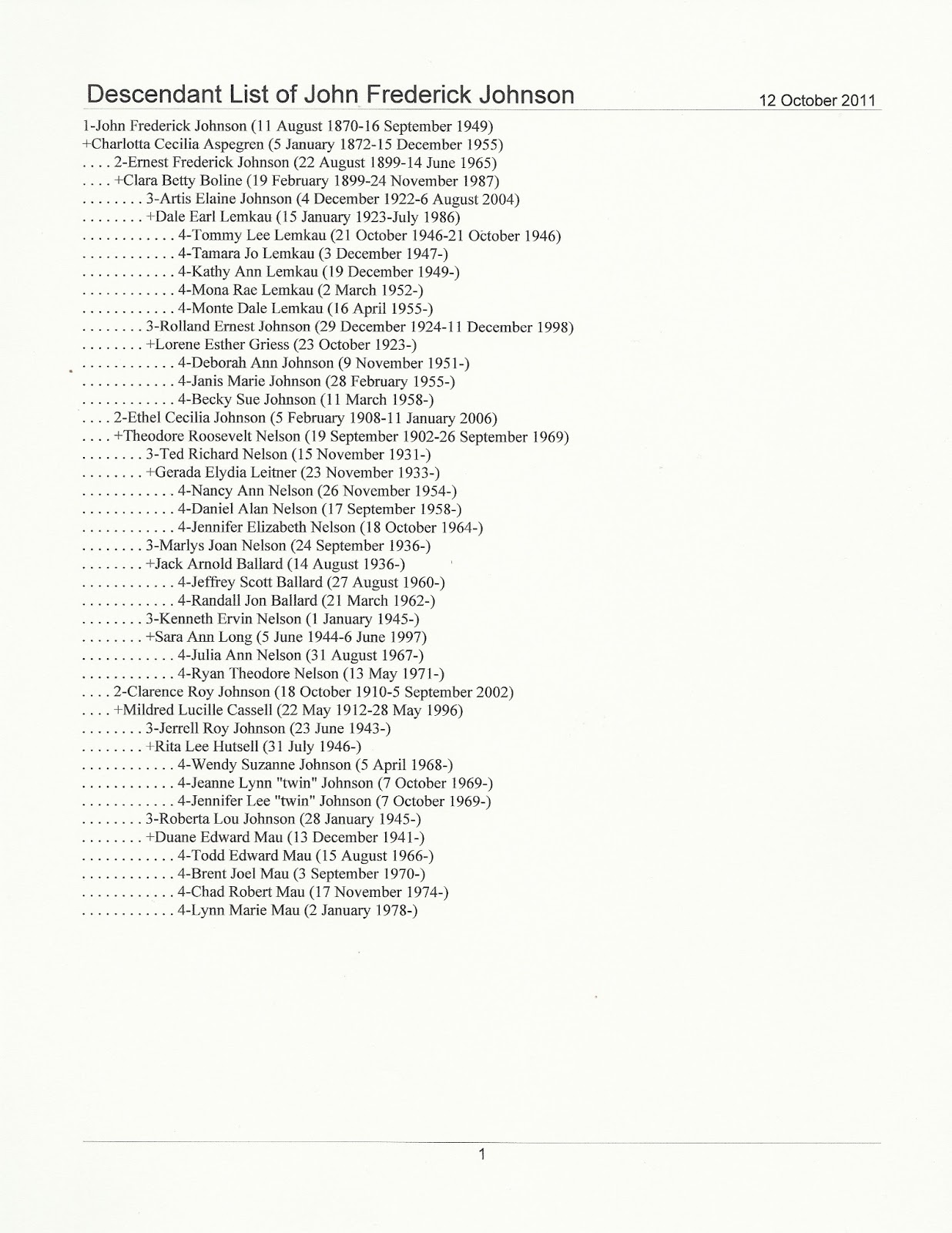
A four-generation Descendant List is indented
 to graphically show family members for each 
generation at the same level. Genealogy software
 packages offer a variety of reports including 
large, multi-page charts that can double as 
wallpaper.

O.K., now you’ve built your family tree; you have some cold, hard facts about some of your ancestors: their names, birthdates, birth places, marriage information and death information. You can reconstruct family relationships and you know where different ancestral families came from. Maybe that’s enough for you.

But there can be more and for me, this is the fun part of genealogy. Think of it as, “What Did You Do in the War Great-Grandfather?”

This part is what happens when you turn the collection of names, dates and places on a genealogy chart into stories?

Most of this is my personal set of stories, first, because I already know the material and secondly, I’ve so many stories.

While visiting friends in Maine a few years ago, we took the opportunity to stop in Oxford County where my great, great grandfather Isaiah Walton was born. I once found, and purchases a history of the county on amazon.com. That book described a grist mill run by Isaiah’s grandfather Ebenezer Hutchinson “…on the outlet to Moose Pond.” We found Moose Pond on the map and talked to some locals who’d heard that there had been a mill on that stream near a little gift shop. The stream was across from the shop and a few yards upstream were the remains of a dam similar to that of a restored grist mill about ten miles away.
End of a successful family history field trip – site of great, great,
great, great grandfather’s grist mill that he sold in 1812.

I hope you've had the feeling I had with my foot resting on the stones of my 4th great grandfather’s mill dam, a mill he sold in 1812 to start a family migration from Maine, to Ohio, to Indiana and to Edgar where my grandmother stopped before the family continued to western Kansas.

Some, maybe most, family memories are not so positive. I knew Isaiah Walton’s wife died in Indiana before he followed his daughter’s family to Edgar but I did not know “the rest of the story” until standing in a small graveyard in the middle of a field northeast of Commiskey, Indiana. There was the grave of Eliza Jane (Hall) Walton, who died in October, 1864 next to a stone reading “Infant of Eliza Jane Hall Walton 1864.” My great, great grandmother died having baby number ten, six years after her ninth and at the age of 47.

Family deaths often came in bunches. A number in Sutton share this family story. When Alice (Oakley) Vauck was born in Morrison, Illinois in 1884 she joined sisters Stella and Isabelle age 4 and 2. Shortly after Alice’s first birthday Isabella died on February 22nd. Two days later Stella died. Now our imaginations take over. Was there some communicable disease, an accident or what?  My family folklore did include their story. Does the Vauck family folklore tell us what happened? They were buried next to their grandfather and my great, grandfather James A. Cassell in the cemetery in Morrison.

Each of these stories will be topped by another waiting to be found. My 7th great, grandmother died in 1700 leaving Joseph Hutchinson of Salem, Massachusetts with seven kids age 2 to 11. Two years later the youngest three died on February 16th, 18th and March first. Eight-year old Ebenezer (grandfather of the Ebenezer above) and the older kids survived.

Now you can begin to picture the details of life 150 or 300 years ago under circumstances that had to tax those folks to the fullest. How do you feed and care for a family, by yourself, in winter, in early 18th century Salem? And it was often in winter that diseases and fatigue took their toll. At some point when you learn of the close call of an ancestor you may begin an existential conversation with yourself. Don’t go there.

My wife’s family has not been disappointing in providing stories. Her 6th great, grandmother, Ann Hostettler and two of her children were killed the night of September 19th, 1757 in what is known in Berks County, Pennsylvania as the Hostettler Massacre. See http://www.berkshistory.org/articles/hoch.html though that account supports September 29th as the date – historical facts can be squishy. An Indian named Tom Lions was believed to have killed Rita’s 6th great, grandmother. Tom Lions has a web site. No, really. See http://hostetler.jacobhochstetler.com/Tom_Lions.html  - bet you didn’t see that coming. Rita’s existential conversation centers on Ann’s daughter Barbara, married four years earlier and living down the road when her parents were attacked.

We don’t always think in terms of individuals or families. We can think of larger groups as do many in Sutton. The stories of the German-Russian families is the story of major migrations of large groups, first migrations from Germany to South Russia then a lengthy period of migration to America including Sutton.

The Historical Society has several family histories for Yost, Griess, Ulmer, Fuehrer, Schmer families and others. But the common story among them has been best told by Sutton’s own Jim Griess in his definitive history, “The German Russians: Those Who Came to Sutton.” This 335-page, almost formidable book tells how the ancestral families of many in Sutton lived first in southwest Germany before there was a “Germany”, why they left, how they went to South Russia, how they lived there, then why they left Russia and how, and why they came to Sutton.
“The German Russians: Those Who Came to Sutton” – 
THE family history for much of our town’s population, 
a fine story and an important contribution to the history
 of Sutton, Nebraska.

Jim describes the stories of several specific families and mentions many more. Nearly all Sutton “Russian” families, as they were first called came from either Norka or Balzer near the Volga River (Volga Deutsch) or from Worms or Rohrbach near Odessa (Black Sea Russians) almost 700 miles to the southeast in today’s Ukraine. 

 But the overall, common “Big Picture” of the group is the clear strength of the book. I’m not sure I can emphasize enough what a treasure the Jim Griess book is for the many in Sutton, and throughout the Dakotas, Nebraska, Colorado, Kansas and elsewhere who share this particular heritage. Few people or groups have a better single source for the complete story of their family history – and a good story it is. (Available at the Sutton Museum, step right up, they are moving fast.) Hours and hours of additional reading material is easily found on the internet.

My reference above was, “What did you do in the war, great, grandfather?” James Demetris Rowlison, my great, grandfather was in the 82nd Indiana Infantry for the entire Civil War, one of only two in Company A to serve from Muster-In to Muster-Out. From January to July in 1864, James kept a diary in a small black book, not an exciting blow-by-blow account of battles and skirmishes but mostly the stuff of the daily grind. He does mention “skirmish lines” and “firing” and only when you track the 82nd in histories do you realize he saw some horrendous action.

The Diary was known throughout the family and my mother painstakingly transcribed it. I posted the full text and his notes on a web site many years ago, but only saw the actual diary once. After my mother died we were not able to find the diary – still haven’t. Whether she moved it, my father accidently cast it out, or whatever, it is not to be found. I had to disclose this at a family reunion a couple of years ago.

Last year, my third cousin visited the Rowlison home town of Lancaster, Indiana. She stopped in Sutton on her way home and handed me a bound edition of James’s Diary printed in a script font and complete with pictures I recall from that old web site. At the end of the text, I’m given full credit for the research and resources for the book – it had been copied from my web site and now helps support the local museum. Great, grandpa Rowlison’s diary is not lost, it lives and lives better than ever, another story fleshed out from the names, dates and places on the genealogy chart and brought to life where great, grandsons and great, granddaughters can take pride in their family history.

There is a risk when digging into your past – you may find some connection that could be disturbing. James Demetris Rowlison, Civil War soldier is someone that any great, grandson would be proud to claim, and I am. However, his aunt Martha grafted a gnarled branch onto our family tree when, in July, 1839 she married a fellow named John Milton Chivington. Mr. Chivington served as an officer in the Civil War before becoming a fire-and-brimstone Methodist preacher in the west, settling for a time in Omaha before moving to frontier Denver. In Denver he became close with politicians in the Colorado Territorial government earning an appointment as commander of a Colorado Territorial Infantry Unit in 1864 just after the Indian raids along the Republican River in south Nebraska.

Col. Chivington’s infantry unit consisted of a motley group including some Denver bar flies looking to “kill themselves some Indians.” They did. The Sand Creek Massacre, also known as the Chivington Massacre was the work of my 2nd great grand aunt’s husband. Not a close relative, but close enough under the circumstances. An undetermined number of Cheyenne and Arapahoe Indians, probably 150 to 250 were killed including many women and children.

The good colonel later further tarnished his image when, after my 2nd great, grand aunt had died and their son Thomas had died John Chivington married his daughter-in-law Sarah. Sarah's parents took serious exception to this turn of events publishing a card in the New York Times on January 11, 1868 in which they said that marriage "...was unknown to us, and a thing we very much regret." They stated that had they known of these plans they would have taken steps to "...prevent the consummation of so vile an outrage, even if violent measures were necessary."

Then, of course, unsurprisingly, Col. Chinvington abandoned the woman.

This posting is based on an article that first appeared in the October and November, 2011 issues of Sutton Life Magazine. For more information on this local Sutton treasure, contact the publisher, Jarod Griess at 510 W. Cedar in Sutton, 68979 or at neighborhoodlife@yahoo.com.

Monday, February 18, 2013

Edgar Cigar Factory

The February 25, 1938 edition of the Edgar Sun newspaper had the following article on page 3:


Thursday, January 31, 2013

1895 Sutton Businesses, Churches & Civic Societies

The Masthead of The Advertiser=News. This issue was identified as
Vol 1 No.7 indicating that the paper began publishing on August 2, 1895.

The Advertiser News was likely a short-lived newspaper in Sutton and not one of the real early ones. Papers were published in town as early as about 1873. The Sutton Register began in 1880 and continued into the 1940's.

Here is a list of several local businesses that advertised in this issue of the paper plus churches and civic societies.

LOCAL BUSINESS of 1895


William Bauer, Shoemaker - Repairing done at low prices. First door north of Grosshans'. Call in.

Dr. J. M. Birkner - Physician and Surgeon. All calls promptly answered.

Alex Bauer - Real Estate, Loans, Insurance. Transportation agent for Railroad and Steamship Lines.  Office, 4th Door South of Oakland Hotel.    (The Oakland Hotel was on the south bank of School Creek on the west side of Saunders Avenue. The Hotel burned down in 1902.)

G. L. Beard - Oyster Parlor.  Fresh Fruits in season; choice Confectionery and Cigars.  First door north of Carney's Hardware Store.    (Carney's Hardware Store was on the west side of the north end of downtown.)

M. V. Clark - Surgeon and Physician.  In active practice 24 years. Special attention to diseases of Women.  (Dr. M. V. B. (Martin Van Buren) Clark was the brother of I. N. Clark, below, and the first doctor in Sutton in 1873. The Clark's came from near Cleveland.)

L. P. Crouch - Attorney at Law. Will practice in state courts, and give prompt attention to Collections. Office in Central Blk.

I. N. Clark - Real Estate and Ice. Choice Farm Lands, Town Property and Western Lands. Office up stairs in Clark's Block.     (I. N. (Isaac Newton) Clark was an early (1873) Sutton developer. He opened the first business in the location of today's downtown on Saunders Avenue. (Operating as Carney's Hardware at this time - later Les Bauer's Hardware.)

E. E. Hairgrove - Attorney at Law.  Office over First National Bank. Special attention given to correspondence.

J. H. Johnson - Dental Surgery.  Teeth extracted without pain. Temporary and permanent sets made on short notice. Office in Opera House.

M. C. King. - Lawyer and Collector. Notary Public.  Office - Bemis Block.

J. W. Legg - Jeweler. Jewelry, Watches, Clocks, Silverware and Spectcles (sic). Repairs a specialty and guaranteed.

D. A. Schaftchenko - City Barber.  Shop 3rd door south of Oakland Hotel.

T. H. Matters - Lawyer and Collector. Practice in all courts. Harvard and Sutton, Nebraska

Thompson Bros. - Real Estate and Loans. Farms and Town property for sale. Real estate Loans negotiated at lowest current rates.

H. L. Vradenberg - Homepathic Physician and Surgeon. Office First Door South of William Reuter's Harness Shop.

The Flour and Feed Store - is still in Sutton, and keeps Flour from three different mills. Always a good stock on hand. Every sack guaranteed to give satisfaction. Come in and get my prices.  Henry Schleicher - Sutton.

Sam Carney Hardware Store - Gasoline Stoves, Screen Doors, Paints and Oils, Refrigerators. Sewing Machine Repairing on Short Notice. ---  Don't Forget to Remember the Place.

The Corner Market - Run by those two old reliable butchers: Brehm & Baker.

M. Tessier & Son Groceries.

C. M. Calmes' Lunch Room and Bakery - All the delicacies of the season furnished on short notice. South Side.

First National Bank - F. N. Rowley, President; M. L. Luebben, Cashier; Theo.Miller, Assistant Cashier.

Toland & Nelson Store - School supplies, bicycles.


THE CHURCH DIRECTORY from September 13, 1895:


German Lutheran - Preaching on Sunday at 2 P.M. Sunday School at 3 P. M. Meetings held in the court house. Max Henning, Pastor.

German Congregational - Preaching at 1:30 P.M. and 7:30 P.M. on Sunday. Sunday School at 9 A.M. Prayer meeting on Sunday at 2 P.M. Richard Hilkerbaumer, Pastor.

Catholic Services - First, Third and Fifth Sunday at 10:30 A.M. Every Sunday at 7:30 P.M. Lecture and Bennediction (sic). Sunday School at 10:30 A.M. on first, third and fifth Sundays. Doctrine for children every Saturday at 2 o'clock P.M.  F. C. Loughran, Priest.

Evangelical Association. Preaching Sunday morning at 10:30 and in the evening at 7:30. A. Wichmann, Pastor.

First Congregational - Services on the Sabbath at 10:30 A.M. Prayer meeting Thursdays evening at 8. Y.P.S.C.E. Sunday evening. Jacob Flook, Pastor.

Immanuels German Reformed - Sunday School at 10:00 A.M. Service at 11 A.M. W. Bonekemper, Pastor.

Methodist Episcopal - Services Sunday at 10:30 A.M. and 8 P.M. Olive Branch 3 P.M.Strangers made welcome. J. W. Royse, Pastor.

Wolga Congregation-German Reformed - Sunday School 9:30. Preaching on Sunday at 10:30 A.M. John Arnold, Pastor.

CIVIC SOCIETIES


Sutton Lodge No. 156, A.O.U.W.  Meets in the Odd Fellow's Hall first and third Monday's.

Sutton Lodge No. 87, Degree of Honor, A.O.U.W. Meets in Odd Fellow's Hall second and fourth Mondays.

Sutton Lodge No. 52. I.O.O.F. Meets in their hall Wednesday's.

Eugenia No. 34, Daughters of Rebekah. Meets in the Odd Fellow's Hall on Friday evening.

Evening Star Lodge No. 49 A.F.& A.M. Meets on second and fourth Thursday evenings.

Lebanon Chapter No. 14, R.A.M. meets in Masonic Hall last Fridays.

Solomon Council No.10, Royal and Selected Masters - Meets first Fridays in the Masonic Hall.

Sutton Chapter No. 54, O.E.S. meets in Masonic Hall first and third Thursdays.

Sutton Lodge No. 75, Knights of Pythias meets each Tuesday evening.

George G. Meade Post No. 19 G.A.R. meets second and fourth Thursday evenings.

George G. Meade Corps No. 167 W.R.C. meets first and third Thursdays.

Pine Tree Camp No. 494, M.W.A. meets in the K. of P. Hall on second and fourth Mondays.

W.C.T.U. meets every two weeks on Wednesday evenings.


A Deeper Look at History - Sutton School Grads


While recently looking something up in the Sutton High School Alumni Directory I was again struck by the predominance of girls in the early years. I wondered how long that lasted and what were the reasons for that marked tilt.

A study of history can happen on several levels. The history column in the Clay County News is a “study” of history at a shallow level being several tidbits of facts from the past. We call those “data points” – just disjointed facts.

If we take a deeper look at a set of disjointed facts we will generally have an opportunity to learn more. A collection of facts plus a bit of imagination and a deeper look expands those facts into a story. That often happens in genealogy research.

My great grandfather died in 1890 at the age of 51. His widow lived to age 88 in 1932 – a few cold facts, but what was Rhoda’s life like after James died?

A photo and the cold facts of dates for birth, marriage and death
are only a start in learning about your ancestors. This family of
Mom and daughters left clues to their interesting and complicated
 lives. We just have to look deeper to uncover their stories.
A look at their offspring offers a clue. The widow was left on the west Kansas wheat farm with eight of her eleven children still at home at ages 18, 16, 13, 11, 9, 7, 5 and 2. Now that is interesting. Add those new “data points” to the few we had before and we've the makings of a story.

By blending in more simple facts about her life and that of those offspring, where they lived, etc. and we learn more and more about Rhoda’s life. For instance, what prepared her for this? Could it have been that when Rhoda was 19 her own mother died at age 47 trying to have her tenth baby leaving Rhoda the oldest daughter with 14, 11, 9 and 4 year old brothers? That was while James, her “intended” was one year into his three year absence with the 82nd Indiana Infantry marching through the Confederacy.

That could be a character building experience.

Meanwhile, back at the Sutton High School Alumni Directory, how long did the number of girls in the graduating classes continue to exceed the boys?
The Sutton High School Alumni Directory for 1884-2001 is a 
priceless resource to uncover “data points” about most of the past 
residents of our community. Take some time to look deeper 
into these pages and you may be surprised at what you find.

I made a spreadsheet. Sure enough, in the first three years, 1884-1886 girls outnumbered boys 4-0, 4-3 and 8-2. Jumping a few years to 1897-1899 the counts were 9-5, 7-5 and 15-3.How about 1913-1915: 9-3, 5-8, 8-7. You see that 1914 had more boys – that had happened twice before and would again in 1921 but in 1916 there were 16 girls and only 5 boys.

The widest gap of girls outnumbering boys occurred in 1940, ’41 and ’42 (except 1964 – more on that).

The branch of mathematics that helps us understand bunches of numbers is the field of statistics. That is the science that helps us gain confidence in our interpretation of bunches of numbers. My grad example violates a critical concept – sample size. To gain more confidence in any interpretation we’d need either much larger class sizes or to look at several schools.

How many more? Surprisingly, not many.

Political polls are a recent reminder of statistical science. A sample size of 1500, turns out, will give a very good representation of the whole population, within an error rate of about 3%. The most critical factor in choosing the 1500 person sample is to be representative of the whole population. If that is done right, adding 500 or so to the sample size gains very little in the confidence level. (It’s a math thing.)

I used another tool in looking at the Sutton High grads – a ten-year moving average. Mr. Excel makes this pretty easy. I tracked the average difference in number of girls versus number of boys for each ten year period from 1884-1893 through 1958-1967 (got tired by then). Using ten-year averages will smooth out “outliers” – single years with abnormal counts that mean little.

My results? Several interesting things pop out.

Turns out that the average class had 2.5 to 4.7 more girls than boys through the 1926-1935 period when the gap spiked up when those ’40-’42 years were included then settled down in the early ‘50’s to quite equitable numbers.

So what could we interpret from this mish-mash of numbers?

I’ll hypothesis, meaning I’ll devise possible explanations that might explain the numbers.

First, a likely explanation is that boys quit school early to work on the farm while girls continued their studies.

Probably a factor, but a good percentage of school age kids were town kids. Did town boys tend to quit school to work in Dad’s store or business? Did they go work on farms? A quick look at 1900 and 1910 census finds a little of that, but not enough account for the numbers. It would take more study to offer that as a bet at the bar, with confidence.

Secondly, maybe parents felt it was more important for girls to finish high school than boys.

Could be, but if so, that would go against quite a bit of “common” knowledge. If there was any gender bias in most of history it was that boys were educated, girls not so much. Would our community be different? Why?

Thirdly, maybe girls were marrying at younger ages.

Also, could be, but that would require digging into more data.

And (______ fill in your own hypothesis here.)

My point is that accepting common knowledge or an opinion should not cut it if you are interested in a rigorous study of a topic. Dig deeper.

There is another interesting thing about the picture we get from our Alumni Directory. The trend in the number of grads does not match the trend in overall population of the community during these years.

The local population peaked around 1900 to 1910 then declined steadily into the depression when it dropped more rapidly and then resumed a steady decline. The number of grads rose during those declines; the classes of 1940 and 1942 were largest classes during this whole period. There was only one class with more than 25 grads before 1921. There was only one class under 30 after 1921 (1963 with 28).

Any idea about what was going on there? Suppose mandatory school attendance tilted the graduation rate? Careful…we should look deeper.

I mentioned the class of ’64. That class demonstrates that in any set of data there can be weird data points. The class of ’64 had 31 girls and 13 boys. There were more girls in that class than all the students in ’63. That’s an “outlier.” It doesn’t mean anything necessarily. Outliers happen.

So what have we learned?

I hope that we’ve learned that there can be a lot involved when you give into an interest in the past. A casual look at the past may give a satisfactory picture but a deeper look will at least add to the picture and may very well reverse your original perception. The study of historic events and people is like so much else, the more you put into it the more you get out.

Wednesday, January 23, 2013

1943 Wartime New Yorker Ads

We don't see these kinds of ads anymore:


A subscription to The New Yorker magazine includes online access to the entire archive of past issues dating back to the issue of Feb. 21, 1925. It is a mind-numbing library, difficult to find a place to start. So, why not start with the issue of the week of your own birth?

June, 1943 was a busy time in World War II. The references to the progress of the war are interesting enough but the ads in the magazine are especially striking. Production of domestic goods and services were interrupted in support of the war effort. Here is an ad from Desoto, once a major car manufacturing division of Chrysler.

The industrial might of the U.S. was diverted to the war effort. Here is a 1943 ad where
the Desoto division of Chrysler Corporation described part of their story to their
customers, the American people, who as taxpayers were buying equipment for the troops.
One advertising industry that was common in 1943 which has fallen away was the cigarette industry. This was a common approach to cigarette advertising back in the day...

We just don't see this anymore...


Wednesday, January 16, 2013

1923 Photo of Our Historic House

Historic House at 309 N. Way Ave. in Sutton, Nebraska

The Historic House of the Sutton Museum - taken April 1, 1923


We received this photo from Mary Kathleen Fish, a Gray family descendant. Thanks to Mary for sharing this piece of her family history and our present.

Sunday, December 30, 2012

Madeleine Leininger - "A Great Woman with a Great Story"


A Great Woman … A Great Story

By Jerry Johnson and the Sutton Historical Society

“A Great Woman … A Great Story” is an appropriate and fitting tribute to perhaps Sutton’s most famous daughter and is presented in a three and a half minute video on youtube at: http://www.youtube.com/watch?v=kcVqOcMUtsM - a tribute to Dr. Madeleine Leininger.

Dr. Madeleine Leininger of Sutton

Dr. Leininger has been recognized locally a number of times in articles and tributes but the story of her career does not grow old.

“He made a difference in the world.” Have you ever heard that said about an individual? Did that person really make a difference? In the world?

We’d all like to think that we made some difference during our brief stay on the planet and on certain scales, we all do. But not many of us truly do something that alters the world for untold thousands and thousands of people. We have at least one Suttonite who did just that.

The Sutton High class of ’42 was a large class for our town, fifty-eight graduates in the early months of a world war. The boys faced an immediate responsibility to “make a difference” on the stages of the Pacific Theater and the European Theater of WWII. One grad made the ultimate sacrifice in a tank battle on the western front near the borders between Germany, France and Switzerland.

Many scattered across the country making their marks from coast to coast. One fellow went on to become an executive at Temple University. Others stayed close to their roots becoming standout citizens of our local community. But the ‘42 grad of this story did truly make an indelible mark on the world.

Madeleine Leininger was born July 13, 1925 to George and Irene Leininger on the farm south of Sutton though the video mentioned above gives her birth as 1920. After graduation from Sutton High she was in the U. S. Army Nursing Corps while pursuing a basic nursing program. She received her nursing diploma from St. Anthony’s School of Nursing in Denver, a B. S. from St.Scholastica (Benedictine College) in Atchinson, Kansas, her M. S. psychiatric and mental health nursing from Catholic University in D. C. and a Ph.D. in cultural and social anthropology from the University of Washington. She was the first person in a graduate nursing program to receive a Ph.D. – quite a distinction. Her official certifications read: PhD, LHD, DS, CTN, RN, FAAN, FRCNA – I’ll not elaborate.

Dr. Leininger’s broad academic background led her to blend her two fields study, nursing and anthropology to create a new discipline, transcultural nursing.

She was working in a child guidance home in the 1950’s when she realized that behavior patterns in children appeared to have a cultural basis. She spent three years in Eastern Highlands of Papua New Guinea on a field research project with the Gatsup people. There she came to realize that nurses and other health care personnel were handicapped in their attempts to provide health care if they did not understand the culture and history of health care of their patients.
Dr. Leininger visited and studied more than a dozen cultures world-wide.

Madeleine studied a number of diverse societies while formulating her then-radical ideas about the nature of nursing. Those ideas coalesced into her Theory of Transcultural Nursing defining an entirely new professional sector of nursing and health care practice.

Dr. Leininger was able to instill her ideas into formal educational programs as she attained leadership positions in the field at the University of Cincinnati, the University of Colorado and as Dean, Professor of Nursing and Lecturer of Anthropology at the University of Washington. It was under her leadership that the University of Washington was recognized in 1973 as the outstanding public institution of nursing in the country. Her resume must have been suitable for framing.

Her academic career continued at the University of Utah where her collection of titles included Director of the Doctoral and Transcultural Nursing Program.

The theory and principles of transcultural nursing were quickly ingrained into nurses training throughout the world as the list of her professional writings grew to include over 200 articles and book chapters, more than 25 of her own books and edited works, 850 public lectures and numerous audio and video presentations. She managed to work in stints as visiting professor and scholar at about 70 universities around the world – her various biographies seem unable to keep up with and agree on the “gee-whiz” statistics of Dr. Leininger’s career.
Dr. Leininger with a group of Gadsup children on a return trip
to Papua New Guinea probably in 1990.

She settled down, as best she could in 1981 at Wayne State University in Detroit where she accumulated another list of academic and professional titles. She retired as professor emeritus from Wayne State University in 1995.

Every formal field of study needs its definitive publication for exchange of ideas and to establish standards and methods. Dr. Leininger accommodated with the founding of the Journal of Transcultural Nursing in 1989 and served as its editor until 1995. The publication recognized their Foundress shortly after her death by reprinting (unfortunately, as a single paragraph!) an article from 2009: http://www.tcns.org/Foundress.html

The Madeleine Leininger Collection constitutes 15.5 linear feet of her papers in the Walter P. Reuther Library at Wayne State. The thirty-three pages of the “Finding Aid” of the collection are at:  https://www.reuther.wayne.edu/files/WSP000725.pdf and is worth your time to get a feel for the important work of this Sutton girl. Prepare to be overwhelmed. Other collections of her works are at Florida Atlantic University, Boston University and Madonna University in Livonia, Michigan.

I’ve provided a few of the dozens of internet links concerning Dr. Leininger. I’m pretty sure no other Suttonite generated as much academic and professional material. But I must include two more of those links. A detailed and lengthy account of her work is at: http://nursingtheories.blogspot.com/2011/07/leiningers-theory-of-culture-care.html and an entertaining youtube video at: http://www.youtube.com/watch?v=cHsfevWnW10&feature=related
is rather clever, if a bit hokey with a skit apparently done by enthusiastic nursing students including an appearance by Madeleine as Mary Poppins. Yes, really.

Did growing up in Sutton have any unique or direct influences that may have led to Dr. Leininger’s success? We probably shouldn’t make such a claim without specific justification. But there is a hint in the 1940 census of where an important influence may have come from. Madeleine was 14 at the time of that census. Her sister Eulalia was 17 and listed as a “public school teacher.” School documents for that fall list Eulalia as a second-year teacher in District #38, the Rock School six a half miles south of Sutton.

We can imagine how a sister but three years older and already teaching school might have had an impact on Madeleine. Leininger family stories confirm Eulalia’s influence including her encouragement and help in sending Madeleine off to begin her education and the career that became “A Great Story about A Great Woman”.

Dr. Madeleine Leininger died on August 10, 2012 and is buried in Sutton’s Calvary Cemetery.

This article first appeared in the November 2012 issue of Sutton Life Magazine. (No longer in publication)


UPDATE: March 2019

This news item appeared in The Clay County News on March 20, 1969


They Left; Where Did They Go? What Did They Do?


Following the stories of Sutton folks out in the world.

By Jerry Johnson and the Sutton Historical Society

The Sutton High Alumni Directory tells us that our classmates and friends and those of our parents and grandparents have dispersed all over the country and beyond. Ever wonder what they are doing, what those in the past did? Their stories are part of the history of the Sutton community too.

State and town promotions include the famous people who were born, or had a connection to the state or town. Nebraskans take pride in claiming Johnny Carson, Dick Cavett, David Jansen, Sandy Dennis, Gordon MacRae and others from the entertainment world. A favorite Omaha trivia question is, “Who gave 18-year old Henry Fonda his acting start at the Omaha Community Playhouse?” The answer of course is Marlon Brando’s mother. Towns create a tourist industry based on the birthplace of a president or movie star or other celebrity. Those connections become part of the local history and heritage.

The cover of a collection of political cartoons from the 1930's
by Herbert Johnson of Sutton

We’ve had recent reminders of our own similar heritage here in Sutton. Madeleine Leininger’s Sutton funeral reminded us of her incredible career as a pioneer in the nursing profession. This 1942 Sutton High graduate created the discipline of transcultural nursing. The archive of her papers (1961-1995) at Wayne State University measures 15.5 linear feet; her name at amazon.com generates 116 results of her books, collections and related works. She had an influence in the world and as her hometown, Sutton and those of us in Sutton can be proud of her.

The opening production in the newly refurbished Allegro Wolf Arts Center was a performance of the play “The Guys” which in its eleven-year history has become the signature work of the arts to commemorate the 9/11 World Trade Center disaster. After performances of the play, the playwright, Anne Nelson told us of visits as a girl to her grandparents in Sutton. She convinced us that even as a New Yorker who was raised in Stillwater, Oklahoma she feels a special affection for Sutton, Nebraska. Those of us in Sutton can take pride in that connection.

The poster for the movie version of Anne Nelson's play
"The Guys" about a NYFD captain and a journalist one
afternoon in September, 2001. Anne's parents are Sutton
natives and graduates of Sutton High School.
In the earliest days of the Sutton Historical Society we began to collect the stories of past residents of Sutton and others who had some connection with our community.  Some were well-known but many had been forgotten; either their stories had never been told or had faded to obscure references on yellowing newsprint in the news office basement.

We enjoy the story of Walter Wellman, one-time 14-year old Sutton newspaper publisher who became obsessed with hot air balloons and tried to become the first man to the North Pole via his balloon. (See the historical society blog at  http://suttonhistoricalsociety.blogspot.com/ )

Herbert Johnson was a political cartoonist and drew cover cartoons for the Saturday Evening Post and other publications. Again, see the blog.

Ummo Luebbens, the son of a Sutton banker invented the round baler.

1964 Sutton grad Diane Klein as Diane Jordan, moved to Nashville and began a recording career that is best described by the title of an interview a few years ago: “Almost Famous.” She appeared in a couple of movies including “That’s Country” where she shared billing with quite a lineup of country stars: http://www.imdb.com/title/tt0191553/.  

Paula Felps (Burklund), class of ’81 enriched the Open House at the Sutton Museum a few years ago with a book signing featuring a few of her works. An internet search today reveals her current work as a writer, editor and among other things, car critic for ladies. Not ordinary cars either. Check out http://www.paulafelps.com/ for a photo of her in a $480,000 Mercedes McLaren. Anyone else here ever driven that car?

We’ve revived a few sports stories. Johnny Bender was a star halfback at the University of Nebraska for five pre-NCAA years before coaching and naming sports teams such as the St. Louis Billikens, K-State Wildcats and Houston Cougars. His story is at our blog.

A few years ago I fielded a call from the NFL Historian (yes, he said it was a real job) who was working on a web site listing the 1,000 oldest living pro football players: http://www.oldestlivingprofootball.com/oldestlivingproplayers.htm. He had traced the Oregon State star and late 1930’s pro Morris Kohler to Sutton, Nebraska and asked if I knew when he had died. I stammered a bit then said, “I could give you his phone number.” I called the Kohler home to warn them before calling the historian back. We soon learned that Morrie was #14 on that list of 1,000 old pros. We were able to revive Morrie Kohler’s football story here in Sutton while he could still enjoy the recognition, again.

Incidentally, two Nebraska-connected fellows were ahead of Morrie on that list: Tippy Dye, the genius who hired Bob Devaney in 1962 and Bill Glasford, NU coach 1949-1955 who still holds down third position on the list of 1,000 at age 98.

Soldiers have brought distinction to our town. We’ve written about the two Medal of Honor winners, Jacob Volz and Orion Howe a number of times – again, see the historical society blog. About a dozen Sutton area men perished in World War II including Marine Merritt Walton who received the Navy Cross entitling his family to see a Navy ship named after him. The destroyer U. S. S. Walton thus is likely the only warship with such a Sutton connection. Nebraska’s southwest Asian war fatalities including Sutton’s own Sgt. 1st Class Tarango-Griess are recognized at the Fallen Heroes Marsh southwest of town.
The Navy Destroyer USS Walton (DE-361) named for Marine Sgt. Merritt
Walton killed August 7, 1942 on Gavutu Island in the Solomon Islands.
Sutton newspapers identified Walton as the first Sutton man to be lost
in World War II.

Ted Wenzlaff from the class of 1921 had a distinguished military career but he also made a great contribution to the understanding of the history of the Germans from Russia. His nephew Jim Griess continues to extend that work.

There are lesser, but still interesting connections between our community and history in general. One hundred years ago Wisconsin Senator Robert “Fighting Bob” LaFollette visited Sutton during his brief run at the Republican nomination for president. Fighting Bob made his connection with Sutton by reminding them that his brother had once lived in Sutton.

Others from Sutton have made contributions to the business world, the arts, education – the list goes on and on. Knowing where our “ex-pats” went and what they’ve done is interesting and worth knowing. Taking pride in someone else’s accomplishments is a sincere way to honor that work.

Members of the Sutton Historical Society consider it part of our mission to collect and preserve these stories that are a part of the community’s history and making them available to be enjoyed by all.

Do you have any nominees who belong on this list? If so, let us know. Better yet, join us in our efforts to build the list. The historical society meets the first Tuesday of the month at 7:30 PM, generally at the Historic House at 309 N. Way Ave. And we have a pancake breakfast at the American Legion the first Saturday of each month from 7:30 – 10:30. Stop in for breakfast, coffee or “just visiting.”  Call 773-0222 for information.

This article first appeared in the October, 2012 issue of Sutton Life Magazine. Contact Mustang, Inc. for more information: neighborhoodlife@yahoo.com  or  510 West Cedar, Sutton, NE 68979 or 402-984-4203.


Interpreting Our History from Stuff & Memories


Our historical society strives to tell the story of the history of our community through several channels.

We have artifacts on display at the museum which one generation remembers, another generation has heard of but are completely new to yet another generation.

The rural school house on North Way Avenue tells its story to anyone with even a hint of an imagination. Visitors standing in the school house can picture what it must have been like to attend such a school sitting alone on a country road in the middle of winter, a small group of kids with one adult often not much older than the oldest students.

We have a growing inventory of old photos from the early days of the town that together tell a story of wooden frame store fronts beside muddy streets with telephone and power poles and lines. We have photos of families and individuals, some identified, many not.

Each of these resources, artifacts, old buildings and photos provide a piece of the story of our town’s past. It is up to us to assemble those pieces to solve the puzzle of what our town was like seventy-five years ago or one hundred years ago or at its very beginning over 140 years back.

Central Block in downtown Sutton, South end, West side, in 1908. This photo appeared in Don Russell's "Sutton Nebraska - 125 Years - A Pictorial History" among other places. Russell attributed the photo to Roger Bauer and Artis Lemkau.
Those puzzle pieces can be used to build a variety of images and impressions of what life must have been like for the early residents of Sutton. Join me in imagining my great-grandmother Anna Klintberg visiting downtown Sutton stores with two or three of her six children in tow as she crossed the dusty or muddy streets shopping for clothes for the kids or more likely material to sew, basic grocery items – coffee, sugar, produce and other things not grown at home or maybe something for herself. Now add a piece of information from the 1900 and 1910 censuses where we learn that Anna never learned English well enough to tell the census taker she spoke the language. Did she shop in Sutton just two miles from her farm home or did she prefer to go to Saronville further away but where her friends and relatives spoke Swedish and definitely where she attended church services conducted in her native tongue as long as she lived?

See how a very few pieces of the puzzle of Anna’s life come together to give us insights into her life.

Old newspapers have become my favorite resource for deciphering the puzzle of life in Sutton’s early days. These old newspapers were written to report the happenings of the day to an audience of contemporary readers who shared the context of living at the time. Articles were written with the valid assumption that readers already knew the background and context of the story and those things did not have to be repeated in the story. So as we read those stories today we can be sure that we are missing things. You can probably see the same characteristic in articles in this week’s newspaper if you imagine yourself 100 years from now reading an old yellowed paper (or in another medium) and recognize that you wouldn’t catch important assumptions.

Our old Sutton newspapers, the Sutton Register and the Sutton News, are great resources for looking into Sutton’s past. The history of the comings and goings of businesses is documented well but generally identify the locations with the name of a building, a name that no longer is used – context again. As we continue studying these old newspapers, the more we begin to build our own version of the necessary context to make better sense of each article.

A persuasive impression from these early newspapers is that early Sutton residents led an intensive social life. Local clubs, lodges and organizations had reporters who filled many column-inches of newsprint each week telling about their respective organizations, and there were a lot of them.

Each church seems to have had organizations for men and women and a few for children. Ladies Aid and church circles played a big social role. The Masons, Knights of Pythias, Odd Fellows and Rebekahs, Knights of Columbus, AOUW (Ancient Order of United Workmen) and other lodges operated in early Sutton, some lasting into recent times. The Masonic Temple building that hosts City Hall was built just fifty years ago.

The Grand Army of the Republic (G. A. R.) had an active post in Sutton with at least 40 members into the twentieth century. The American Legion and the Auxiliary has a long history in town and continues today.

There were clubs for specific activities such as the Bicycle Club, Walking Club, numerous card clubs, Sutton Junior Stamp Club and the Sutton Girls Stamp Club. (Wally and Fritz Bender were stampers.)

My father remembered his days in DeMolay and regretted that that organization had folded before I came along.

Clubs were known by their initials. The O. E. S. had a chapter in Sutton, No. 54 as well as the P. E. O. Sisterhood, the J. U. T. and S. O. S. The W. C. T. U. (Women’s Christian Temperance Union) fought their battle against Demon Rum in Sutton, throughout the county, state and nation.

The DAR (Butler-Johnson Chapter) was active in Sutton. There was a Fortnightly Club, Women’s Home Missionary Society, Red Cross, Farmers Union and something called W. H. M. S.
 
I once ran across an article about the forming of the Clay County Dentists Association. Belonging to a club was a popular thing to do, be it a professional club, social, special interest or whatever. And as you’d expect, people joined multiple clubs.
The Sutton Bicycle Club in 1894. This photo was attributed to C. V. Hines in the book, "Sutton Nebraska - 125 Years - A Pictorial History" published by Don Russell and the Clay County News in 1977.

My nominee for the champion Sutton Clubber is Mayme (Wieden) Clark whose name appears in articles about many clubs. She was not only a member but was often an officer, the reporter or just had her name pop up a lot.

O. K., so there were lots of clubs in Sutton over the years. What can we infer from that piece of information?

It’s clear that Sutton folks from the early days of the 1880’s into the ‘30’s were social creatures. These clubs and organizations were a form of entertainment in the pre-TV days. But there was probably more to it than that. We can’t help but imagine that members of these clubs developed a large network of very close friends. They were very willing and eager to spend a significant amount of time engaged in a particular activity with the same circle of friends month in and month out.

Does knowing such information help you to understand more about the people in our past? Of course it does.

Does the process of analyzing these tidbits of information to arrive at such a conclusion sound interesting? I think it does.

This article first appeared in the September, 2012 issue of Sutton Life Magazine. For information about this small-town publication contact contact neighborhoodlife@yahoo.com or write to Mustang, Inc., 510 West Cedar, Sutton, NE 68979 - 402984-4203.