Powered By Blogger

Sunday, October 22, 2017

Satch's 62nd Birthday


The Clay County News on September 14, 1967 carried this call for a birthday card shower for Satch.

Satch, Alexander Idt, was a fixture in downtown Sutton for decades. He taught us a lot about the human condition and we were all better people for having known  this gentleman, and gentle man. 


Remembering the Pritchard Family


Grave 10 of Plot 09N-12-01 at the Sutton Cemetery has a stone inscribed, “GWLADYS PRITCHARD JONES” with the dates “1883-1928”.

Should you have noticed that stone, I’m guessing that among your first thoughts was something along the lines of, “How did a monument carver make such a typo with his chisel?”

Misspelled? Or was this woman's name actually G(w)ladys?
The volunteer who created the findagrave.com memorial for this person likely took a few minutes before stepping up to correct the mistake. The memorial lists the lady as “Gladys Pritchard Jones”.

I vaguely remember noticing the name four years ago while I was photographing Sutton Cemetery gravestones as a volunteer for findagrave.com at a time when fewer than 25% of the cemetery had been photographed for that robust website. But I was trucking right along with the project and did not investigate that grave inscription.

We uncover many mysteries, big and small, and some get passed over or forgotten while we are working with stories about the Sutton community. But sometimes a situation falls into our laps driving us back to a mystery.

This 20" X 30" framed needlepoint triggered our
interest in the David Pritchard family, early settlers
near Sutton.
Such a situation was in a recent email from the senior curator at the Nebraska State Historical Society who offered to transfer a framed needlepoint to the Sutton Museum. The item came from the estate of Miss Maude Pritchard of Sutton in 1956, given in memory of David and Mary Ann Pritchard of Sutton.

I was familiar with the Pritchard family; they were once near-neighbors. We accepted the curator’s offer, retrieved the item from the state museum and it is now part of our Sutton collection.

The item deserved proper documentation so we immediately delved into the story.

My recollection from about 1950 was that three people lived on the Prichard farm, one mile west on the DLD and a quarter-mile north, west side, and that two of them were blind. I knew I could check with the Answer Ladies who sit at the back table on our Pancake Saturdays. Sallie Barbee straightened me out – there were only two people there and both were blind. She remembers her family stopping to check on the Pritchard’s.

Sallie believes her family did errands for the Prichard’s. I think we, and others probably did too.

Brother and sister Bertram and Maude Pritchard were the two blind residents. Bertram died in 1950, Maude in 1955, fitting the 1956 date for the gift of the needlepoint to the museum in Lincoln.

David and Mary Ann (Davies) Pritchard immigrated from Wales in 1888 with five children: John David, age 17; Maude was 13; Bertram, 8; William Davies Pritchard was about 8 and may have been Bertram’s twin and the baby of the family was Gwladys, age 5.

The family left census records, marriage records and other traces where they sometimes identified their origin as Wales and other times as England. They likely saw Wales as part of England, or at least a lesser part of the United Kingdom.

Although the younger daughter was sometimes called Gladys, formal documents, her 1908 Lancaster County marriage license and her tombstone included the “w” in Gwladys. What kind of a name is that? What kind of a word?

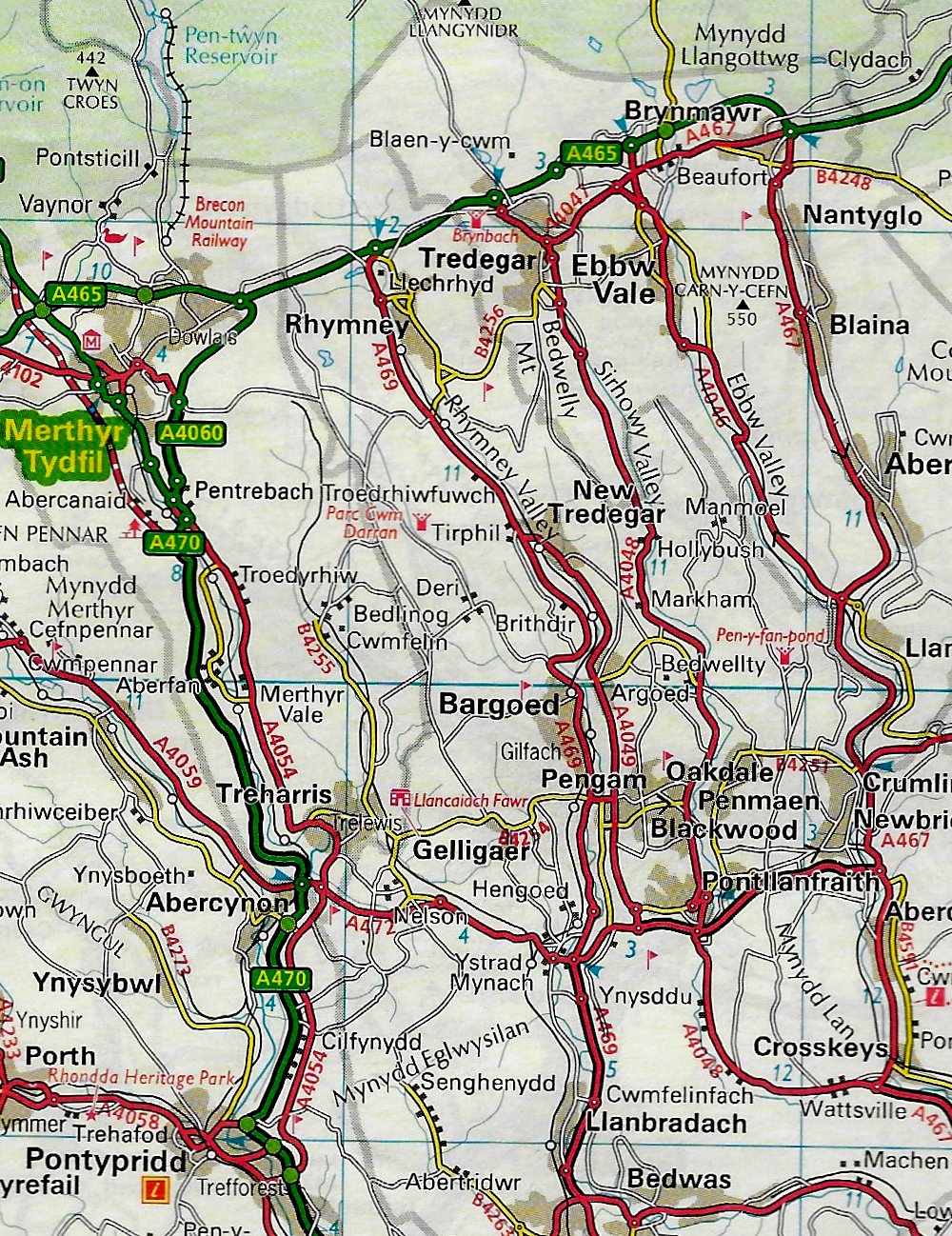
Have you ever looked at a map of Wales?

The Welsh do some particularly peculiar things when assembling letters into words.

The Pritchard family came from Breconshire in Wales. The -shire suffix refers to an area that corresponds to our counties. But it’s squishy. The Brits have occasionally merged counties, changed boundaries and changed names of counties as recently as 1965 and 1974. And they have different kinds of counties. It’s complicated.

But back to Welsh names.

Penkelly Castle near the boyhood home of David Pritchard.
David was born in Penkelly also called Pencelli. Mary Ann was born in Beaufort, which is near where Sir Thomas John Woodward grew up before he changed his name to Tom Jones, perhaps the only Welshman many know of.

The Pritchard offspring were born in the tiny village of Bedwellty.

The village of Bedwellty in Monmouthshire, Wales. Ever been to a pub in the UK?
You'd love it. There is nothing like it in the U.S. They are not bars, or snack shops,
or restaurants, or coffee shops or donut shops but they do all of those things better
and all in one place, early morning to late at night. 
These are not unusual names, but in the surrounding area you find Ebbw Vale, Cwnbran, Ynysybwl, Mynydd Eglwysilan, Troedrhiwfuwch and the shire’s largest town, Ystradgynlais. It is our good fortune that the Welsh were not predominate in settling the New World.

More to our point, there are towns called Capel Gwynfe, Gelin gwm Uchaf, Gwernesney and Gwyddgrug and a mountain called Gwaun Rhudd. Now the Pritchard girl’s name of Gwladys makes more sense.
 
The Welsh have more fun than most when collecting letters to create their words. Perhaps the Welsh
language is nothing more than a huge joke they play on the rest of the world.
But where did the name come from?

Saint Gwladys ferch Brychan was the queen of the saint-king Gwynllyw Milwr. Saint Gwladys died in the year 500, or maybe 523. Her feast day is the 29th of March.

So, the name Gwladys Pritchard Jones in the Sutton Cemetery is no misprint.

John, Maude and Bertram never married and lived out their lives on the N ½ of the SE ¼ of Section 33-8-5.  Leonard Johnson farmed and purchased the 80. It was part of the 400+ acres that were sold at auction by the Douglas family a few years ago.

The Pritchard farm, show here belonging to Mary, was a mile west of the park corner
and the second 80 to the north.. The C. Johnson farm to the north was that of Charley
Johnson, my great, grandfather. That quarter passed to his son Albert and in turn to
his son Leonard. F. Johnson was Charley's son Fred; that farm later to Clarence Johnson
and is still in the Johnson family, farmed by the Jasnochs. 
William Davies Pritchard left Sutton and was married to Katherine Frantz in Denver in May 1918. Later that year he filed his WWI draft registration and noted that he had a physically disqualifying condition, stating “has lost one eye”. As Bertram and Maude were later blind, the family may have had some genetically connected eye disorder. William died in 1964. He is the only family member not buried in Sutton Cemetery.

Daughter Gwladys married Harry Jones in Lincoln on the last day of 1908. She died in 1928. Neither William or Gwladys had children.

We’ve told about the demographics of Sutton often during the lifetime of the historical society, telling of Germans, Germans from Russia, Swedes and Danes, the Irish and even a few Scots. Many of the U. S. residents who settled in this area were from “back East” – Iowa, Illinois, Pennsylvania, New York, etc. but with deeper roots from England. I’m not sure we’ve mentioned the Welsh before.

When we speak of the United Kingdom, the U.K., we usually think of England, Ireland (at least Northern Ireland), Scotland and ... finally Wales. The history of Wales was closely blended into the history of England early to the point that they tend to lack a distinctive story.

Well, we hope that the story of the Pritchard family adds a tiny sliver of proud Welsh history to the Sutton story.

We do not know of a second Welsh family in Sutton's story, but the Pritchard family
does connect the name of a Sutton Welsh girl with a Queen, and a Saint.
Another thing the Pritchard story does is illustrate how a single artifact or a single piece of information often offers a clue to a little piece of Sutton history. That clue may have been laying around for a long time. Old newspapers, an item on a census from 100 years ago, scrapbooks, letters and other attic treasures, or even an unusual spelling on a tombstone can lead to new knowledge and understanding of our vague or forgotten collective memory.

Our museum has become the depository for literally hundreds of Sutton artifacts and clues that could unravel vague and forgotten memories. Les Bauer’s collection of WWII photos, journal entries and letters that we wrote about last month is an example. Paintings by the Ebert sisters and their art students likely are clues to people and events. Military uniforms, old photos, family histories, the Sutton depot cart, our incubator and other artifacts have interesting and important stories to tell, if someone just takes a bit of time and effort to delve in. It takes little more than a healthy dose of curiosity.

We’ve made this pitch several times. The success of the Sutton Museum will very soon hang on our success in attracting a new people to step forward and join us, the sooner the better. We’re calling on your curiosity this time.

There are many things about the Sutton story that are not known today, in mid-2017, but they are knowable. It just takes someone with a bit of curiosity and resourcefulness. It need not take much time or heavy lifting. Most of the research for the story of the Pritchard family was done online and in a few hours (not counting some real interesting distractions that popped up in the process.) The always-handy Sutton High Alumni Directory told us that Maude was the only Pritchard grad, Class of 1893.

The online resources were findagrave.com (free), Google searches (free) Google Earth (free), ancestry.com (subscription needed, but there are similar and adequate free sites), census records (available on ancestry.com plus other sites, some free – and that’s about it.

Essentially the only information we found that relied on collective memories was that Bertram and Maude were blind and that the family had lived on that 80. Otherwise, the information was sitting there waiting to be found.

The Pritchard family of seven immigrated in 1888 leaving family and friends in Wales. We don’t know how long or often they corresponded with those people. The family lived out their lives, only two of them ever leaving Sutton, had no offspring to remember them. They died and were slowly forgotten.

The Pritchard name survives in a major family plot in the Cemetery, on plat maps and land records, in one line in the school directory and possibly a few mentions in old newspapers. Probably the only physical item from the Pritchard family is the framed needlework now in the Sutton Museum. And there is this article, the product of a few hours research.

How difficult is it to conduct this kind of research? It can be difficult, the first time. It can be tricky the second and third time, but the time and effort from beginner to journeyman doesn’t take long.

Want to have some fun and satisfy your curiosity? Just say “Hi!”

This article first appeared in the September 2017 issue of Sutton Life Magazine.


Thursday, October 12, 2017

Sutton High Commencement - 1884

Among the boxes and totes of material from Shirley Wach received by the Historical Society was this small document - the program from the Commencement Exercises for Sutton High School in 1884 - the very first class to graduate from Sutton High.

The document was sent to Allie Thompson, nee Clark, one of those four 1884 graduates while she was living in Lincoln from someone in Philadelphia.


This is the first page in the class listings in the Sutton High Alumni Directory of 2011. The class of 1884 was the first graduating class of Sutton High. We are grateful to Shirley Wach for enabling the Sutton Historical Society to have, and display this rare document.


Wednesday, October 11, 2017

Ong High School student body - spring 1928

This photo was among my mother's high schools stuff. It is the student body of Ong High School in the spring of 1928 - 55 students and three faculty members.


Key to 1928 Ong High School Picture:

The writing on the back of the photo was faded so this is my best guess about the identity of all in the photo. The asterisk identifies students who graduated elsewhere, i.e., Mildred Cassell graduated from Edgar High in 1931.

First Row, left to right:

Milford Hurlbert, Class of  1931; Searles Peterson, ‘31*; Dwight Rowlison, ‘30; Ray Steele, ‘31; Clayton Johnson, ‘31; Merrill Benson, ‘30*; Waldine Olson, '31; Dean Wight, ‘30; John Anderson, ‘31; Marlyn Engdahl,  ‘29

2nd Row:

Maurine Boswell, Class of 1931*; Lela Anderson, ‘31; Allene Franson, ‘31; Vida Bottom, ‘31; Eva Rowlison, ‘31; Mildred Cassell, ‘31*; La Verne Swanson, ‘31; Lois Caldwell, ‘29*; Ruth Steele, '29; Glenda Bottom, ‘29; Margaret Nelson, ‘29; Ramona Overturf, ’29; Jean Asa, ‘29

3rd Row:

Miss Gayle De Armond – Ass’t Principal, Mr. Laurence Stickell – Principal; Edith Hokom, ‘29; Lydia Shriefer Mosley ’28; Eleanor Hokom, ‘28; Norma Bjork, ‘31; Violet Larson, ‘31; Inez McCloughan ‘31; Nella Searls ‘28; Catherine Lemkuil, ‘30; Ruth Franson, ‘30; Lola Bumgardine '31; Loretta Nelson, ‘31; Frances Christensen '28; Marian Swanson ‘28; Edythe Swanson, ‘28; Olive Swanson, ‘28

4th Row:

Leona Carlson Ethington, Class of 1929; Oleta Rowlison Pomeroy ‘28; Helen Munsel ‘31; Lyle Johnson, ‘28; Mr. Victor Bracke – Superintendent; Leonard Nelson, ‘29*; Louis Hanson, ‘28; Burdette Olson, ‘30; Marion Hart, ‘28*; Jake Beck,  ‘30*; Wayne Cassell, ‘28; Lynn Benson, ‘30; Harold Johnson, ‘30; Roswell Peterson, ‘29*; Mr. Fulton Davenport – Principal; Frederick Beck, ‘30; Melvin Olson, ‘30

 Please identify any corrections in the comments. 


Monday, October 9, 2017

Shirley Wach donation - October 2, 2017

Shirley Wach recently moved from one house in Georgia to another. She decided that many of her Sutton treasures needed to go back home.

Her son Keith made this delivery on Monday, October 2nd. We've had a week of inspecting and examining. We have begun sorting and listing.

We shouldn't be enjoying this all by ourselves - would you like to join us?


Call me at 773-0222 if you're interested in digging in.

Saturday, September 30, 2017

1907 Second Grade Class - Sutton Schools


This photo was posted to the information about Irmengard Bender on ancestry.com by Catherine Gardner, a granddaughter of Irmengard who was the daughter of Jacob Bender and Eugenie (Reuss) Bender.

Irmengard is the third girl from the left in the second row.


Catherine's reading of the identification of the children is: Top Row, l to r: Edith Thompson, Hilda Rauscher, Walter Hall, Stella Yost, Lydia Heckman, Viola VanPatten, Elizabeth Roth (Teacher) Edna Zimmerlee, Frieda Bowman, Lydia Schwartz, August Heinz, Eric Luschie, Edward Luebben.

Second Row: Melita Griess, Clara Lohmeier, Irmengard Bender, Frieda Luschei, Esther Schleizer, Velma Riddle, Christina Steinhauer, Margaret McCall, Esther Yost, Anna Pankou, Dean Chambers, David Dearing.

Bottom Row: Woldener Steinhauer, Ruben Nolde, Henry Gemar, Harry Lange, Stanley Bowdish, Peter Steinhauer, Henry Rauscher, Ferdinand Reifchnerd, Sam Steinbrecker. 

Les Bauer's WWII Soldier's and Sailor's Treasure

 A recent donation from the Bauer family caused quite a stir for us at the Sutton Museum. A single box was the repository of Les Bauer’s significant and lasting contribution to Sutton history.

Les Bauer with Seaman Charles H. Detwiler, Sutton Class 
of 1939. Les only posed for this one photo, 
as far as we’ve determined.
Les Bauer was a leading Sutton businessman with a hardware store on the west side of the north end of downtown. The store was History itself. Les began working for Sam Carney, Jr. in that store when he was a young man; Sam, Jr. had earlier taken over the store from his father Sam, Sr.

Sam Carney, Sr. had his start in that same store when he arrived in Sutton and went to work for Isaac Newton. That hardware store had a continuous role in the Sutton business picture from the earliest days through the memory of many of us.

Les had his own museum in his store where he displayed many items, including an extensive arrowhead collection.

The Les Bauer treasure that has us so excited this summer came from a project from about 1943 through 1947. Les invited Sutton soldiers and sailors to come to his store, in uniform, where he snapped a picture of them. Most were taken on the sidewalk in front of the store with the neighboring Grothe Drug Store serving as the backdrop.

The collection of nearly 200 pictures was only one of three portions of this treasure. Les invited these men and women to write about the places they’d been and the things they’d done all over the world. We have those journals with about 340 entries from July 1, 1943 through April 29, 1947. The early entries contain little more that name, rank and serial number but later writers often filled two or three pages for their story.

The third portion of the treasure is a collection of letters from several Sutton servicemen who corresponded with Les for varying lengths of time.
Our assignment, which we accept gladly, is to examine, analyze, sort and find a way to display and share the Les Bauer WWII Soldiers’ and Sailors’ Treasure.

We have other sources of information about Sutton servicemen. The American Legion Auxiliary sponsored a “Service Record Book of Men and Women of Sutton, Nebraska and Community and there is a second book associated with the American Legion.

Some photos were taken with family
members. This soldier was not identified.
Any ideas?
The late Lawrence Trautman donated a scrapbook to our museum that included newspaper clippings of the stories of Sutton’s dead and missing in the war.

The photos in the collection are a small, 2 ½” X 4” format, most posed in front of the hardware store but a few were taken in other parts of town. The majority are labeled but a few dozen are mysteries, like so many old photos found about town.

The first entry in the journals was by Corporal Marvin Pope on July 1, 1943. He was followed by Yeoman George Krass, Jr and Corporal Robert H. Hunzeker and more than 300 additional Sutton vets.

The name of Henry Francis Lohmeier appears on an early page, likely in Les Bauer’s handwriting. Henry Lohmeier was inducted on February 5th, 1942 and was reported missing in the South Pacific on July 20, 1943. He was the son of Mr. and Mrs. Joe D. Lohmeier. A search on his name brings up a book on books.google.com called “The Search That Never Was: The Untold Truth about the 1948-49 Search for World War II American Personnel Missing in Action in the South Pacific” written by J. L. Wright.

Mr. Wright’s uncle Lloyd Moran and Henry Lohmeier were crewmen on a PB4Y-1 plane, tail number 31952 commanded by Lt. j. g. John Haskett of Alhambra, California. Their plane, designated 5V15, was lost on a raid of Bougainville Island.

The PB4Y-1 aircraft was a navy modification of the B-24 workhorse bomber. Sutton’s Henry Lohmeier was an Aviation Ordnanceman Third Class on that flight.

Henry Francis Lohmeier and the crew of the Galloping Ghost PB4Y-1 aircraft.
The crew departed Carney Field on Guadalcanal at 0128 on July 18, 1943 and
were lost near Faisi Island, no chutes, no distress call. 
Google books include a “tease” of their books online and the account of the mission appears in the first few pages of Wright’s book and is available online. Amazon.com has the paperback book at $20 - $30 from various sources.

Much later in the sequence of journal entries is #326 written on January 23, 1946 by a soldier who was discharged a few days earlier on January 10th at Fort Logan, Colorado after 41 months of service, 21 of which were overseas, Combat Engineer Walt Becker.

I took that journal and other items of the Bauer collection and made my first of multiple visits to the Sutton Community Home. Walt entertained me for some time reading through his war story remembering buddies and commanders and details at each stop through months of training and moving about the South Pacific toward Japan.

It would be unfair not to include the text of Walt Becker’s journal entry in this article. Parenthetical notes are inserted for clarification:

Jan. 23, 1946
T/5 Walt Becker 37452948
Co. C., 233rd Engrs. Combat Bn.    (Engineering Combat Battalion)
A. P. O. #77 San Francisco, California.
Age 25 – March 27, 1920.
Inducted – August 10, 1942.

Took eight weeks of basic training at Camp Crowder, Mo.

From there, I was sent to Freda, California, and Yuma, Arizona for eight weeks of desert training.

Walt Becker with Les Bauer's journal where Walt recorded his WWII
experiences on January 23, 1946.
On the 4th of January 1943, we were sent to Camp Pendleton, Virginia for a few weeks where we joined the Eastern Coast Defenses. For further training, we were sent to Fort Story, Virginia.

(Camp Pendleton and Fort Story are near Virginia Beach)

From there, I was stationed at Camp Battle, No. Carolina until August 12, 1943. Then we went to Camp Picket, Virginia and joined the 77th division on the 15th of October, we went to Fort Pierce, Florida for six weeks of amphibious training. We returned back to Camp Picket, Virginia for over-seas preparations.

We left Camp Picket, March 7, 1944 for Seattle, Washington. We left the west coast on the Nordam. 

(The Holland America cruise ship “MS Noordam” was built in 1938 and leased to the U. S. during WWII. The name survives on a modern cruise ship.)

We arrived at Hawaii March 28 for further training of three months. On the 24th of July 1944, we landed on Guam, which was the first combat that we saw. The 1st of Nov., we boarded the ship for Leyte. The 7th of December, we landed on Ormoc Bay, where we were located until March 7, 1945. At that time, we loaded the ship for the Riuikiuis Island and landed on I. E. Shima.

(Ormoc Bay is a large bay in the island of Leyte in the Philippines, site of a series of air and sea battles from 11 November-21 December 1944. Ie Shima island and airfield is off the northwest coast of Okinawa in the Ryukyu Islands. The Wikipedia entry for “Ie Shima Airfield” describes is seizure by the 77th Infantry Division in April 1945.)

From there we went to Okinawa.

The 8th of November we left Okinawa for Japan, and landed at the Kura Naval Base.

(Kure Naval Arsenal was a major Japanese shipyard. It was attacked by American bombers from May-July 1945.)

December 1st, 1945, I was on my way home on the U.S.S. General Mann, and arrived at Tacoma, Washington, Dec. 27th. I received my discharge at Fort Logan, Colorado, January 10, 1946.

I was in the service 41 months, of which 21 months was spent over seas.

                                                                        //Walt Becker//


Roger Sheridan, Sutton Class of 1940.
The photo is stamped: "Jul 21 1944"

More than 50 letters from throughout the world to Mr. Leslie Bauer in Sutton make up the third portion of this donation. Les was writing to many soldiers and these are their responses. Most are single letters from a person but a few of the exchanges continued – eight were from Jerry Lilliedoll from all over including Stockton Field in California, Texas, Arizona and the Pacific. W. J. Bender sent a few; Ted Wenzlaff sent stamps from England for Les’ collection, etc.

About a dozen of the letters came to Les via the V-MAIL service, short for Victory Mail. Overseas V-mail letters were censored, photographed and shipped as thumbnail-size images on negative microfilm. Upon arrival in the states, the negatives were printed on pages 60% of the original size (4 ¼ X 5 3/16 inches) and mailed to the recipient.

Thirty-seven mail bags of 150,000 letters weighing 2,575 pounds were condensed by the V-mail system to one 45-pound bag, a great savings when shipping space was precious.

Now that we have this treasure at the Sutton Museum, what are we going to do with it? How can we display it? How can we share these photos, journals, and letters?

Letters from the Bauer collection, these from Musician Rolland Sandberg, Class of 1943
with a Navy band in Hawaii, Tec/5 Victor Kahm, Class of 1931 with the 1st Cavalry
Division in Tokyo in September 1945 and Lt. Col. Ted Wenzlaff, Class of 1921 in
England, Christmas Eve, 1942.
This space-efficient V-Mail (Victory Mail) letter was from Tec/5 Harry Nolde,
Class of 1928 with an anti-tank company of the 21st Infantry Regiment (Gimlet)
Christmas 1943. Regiment records suggest he was in Australia or perhaps on
Goodenough Island in Papua New Guinea.
We’ve mentioned the collection in our newspaper column and in this article. We’ve posted several 
individual items on our blog and Facebook page. We need to do better.

We’re open for suggestions. If you have an idea of how we can share this material – these are the parents, grandparents and great, grandparents of many people living in Sutton today. These photos and writings of our WWII Sutton vets may not have made it into the family stories. They should, but how?

If you agree and would like to help with this project, contact any of us at the Sutton Museum – try 402-773-0222 or jjhnsn@windstream.net for starters. Thanks.

Addendum:
The July 22, 1943 issue of The Sutton News had this item:


Les Bauer WWII collection - Under Construction


Under construction:

We will be adding photos and journal entries from the Les Bauer collect to this page.


Les Bauer WWII collection - Under Construction


Under construction:

We will be adding photos and journal entries from the Les Bauer collect to this page.


Les Bauer WWII collection - Under Construction


Under construction:

We will be adding photos and journal entries from the Les Bauer collect to this page.


Les Bauer WWII collection - under construction


Under construction:

We will be adding photos and journal entries from the Les Bauer collect to this page.


Friday, September 1, 2017

Yost Auto Used Car Sales - September 1942

This ad appeared in The Sutton News on September 10, 1942. Car manufacturers had shut down civilian car lines switching to vehicles for the war effort. Used cars were thing. Note the warning about prices and the warning about a shortage of anti-freeze.

The tag line says Yost Auto had been in business 28 years putting its origin at 1914, as we've noted elsewhere. 


Sunday, August 20, 2017

Sutton Service Men - August 1942


The Sutton Register attempted to keep up with the list of man serving in the armed forces during World War II. This list appeared in the August 27, 1942 issue of The Sutton Register.