Powered By Blogger

Tuesday, May 31, 2016

Dr. Martin V. B. Clark - Clay County's Pioneer Doctor


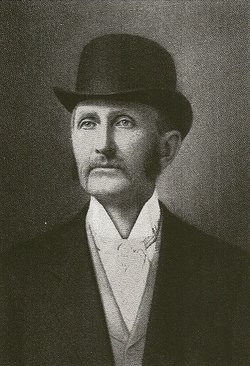
Dr. Martin Van Buren Clark was Clay County's first physician and pharmacist.
Dr. Martin V. Clark died at his home in Sutton on March 22, 1922. He had been a big part of the story of Sutton from the very beginning. He was the county’s first doctor.

Martin Van Buren Clark and his brother Isaac Newton Clark arrived in late 1871, more than a year and a half after the first homesteaders arrived in Northern Clay County. What did they find when they arrived?

Luther French is credited with the founding of Sutton. Mr. French staked out his homestead claim in early 1870, settled into his dugout and proceeded to grow a little wheat on land that is now the north section of our town.

He was alone out here on the prairie until the next spring when a trickle, and then a small flood of people came from the east and stopped here along the banks of School Creek. These 1871 arrivals were the ones who were much more interested in citing a town than Mr. French had been.

The earliest shops, dominated by saloons, lined Main Avenue. Those first settlers were postured in the path of the railroad and in August Burlington tracks cut through on the south end of that business strip.

Within days of the arrival of the railroad, John Maltby persuaded Luther French to survey his 80-acre farm into town lots as Maltby and friend William Way had taken possession of the 160 acres to the south – another good story we’ll pass on this time.

So when Martin V. B. Clark and brother I. N. Clark arrived on November 1, 1871 with their families, the community of School Creek had been renamed Sutton and 240 acres designated for the town.

French’s sale of his town lots were the first real estate transactions recorded in Clay County. It’s beyond the scope of this article but there seems to be an open question about those transactions. Our understanding of the Homestead Act leads us to believe Luther French would not have had clear title to his homestead until he’d completed the five-year process of proving-up the claim. Yet, there he is a year later selling off lots. Perhaps I’m missing something. However…

By the end of 1871, it was clear that town of Sutton would exist. What is not always clear, are the details of how our town came to be.

We have several contemporary accounts of those early days completed while the main cast was still around to authenticate the details. Unfortunately, that may not have always happened.

Most accounts stem from two sources. The nation made a fuss of its Centennial in 1876 including Clay County which commissioned a formal history. The committee consisted of Dr. Martin Clark, Judge John Maltby and Erastus White of Sutton along with Ezra Brown, Ira Pearsall and J. T. Fleming of Harvard. Dr. Clark read the entire text of “A History of Clay County, Neb.” at the celebration of American Independence in Sutton on July 5, 1876. This was a mere five years after most of the founding events occurred. We seldom get an account that contemporary from the main characters.


We're fortunate that within five years of the arrival of early Sutton and county settlers, the nation's centennial prompted the writing of a thorough history of the county. Additionally, the task fell to some educated early settlers.
A second oft-quoted source is the “History of Hamilton and Clay Counties” edited by George Burr and O. O. Buck and published in 1921. It contains more than 600 pages of biographical sketches of early Clay County Movers and Shakers including the Clark Brothers. Those gentlemen died in 1922 and 1927 so they were available to consult with on their own stories. Yet, details, especially specific dates, differ between those two primary sources.

Later stories of early Sutton history, including our own on behalf of the 21st Century Sutton Historical Society draw heavily on those two sources while wrestling with the variations in detail.

Another challenge in telling the story of the Clark brothers is that the normal robust genealogical information available online is really skimpy for these fellows. And, believe it or not, our Martin Clark is not the only Martin V. B. Clark with a wife named Mary from that era – the other was in New Hampshire.

Our Martin was born April 28, 1840 in Parma, Ohio, a south suburb of Cleveland. His parents were David Clark and Ximena (or Zimena) Roberts of Hartford, Connecticut. The couple had four children but only Martin and Isaac appear to have lived to adulthood.

Both Clark brothers were of an age that destined them for military duty in the Civil War. Martin served in the 7th Ohio Infantry, Company C and later rose to the rank of sergeant in the 8th Ohio Artillery Battery. He continued in federal and state military units for five years. Brother Isaac served in the 25th Illinois Infantry – both were active in Sutton’s George Meade Post of the G. A. R.

Mary Derby Henry - Mrs. Martin V. B. Clark
Martin Clark married Mary Derby Henry of Parma on the 4th of July, 1865. They had three daughters when they arrived, a fourth was born in Sutton.

Alice Clark was born in 1886. She is listed as Allie in the Sutton Alumni directory where she and her cousin Myra constitute one half of Sutton’s first high school graduating class. Alice would marry John W. Thompson who was a practicing physician in Sutton for many years. Their son John Clark Thompson was a doctor in Lincoln.

The second daughter was Mamie born in 1867, not to be confused with Sutton’s long-time social leader Mayme (Wieden) Clark, Mrs. Albert Clark and daughter-in-law of Isaac. Martin’s Mamie died in 1879 at the age of 11 and is buried with her parents in the Sutton cemetery.

Daughter number 3 was Edith Lorena Clark born in 1871 in Parma Heights, Ohio and therefore an infant when the family arrived in Sutton. Edith married Oscar Challburg and they had two children, Martin W. and Adelina. Martin Challburg is still well-remembered as a downtown Sutton insurance agent – office on the east side of the north end if I remember right – correct me if I’m wrong. I’m certain Martin Challburg had a lifetime of fine accomplishments but he is best remembered (test this if you’d like) for his two Great Danes – and grrrrreeat Danes they were. It was a memorable spectacle to time your visit to Carlsgaard’s Dairy Drive-in on the south end of town to be there when the Challburg’s treated those dogs to their ice cream cones. One-gulp treats.

The fourth daughter of Martin and Mary Clark was Ruth. One source lists her husband as Elmer G. Briard, a farmer of Madison, Nebraska. There’s other, less compelling evidence connecting her to a Fredrick Klein in Minnesota. There may have been two Ruth F. Clarks born in Nebraska in 1881. It’s on the list for further investigation, maybe.

Martin Clark attended Baldwin University in Ohio after the Civil War and then completed medical school at Western Reserve University in Cleveland – now known as Case Western. He was a professor of pharmacy and practiced medicine before he came to Nebraska.

Although Martin Clark wrote that he arrived in Sutton on November 1, 1871, other accounts claim he and his brother purchased all of Luther French’s unsold lots in October. And that too is part of the fun of this.

That part of French’s original homestead that extends into the west part of town was incorporated by the Clark brothers as “Clark’s Addition.” Almost six years ago, we wrote articles speculating on the origin of the names of Sutton’s streets and avenues. Out west there is a Clark Avenue and two names that match the names of Isaac’s children, Roy and Myra. There was a Glen Lake in the neighborhood, today’s Clark’s Pond. It all fits.

But there is no Alice, Mamie, Edith or Ruth avenues that could have been named after Martin’s kids. There is however a Euclid Avenue at the very west edge of town. Our fun speculation about that name six years ago was that that street was part of Martin’s legacy. Case Western Reserve University is on the east edge of Cleveland where the campus is bisected by a major street heading off to the distant suburb of Euclid. That Cleveland street is Euclid Avenue. Our speculation was that someone special lived on that street, special enough to warrant Martin naming a street in the brothers’ addition to Sutton after the Cleveland street. We can hope that someone special was his bride Mary Derby Henry, but we don’t have to.

The first commercial building on Saunders Avenue was an imposing structure
originally housing a hardware store, pharmacy, doctors office and home for
two families. Later occupants included a hotel, apartment building and other
commercial endeavors.
The first businesses in Sutton sprung up on Main Avenue, north of railroad tracks and the reputation on those first saloons, and perhaps other businesses contributed to the animosity that developed between the Burlington and Sutton. The Clark brothers chose to locate their first business on the west side of Saunders Avenue and south of the creek.

The first Clark House was a two-story building with Isaac’s hardware store and Martin’s pharmacy. Martin also set up his medical practice in the building – the first in the county. He was also an early county coroner. The brothers and their families lived upstairs for a while. The building later served as a hotel and as a boarding house and served the town until 1941.


Dr. Clark’s scientific background included not only his professions as a medical doctor and a pharmacist but he also taught applied chemistry and toxicology at Baldwin University and was known as a legal chemist. Courts in Clay and surrounding counties employed him for toxicology analysis in criminal cases – kind of a C.S.I. Sutton story.

His biographies list several cases: State vs. Anderson in Clay County, an arsenic case; State vs. Lee in Saline County, strychnia; State vs. Rath, Clay County, strychnia; State vs. Stevenson, Nuckolls County, Corrosive sublimate which was the first prosecution under “the pharmacy act” and State vs. Morse in Gage County, another strychnia case.

Whatever else Dr. Clark contributed to the development of Sutton, his lasting legacy is found in a gift he and his brother left to the City of Sutton in those early years. They carved out a four-block square straddling School Creek from the property they had purchased from Luther French donating that land for the Sutton City Park. The extreme southeast corner of the original park, the section on the south of School Creek today is home to a portion of the Sutton Museum – the Wolfe School, our country school museum.


This section of the map of early Sutton shows the original French homestead shaded with the Clark brother's addition extending past the border of this map to the west (left) of Glen Lake, more commonly known as Clark's Pond. The Clark brothers intended from the start, that the four blocks marked as Clark Square would be the Sutton City Park.

This article first appeared in the May, 2016 issue of Sutton Life Magazine.

1925 Clay Co Educational Directory


The County Superintendent of School published an annual directory of all the schools in the county. The small booklet was crammed with information that was informative at the time, but is informative, very interesting and valuable today.

This is the directory for the 1925-1926 school year by Fannie R. Haylett, the Clay County Superintendent of Schools. The booklet gave considerable background information about the county schools and a map of all the schools (this was prior to when the navy carved out a chunk of the west half of the county). The part that is usually most interesting to us is the data about the individual school districts.

We learn the identity of the teaches and school board members, plus the professional qualifications of all teachers.

The columns of the main pages are labeled: "Dist." - the district number; teachers' names; "AD" - teachers' address - abbreviations; "Salary" - monthly; "EXP" - years of teaching experience; "ENR." enrollment in the school; "CEN." School census information - I think that is the number of 5-21 year olds in the district; "SCHOOL BOARD MEMBER"; "AD" - addresses of the board members, abbreviated; and "NAME" the name of the school.

My observation, and I'd appreciate feedback on this, is that in some general sense, the people toward the north half of Clay County tended to refer to their school by District number while those in the south preferred to use the school name. I went to District #16 and did not know it was the "Nuss" school until years later. Cousins down by Highway 74 went to the "Prairie View" school and did not use the number for District 53. Or am I wrong?


Sutton Librarian response to prudes - 1906

Mathilda Mary Maltby, aka Mrs. John Maltby, was the Sutton Librarian after her husband died while they were living in Fairfield in 1895. She was a London girl who married John Maltby in 1862.

This note appeared in The Sutton Register.


DNA Testing - High-Tech Genealogy Research


One of the two genealogy-based TV shows usually wraps up episodes with a segment about DNA testing of their guests. Have you wished the moderator would explain more about the tests? Glad you asked. Let’s look into DNA this month.

We’ve addressed genealogy a couple of times in these articles and family history remains the most common query we get at the Sutton Museum. The story of the families of past Sutton residents often reveals details of the town’s story. And it is often interesting to learn where those Sutton residents came from. Let’s see how you can use DNA to really look at where we came from.

First, the basics. DNA is a molecule of deoxyribonucleic acid. DNA molecules are in the nucleus of every cell in your body and contain four chemicals identified as A, G, C, and T. They pair up into “base pairs” - A with T and C with G as depicted in Figure 1. The outer bands are molecules of phosphate and sugar and that’s what DNA looks like, in all of the trillions of cells in your body. Human DNA has about 3 billion base pairs and more than 99% is the same for all people. The tiny amount of differences account for all the varying characteristics of all people.


Figure 1.The well-known Double-Helix model for the DNA molecule was
first published in Nature Journal in 1953 by Watson and Crick.
Change just a wee bit more of our human DNA and the arrangement of the same components will produce other primates, mammals, insects, trees, grass and a toad. DNA of all living organisms contain just different arrangements of those A, T, C and G things. (there’s always an exception: some viruses, otherwise, yes.)

Now for the X-rated portion – well “R?”. When any reproduction occurs, the Daddy DNA splits randomly into two pieces and one piece joins with a half of a DNA piece from the Mommy, again some random half. If Daddy was an Angus bull and Mommy was a Herford cow, the calf will likely look somewhat different from either of them. If the Daddy was a Poodle and the Mommy was a German Shepherd, well, I don’t want to think about that. Daddy is a tall grass, Mommy is a shorter grass, something in between is “likely”.

Same thing for you and I. You inherited one half of your DNA came from Dad, ½ from Mom, and by “inherited” we really mean that you have ½ of those defining characteristics for each parent imbedded in your genetic make-up. You may get mom’s blond hair, dad’s blue eyes. And your brother may get dad’s tendency to lose hair and mom’s brown eyes. Not all DNA gets used but it gets passed on. Your baby picture may look a lot like grandma’s. It means ¼ of your DNA came from each grandpa and from each grandma. One-eighth from each great-grandparent, etc.

Your DNA has about 3 billion DNA base pairs that came down your family tree to you. You may have some base pairs that came from Charlemagne’s DNA, or Julius Caesar, or Genghis Khan. (Mr. Khan is a special case. He and his sons were prolific. About 1 in every 200 men on the planet are descended from Mr. Khan, lots of women, too.)

What can we learn from DNA tests? We’ll look at three types of tests based on “how far back.”

I’m most familiar with the ancestry.com test. They do two analyses called “matches” and “ethnicity.” Match testing looks for relatives that would appear on a family tree you’d construct by classic means of grandma’s stories, census records, church and government records and the work of other researchers.

Ethnicity testing looks at where your distant ancestors were likely living from 500 to 1000 years ago. Ancestry identifies 26 regions of the world and gives you a rough percentage estimate of how much of your DNA came from folks in each region.


Figure 2. A DNA test will illustrate your relationship with someone else whose DNA test is on file. In this case, granddaughter Emily was a match with a fellow in the blarsonfamily. Both of us had extensive family trees on file and ancestry.com's software located the common ancestors, Emily's 6th great grandparents, two generations earlier than our immigrant Israel Aspegren.
I also use another web site called gedmatch.com. I’ve copied my “raw DNA” data from ancestry.com uploading it on gedmatch where a number of researchers have software that you can compare your DNA with any of many databases created using the DNA of people known to have come from some region. These tests look at a time period a few steps back from ancestry’s ethnicity test. Actually, a long hike back. Groups, and individuals have migrated around the planet for thousands of years. This series of tests looks back 8,000 to about 40,000 years ago.

Let’s back up. We don’t learn much just looking at your DNA string of A, T, C and G pieces in isolation. We have to compare it with something else, some known thing, either someone else’s DNA or a database that “summarizes” a bunch of known people. If your DNA looks more like those people than other groups, you likely have some connection to them. Pretty simple, huh?

Simple, but a lot of work. Comparing 3 billion of anything with a bunch of other 3 billion things takes a while. DNA testing doesn’t even do that. Portions, “snips” of DNA are tested. The main ancestry.com ethnicity test uses 700,000 snips of your DNA to test against 700,000 snips from each of the thousands of others who’ve tested. But still, you better use a computer. And there you have it.

Now, down to business.

What is DNA testing? I’ll defer to the experts. Here are 12 videos of a few minutes each (1 is 15 minutes) Grab some popcorn. I’ll see you on the other side…  https://www.ancestry.com/academy/course/ancestry-dna-101

All right. Did you enjoy the movie?  Okay, let’s take a look at what a few test results look like.

I took the ancestry.com test about two years ago and my granddaughter Emily took the test last December. I’ve probably learned four times as much examining the two tests than with just one.

Ancestry compares the results of your DNA test with the results of all others who’ve taken the test. When they find a DNA match between two tests, they can estimate how close the match is – as distant as eighth cousins. The common ancestors for eighth cousins will be their 7th great-grandparents. Those are likely people who were born about 1650, give or take.

That is what the DNA test tells you – this other tester is related, at about this level of cousinhood.

Remember what the speaker in the movie above emphasized? You need to have your family tree file at ancestry.com to go further.

Figure 2 shows the relationship between our granddaughter Emily and another DNA test identified as “blarsonfamily”. That family member who took the test is Emily’s 4th cousin, 3x removed – that is he is my father’s 4th cousin and my 4th cousin 1x removed. Our common ancestors are Johan Börjesson and Sara Ericksdotter. The ancestry system could only tell us all that because both the blarsonfamily and I had posted our family trees on ancestry.com and both of us have our lines traced to that couple.

Could we have made that connection without DNA? Yes, with a bit of work. But, if you’ve done family research there is a tinge of doubt about some lines. Records may have been ambiguous, you may have copied data from another research that looked “pretty good” and, not to dwell on the topic, but families sometimes have rumors and whispers that cousin Billy looks more like the mailman that Uncle William. Most are likely groundless stories, but…who knows. DNA connections do not have that kind of uncertainty. When we get a DNA match, then the records were good; my research was solid and Aunt Annie deserved better.

A word about this specific family tree. Johan Börjesson was born in 1738 in Ã…sby, Östergötland, Sweden. You’ll see the Aspegren’s in Figure 2. Israel father, Greta’s husband was Peter Jönsson so Israel was named Israel Petersson under the Swedish patronymic system. For some reason, before he immigrated Israel’s son Adolph changed his name to Aspegren. Israel and his other sons Axel August and Carl Gustaf also took up the name before coming to America.We don’t know why.

We do know that the Aspegren/Petersson family was poor in Sweden. The Swedes included a title with names on official records. It was a title recognizing the person’s economic, and probably social status. On Adolph Aspegren’s birth record his father Israel is idenitied as backstugsittare – literally ”hill cottage sitter” or ”back hut dweller” and fattighjon - ”pauper.”

I recently was in contact with a fellow in Sweden discussing one of our common relatives. I mentioned that this woman had worked in Adolph Aspegren’s bank in Saronville. He fired back an email asking what I meant – did Adolph Aspegren own a bank in America? I had to answer that, “No, he had two banks. He was President of the Farmers State Bank of Saronville and the bank in Verona.” The fellow was excited that the Aspegren’s had come so far from their situation in Sweden.

Israel Aspegren would have been described with a different word if he’d been even the poorest farm laborer or rented his dwelling. He was most likely dependent on the village or a friend or relative for support. The family may have had a small garden, maybe a few chickens but little else. They would have been “dirt poor” if they would have had dirt.

The extended Aspegren family includes many in northeast Clay County who can take pride in what our Aspegren ancestors did. This is what the rewards of genealogy look like.

But I digress.

I have 37 DNA contacts on ancestry.com with the common ancestor identified as described above. Emily has 75.

The next category of DNA matches on ancestry.com is “4th cousins or closer.” This includes matches in which one of both of the online family trees do not contain enough information to pinpoint the common ancestor. But there are hints that enable us to contact that match and discuss what we know. I have 115 such 4th cousins, Emily has 89.

The Big Category is the list of all matches up to the 8th cousin level. The DNA analysis system found some common DNA indicating we are related. These lists continue to grow as more tests are posted. I have over 4,000 such matches, Emily’s list is closing in on 5,000.

Ancestry does an analysis of your ethnicity. This will be the first thing you’ll look at when you get your results back, guaranteed.


Figure 3. My ethnicity profile, pretty much as predicted from my known
family tree though I can not identify most of the trace regions.
My ethnicity information is at Figure 3. These are estimates and the “range” is wide. My Scandinavian ethnicity is 52% with a possible range of 30%-70%. I suspect that the wide range reflects the randomness of the way parents’ DNA splits as much as it does the characteristics of the test. Remember the movie and the wide range of ethnicity variations among the four siblings?

Ancestry provides a lot of additional information about the process. Scandinavian ethnicity is the result of a comparison with a composite of 272 people native to Scandinavia. The Europe West database has 416 individuals; the Irish has 154.

My family tree would lead you to expect my ethnicity to be 50% Swede, 25% Scot and 25% from the colonial period, mostly English and Irish. My Irish component would be almost exactly 6% based on my 4th great, grandparents. But this ethnicity test is looking at regions during the period from 500 to 1000 years ago. The European regions in my test are shown in Figure 4.

Emily’s ethnicity is more Great Britain, less Scandinavian and more mainland Europe. Her numbers make it look like I’m probably the only grandparent passing along the genes of the Emerald Isle.

Figure 4. We have some latitude in defining regions.
Ancestry uses these regions in my profile.
I tried another website and its offerings. I downloaded our raw DNA files from ancestry.com and loaded them at gedmatch.com. This site is free. Ancestry.com charges $100 for a test, occasional sales at $90 or $80.

Gedmatch.com goes way back to the early human migrations, about 8,000 to 40,000 years ago.

There are numerous websites and videos about early human migrations. This topic, like DNA analysis is only a few decades old. And DNA research has had a role in understanding early human migration. You can get a taste of this topic at  http://www.bradshawfoundation.com/jouney/


Gedmatch also has a provision to upload your family tree, this time in the universal GED format so you have both means to connect with relatives, DNA and tree files. However, the gedmatch database has far fewer contributions.

Gedmatch has several different comparison programs, some seem to be the pet projects of individual researchers who use specific, narrowly focused databases. I can’t say I understand much of what I know about them.

Emily’s test results from one test is at Figure 5. It is the “Admixture MDLP project, version K13 Ultimate.” There are many different tests and variations.

The first issue is the vocabulary – it’s variable, not standardized. Her big green pie slice is ENF, European Neolithic Farmers. These guys came into Europe about 10,000 years ago and were among the first farmers. That might be where the Brits came from.


Figure 5. Granddaughter Emily's long-ago genetic profile - from 8,000 to 40,000 years ago. The website gedmatch.com offers several different tests against varying control populations giving different estimates for these tests. These tests are not associated with individuals and not even nationalities (there were no Swedes or Germans 8,000 years ago) but we're looking here at ancestors from prehistoric times, often wandering bands of early humans.
ANE stands for the main Northern Eurasians. Scandinavians? WHG-UHG stands for ancient European Mesolithic hunter-gathers and the initials literally mean “Western Hunter Gatherer – Unknown Hunter Gatherer.” Estonians, Lithuanians and Finns have a high percentage of this DNA so our Scandi’ folk may have come from this bunch.

The Caucas-Gedrosia refers to southeast Asia and much of the Africa – Europe early migrations went through there.

Emily has some teeny DNA bits that I don’t have. There is a wee, wee, wee bit of American Indian. That shows up on almost all of these tests I’ve tried for her file on gedmatch. Her “Siberian” bit has only shown up on this test. And she has more than 1% Subsaharian African DNA. That is one of two major African-American groupings. This one includes Mandinka, Yoruba and Esan among others. Where did that come from? Well, three of her grandparents, myself included, had ancestors in Colonial America where slaves were held even in New England and in the south to 1865. The TV show “Finding Your Roots” has examined a number of celebrities with mixed-race ancestry and learned the details of those distant parents.

Another ancestry DNA kit is on the way to Emily’s cousin in California and I’ll soon start juggling three sets of matches and tests. This granddaughter’s father is African-American with family lines we can trace to the Alabama-Georgia border before the Civil War. More fun ahead. And one of our daughters has tested with yet another DNA system associated with National Geographic. I’ve only peeked at those results.

DNA testing contributes to our understanding of our history on so many levels. Each and every of the trillions of cells in your body contains information about your parents, grandparents and distant ancestors way back to the beginning of mankind…and even beyond, but that’s another story.

If you have questions about DNA testing or would like more information about how to try this yourself, feel free to contact me at jjhnsn@windstream.net.

This article first appeared in the April, 2016 issue of Sutton Life Magazine. Contact Jarod Griess at mustangmediasales@gmail.com for more information about his publication.

A Sutton History Quiz and a Follow-up to an Earlier Post


It has been almost seven years since we started this series of articles about the history of Sutton; that’s almost eighty articles, about Sutton history. Would it have been reasonable in the summer of 2009 to think we’d think of that many things to say about Sutton’s past?

So how do we come up with so many topics? It generally is a struggle but our community has come through with ideas and material that has made it all possible.

This month we have two topics, a new one and a follow-up. The new one illustrates a topic falling into our lap.

Diane and John Overturf occasionally share some “finds” from among their family treasures. One recent find was a brochure from the Sutton Commercial Club. It’s a bit faded but it looks professionally done and makes a good pitch for our town at some point in the past.

This brochure by the Sutton Commercial Club is undated. When was it printed and distributed?


When was that point? That’s the crux of our story this month.

 The brochure is a tri-fold with the phrase “Sutton, in the middle of Nebraska” as a title. There is also a copy of the shield from Highway 6 road signs. The inside of the brochure has a map of Route 6 for the original full length from Long Beach to Cape Cod indicating Sutton as also in the middle of the country at the mid-point of that road.

The designers chose five photos to illustrate the Sutton of their time: the high school, the auditorium, the Carnegie library and two churches. The school, auditorium and library are all long gone. One of the churches was the one on the corner of Hickory and Way, today’s Allegro Wolf Arts Center. Only St. Mary’s Catholic church survives in the same role as when the brochure was printed.
This was the "inside" of the undated brochure featuring a shout-out to U. S. Route 6 and photos showing off four Sutton buildings, three of which no longer exist. The representative church now houses the Allegro Wolf Performing Arts Center.

So, when was the brochure printed? We don’t know. It is not dated.


This kind of thing happens a lot. We receive a donation of a real cool piece of Sutton memorabilia, but some important detail is missing. Photos with mystery people is real common.

It would be nice to know when the Sutton Commercial Club began using this advertisement for our town. And they did leave a clue.

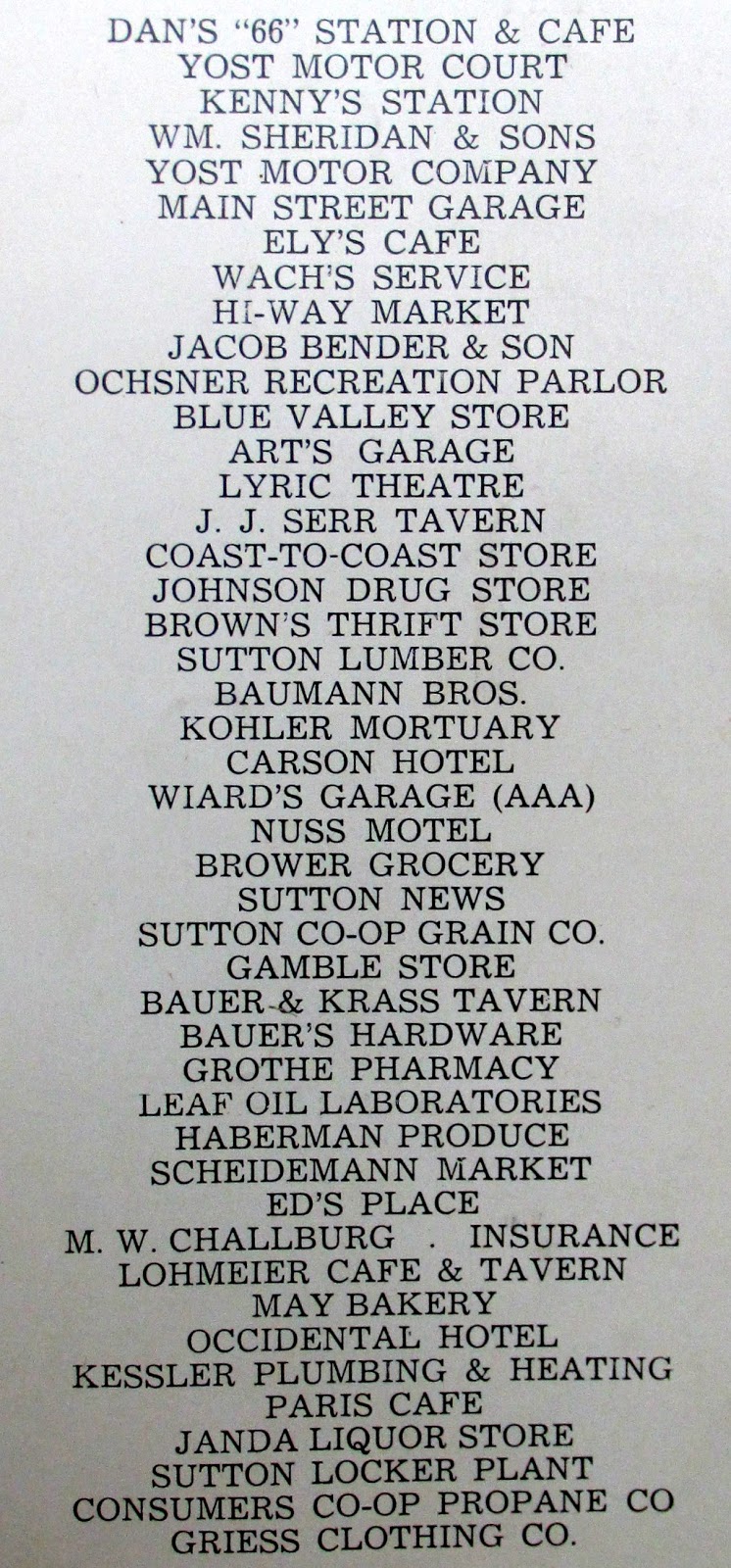
On the back of the document is a list of businesses that helped fund the publication. The brochure was printed at the time all of these firms were in business. Right? When was that?

 
Let’s crowdsource some Sutton history. Can you figure out when it was that all these businesses were operating at the same time? We’ve provided the list.

The well-known ones aren’t much help. Jacob Bender & Son operated for about 125 years – that doesn’t pin down much other than it was before the business closed. Same thing for Sutton Lumber Co., Co-op Grain and Co-op Propane, Lyric theater, Dan’s “66” and Yost Motor Company. They all were around for decades. The Yost Motor Court likely gives us some help if anyone remembers what duration that sign was up.
The crux of our story: when did all of these businesses
operate simultaneously? Answer that and you've dated
the mystery brochure.

There may well be one or two of these businesses that would definitely date the brochure, if anyone can establish when they were open. When were the Janda Liquor store and Brower Grocery in business? I don’t remember those, or ever seeing mention of either. And where were they? Inquiring minds want to know.

So, envision a graph with the time lines for the period of operation of these businesses and somewhere there is a period, likely a very short period when every one of them is there.

See how this works? It is little puzzles like this that add so much to the study and enjoyment of history. Or maybe it indicates some kind of personality disorder. Your call. 

We’ll post this article including the list of businesses on the Sutton Museum blog expanding the players in this game. A reminder, that url is suttonhistoricalsociety.blogspot.com.


The second part of our article this month is the “follow-up” we promised at the beginning.


Last summer our series of articles on Sutton history went off the rails for one month, intentionally, with an article completely unrelated to Sutton history. I didn’t have a topic in mind, at least one that I could research and write in time for when the good people at Sutton Life Magazine needed it.

There was a story I’d told several times since moving back to Nebraska in 2005 whenever someone commented about those new-fangled computers that the young people were using. My reply was aimed at both assertions. First, computers have been around longer than you think. And secondly, computers aren’t only for young folk.

The article described Charles Babbage’s 1822 design of his Difference Engine and I found a picture of the model in the British Museum. Computer concepts in the form of cards much like the classic IBM card were used to operate looms way back. Computers were commonly in use in the military and in business from World War II and certainly in the years shortly after the war.

My own introduction to information technology was my assignment to Strategic Air Command (SAC) headquarters near Omaha where I was “pushing code” as a COBOL programmer in 1974. Our systems (a word we used a lot which is a more sophisticated version of “thing”) helped plan and analyze bomber routes from U.S. bases, to targets in the old Soviet Union and we even told the navigators how to get back home.

(Air Force joke diversion: Do you know the importance of the navigator on an air crew? The navigator was the crew member least uncertain of where they were.)

I included another story in the article, the story of Grace Hopper. She joined the Navy at the age of 37 (and 16 pounds overweight) in the midst of World War II and was assigned to work on the first large-scale Navy computer located at Harvard University. She is generally credited with inventing the COBOL programming language and of a long list of accomplishments that led to the development of computer technology, especially software development processes,

One of several books on our lady of interest.
As a way-back COBOL programmer, and having heard Grace Hopper speak about five times, I can’t talk about this topic without bringing up her story. Her Navy career is legendary having been promoted to Admiral – the promotion ceremony was conducted by President Reagan in the Oval Office – and with Admiral Rickover, she was held on active duty way, way past normal retirement age – a thing requiring congressional approval. She retired at 80.
 
So computers were not the real new thing as people here in Sutton often described them.

And I pointed out that where I’d lived in California, there were old fogeys, older than me who were running blogs and websites from their rooms in the retirement home.

So my point was that the resistance to using computers was not a matter of how new they were, nor was it a matter of people’s age. It was more a geography thing.

So that was our one article out of about 80 that had nothing to do with Sutton history.


Or so we thought.

A few weeks ago I received an email from a woman named Stephanie Wilson who was researching her family history. Her records showed that her grandfather, Charles Phillips, was born in Sutton, she’d never been anywhere near here and was looking into our town.

I followed up on her email and found that there was a Dr. Charles Phillips who was a Dentist in Hastings in the 1910 and 1920 census and that he had a son, also Charles Phillips who was born in 1905. The younger Charles was Stephanie’s grandfather. He is buried in Arlington National Cemetery and cemetery records show he was born in 1905 in Sutton, Nebraska.

She had found my Sutton Life Magazine article on our blog and saw the reference to Grace Hopper. She included a link to a portion of the book, “Grace Hopper and the Invention of the Information Age” by Kurt W. Beyer at the Google Books site. In that excerpt is the story of Grace Hopper and the fellow who she worked for at Harvard University, Charles Phillips, her grandfather.

I was looking for more evidence that Charles Phillips really had this Sutton connection. And the more I thought about it, the more I thought that there was something familiar in the story.

I did a search, on our own blog, and found a post of a Sutton Life Magazine article from 2010 in which I had tried to trace the origins of Sutton street names. There were a few avenues in the east part of town I couldn’t figure out. One of those was Phillips Avenue. And there I’d explained, “Dr. Charles Phillips was a dentist in Sutton but only from 1905 until 1908. He is unlikely to be the source of this name…”

It was a surprise to find a Sutton connection with our story about information
technology - a connection those of us Sutton folk who've been steeped in
"computer stuff" can point to with pride.
It was a throw-away line. The timing wasn’t right for the dentist to have named the street but there it was. So six years ago, I’d placed the dentist Dr. Phillips in Sutton at the time his son was born. And no, I do not remember where I found that information. Perhaps there was a newspaper ad for the dentist or some mention in newspapers from that period that I was using for our newspaper column.

So, the one Sutton Life Magazine article that had no connection whatsoever with Sutton history, turns out to have had a connection, and a pretty good one at that. One of our Sutton natives, even if he was only a resident as a toddler, played a key role in the creation of the Information Age.

Who’d a thunk?

And that’s what makes the study of history, especially local history such a fascinating thing. The more we dig around building a collection of tidbits, facts, rumors and stories and preserve them in some central repository, the more likely it is that some vaguely related tidbit or story will pop up that is connected to that collection.

But there has to be some kind of … let’s call it infrastructure, where that collection can live. You have to have a museum or something a lot like one to put that information and artifacts, where it can all sit and wait for more stories and stuff to add to the story.

Your Sutton Museum serves that purpose. As do our growing collection of newspaper columns, magazine articles, the blog, Facebook postings and maybe even those occasional tweets.

The members of the Sutton Historical Society are proud of our efforts and of what we have added to the story of Sutton’s history. Every community has a robust history. Not all of those histories have been sufficiently preserved. Henderson, Aurora, York and many other surrounding communities have museums and on-going efforts to find and record that story of the past. But the history of too many of our nearby communities is fading fast, past the point where it can be retrieved, even if someone tried today.
 
If you agree that what we are doing is useful, why not join in to keep these efforts going. Contact Jerry Johnson at jjhnsn@windstream.net or anyone else associated with the museum to learn more. Or just say “Hi” at our Pancake Breakfast at the Sutton Legion every first Saturday of the month.

Grace Hopper joined Admiral Hyman Rickover as Naval officers who were retained on active duty well past the normal limit on time-of-service. Here Captain Hopper is takes the oath of office when she was promoted to the rank of admiral in something of a special ceremony and venue.


This article first appeared in the March, 2016 issue of Sutton Life Magazine. Contact Jarod Griess at mustangmediasales@gmail.com for more information.


Early Newspaper Ads and Items

As we research and write about Sutton's past for our weekly column in The Clay County News, we find articles and ads that seem to be worth sharing...

 This ad appeared in the Sutton News on the date shown.


 This clip comes from the Sutton News, also on February 16, 1906.


M. L. Leubben was with the north bank, then called First National Bank of Sutton (it became a state bank in 1913 along with most small town national banks. Melchoir Leubben's son Ummo was the inventor of the round baler, here identified as the Leubben Cylindrical Baler Co. This items dates the manufacturing in Lincoln as early as 1906 - other sources imply the company operated in Sutton and Beatrice before Lincoln. The patent for the baler was applied for on October 18, 1910.

N. A. Tyler is one of two Confederate soldiers buried in the Sutton Cemetery, the other being Leonard Jarrett. Nathan Tyler's gravestone does not identify his year of death but we've narrowed it down to the late 1920's. And we've advanced a theory about why that year was not engraved on his stone. The census lists his occupation as "monumental work." He was the guy who engraved names and dates on tombstones in Sutton.


And here one of our early "Great Ladies" of Sutton, Mathilda Mary Maltby, a widow in 1906 and the town's librarian staked out her position on censorship


Saturday, April 30, 2016

BECOMING NEBRASKA


The Great Seal for Nebraska’s Sesquicentennial Celebration is popping up more and more with one year to go until March 1, 2017.


The Nebraska Sesquicentennial, its 150th birthday is just a year away and committees across the state are planning the celebration. How should we mark the 149th anniversary of Nebraska statehood this year?

Well, this month we’re going to look at what came before Nebraska statehood on March 1, 1867.

What is it like in the country when a new state joins the union? Do you remember the excitement when a new state is added to the country, when a new star is added to the flag? Maybe not. If you’re not into your mid-60’s that has not happened within your memory.

Hawaii is our newest state joining the republic on August 21, 1959 as our 50th state just seven months after Alaska made the old 48-star flag obsolete in January of that year. That 48-star flag served the country for 47 years and was the longevity record-holder until ten years ago when our 50-star flag passed that milestone and is now, by far, our longest-serving design for the star-studded blue field in the upper-left hand corner of the flag.

We remember that the United States began with just 13 states formed from 13 British colonies. But how did we get to 50 states and what was the 14th state?

First, when did the U.S. come into being? The Constitutional Convention stated that the constitution would become effective, and by extension, the nation would be formed when nine colonies had ratified the document. However, the original intent of the convention was to amend the Articles of Convention. Those attending that meeting had quickly scraped the Articles and started anew. But the Articles required unanimous approval by all 13 colonies to enact changes.

Whoops!

So our country began with a compromise, actually several. When New York became the 11th colony to ratify, the Continental Congress Confederation decreed the new constitution was in force in a resolution on September 13, 1788. The new nation was officially formed as far as they were concerned.

Creating our new nation was not a slam dunk. There was considerable opposition about details, some of them big ones. North Carolina took another year until November, 1789 to decide to join and Rhode Islanders finally approved of the United States after yet another year on November 29, 1790, almost four years after Delaware earned their title of The First State (still a big deal in that little state.)

So it took four years for the 13 colonies to become the 13 states. How long was it until there were 14? Not very long. Vermont was first in line.

Article IV, Section 3 of the Constitution defined how new states were to be added, “New States may be admitted by the Congress into this Union; but no new State shall be formed or erected within the jurisdiction of any other State; nor any State be formed by the junction of two or more States or parts of States, without the consent of the Legislatures of the States concerned as well as of the Congress.”

A couple of things. First, capitalization and punctuation was a bit of a novelty in the document. Next, did you notice that the Nebraska panhandle can’t join Wyoming unless we let it. And, this defines how a state becomes a part of the Union but makes no mention or how a state may leave. When that question came up about 70 years later we didn’t find any compromise, unless you count a suggestion that I’ll paraphrase as, “Let’s just go out and have us a civil war about it.”

So Congress exercised its authority on March 4, 1791 to admit Vermont as the 14th state, barely three months after Rhode Island got around to being #13.

Vermont was the first of 21 new states added to the union before January of 1861 when Kansas became a state just weeks before the beginning of the Civil War. That was averaging a new state about every three and a third years.

Then we even made two new states in the midst of the Civil War. West Virginia is a good story. After Virginia seceded from the Union to join the Confederacy, the west part of Virginia seceded from the Confederacy to rejoin the Union. Nevada was less contentious when it became a state.

After the Civil War there were 36 states. Let’s not bookkeep the sequence and dates that states in the defeated Confederacy wandered back home.

Nebraska became the first of 12 new states in the next 45 years until New Mexico and Arizona joined in 1912 for another average rate of more than one every four years. And there we sat with the 48-star flag until 1959.

So today’s Americans have been denied the excitement of seeing a new state join the Union. Our only opportunities to witness any part of the process would be to follow the low-volume discussions about the District of Columbia or Puerto Rico or the various separatist/secession noise. But there was a time when new states were almost routine news.

Or was it?

How “routine” was the process that led to bringing Nebraska Territory into the U.S. and later statehood?
Lands in the West were administered as territories. In 1854, Nebraska Territory stretched from Rulo to Glacier National Park. Yes, the territorial capitol was in Omaha.


Not very. Nebraska Territory and Kansas Territory were created in 1854 with the Kansas-Nebraska Act. That act overturned the provisions of the Missouri Compromise of 1820 the first of two “Missouri Compromise” acts, the second in 1850. The issues in those pieces of legislation were not so much organizing new territories as it was slavery. And it wasn’t the question of whether or not there would be slavery in the United States. Few were advocating abolition at this point. The question in those acts was where slavery would exist.

There were 22 states in 1818, 11 were free states and 11 were slave states. The senate was balanced in that regard. But the north was more heavily populated so the House of Representatives “leaned free” and when discussion began about admitting Missouri as a state a New York representative proposed banning slavery in that new state.

There were about 2,000 slaves in the territory that would become Missouri and southern states were opposed to any such ban. Henry Clay of Kentucky and our county’s namesake came up with his Missouri Compromise of 1820 to admit Missouri as a slave state and to spin off a big piece of Massachusetts as the free state of Maine. Another provision divided the remaining territory of the west in Louisiana Territory as free north of 36 degrees and 30 minutes of latitude and permitting slavery to the south.

Historians agree that Clay’s 1820 compromise defused the slavery issue and postponed the civil war for 30 years.


Alvin Saunders (1817-1899) was the 10th Governor of the Territory of Nebraska serving from May 15, 1861 until statehood on March 1, 1967. He served as a U.S. Senator from Nebraska from 1877 to 1883. Yes, the namesake for Saunders Avenue.
Fast-forward to 1848 when the U.S. acquired lands in the southwest after the Mexican War. California was applying for statehood and slavery was still the question. Henry Clay again proposed a compromise along with Senator Stephen Douglas of Illinois.


This Missouri Compromise of 1850 admitted California as a free state and authorized Utah and New Mexico territories to determine their own slave status. There were several other provisions but they would unravel in short order.

Then Stephen Douglas was the architect of the Kansas-Nebraska Act of 1854 which created the territories with those names. The immediate purposes of the act were to open up the plains for farming (that worked out well) and to create order and stability to build a transcontinental railroad.

Railroad planners debated a northern and a southern route and the consequences of that decision were huge. As congress discussed railroad merits of the routes, the issue of slavery in the new territories again crept into those discussions and then dominated.

The Nebraska rail route was popular but much of its support came from southerners who were adamant about slavery. Missouri Senator David Atkinson famously said that “…he would rather see Nebraska ‘sink in hell’ before he would allow it to be overrun by free soilers.”

Nebraska Territory was large. It looks familiar down here in its southeast corner but the territory extended essentially from the Missouri River to the Continental Divide and north to the Canadian border. Much of the Dakotas, Wyoming, Montana and some of Colorado would be later carved out of it.


Omaha was the Nebraska Territorial capitol. Two building served as capitols. (Personal note) The stones blocks from this building were used (so we were told) to build a large house (legitimately called a mansion) at 3530 “J” Street in Lincoln. Four of us Sutton college boys of the 1960’s were among eight who rented the second floor of the house from a Lincoln cop, later Chief of Police.

The first Nebraska Bill authorizing the territory was complicated as Douglas continued to walk the line between the sides of the slave issue. We could go on for many pages. The terms of the Compromise of 1920 prohibiting slavery north of the demarcation line were repealed. Residents of the territories would determine their own slave status. “Anti-Nebraska” public rallies sprung up across the northeast as opposition to the act grew.

The debate in Congress was bitter. There were filibusters and threats of violence by elected officials and all manner of shenanigans. Eventually the bill squeaked by.

The impact was disastrous on so many levels. Pro-slavery settlers poured into Kansas from Missouri to tilt local elections. Abolitionist settlers called “Jayhawkers” (did you see that coming?) came from the East and open warfare broke out leading to the name “Bleeding Kansas.” Eventually the free soilers won the population race to make Kansas a free territory.

Nebraska and Kansas Territories replaced much of the Indian Territory and quickly the Kickapoo, Delaware, Omaha, Shawnee, Otoe, Missouri, Miami, Kaskaskia and Peoria tribes were displaced.

The Democratic and Whig parties were split along geographic lines by disputes that led to the Kansas-Nebraska Act and were soon ineffective as political parties, the Whigs disappearing entirely. Stephen Douglas and former Illinois Congressman Abraham Lincoln conducted seven joint speaking appearances in October of 1854 discussing their differences with the act and slavery in general. That series of speeches was the precursor to Lincoln-Douglas debates when Lincoln ran for Douglas’ senate seat four years later.


The pressing need to connect the two coasts of the mid-19th Century United States was a driving force behind organizing the prairies and creating Nebraska Territory.
Kansas was admitted as a state in January, 1861, pretty much the last straw. Confederate artillery fired on Fort Sumter in Charleston, South Carolina on April 12th and the Civil War was on tearing the country up from 1861 until April, 1865.

Then two years after the Civil War decided the slavery issue, Nebraska was admitted as the 37th state in the Union on March 1, 1867.

It was routine congressional act.

We’ve digressed from our usual custom of talking about Sutton and Clay County history this month. We hope this article reminds you of things barely heard in school or introduces you to another important story in our past.

So during the next year up to the 150th anniversary of Nebraska statehood, be reminded that the expansion of the United States into our part of the country was a complicated and messy process with repercussions that literally tore the nation apart.

Nebraska was big part of the national conversation even before there was Cornhusker football.


Nebraska became the 37th state in the union after a tortuous period of legal, political, cultural and social turmoil culminating in the Civil War. Nebraska had a painful birth.


This article first appeared in the February, 2016 issue of Sutton Life Magazine. Contact Jarod Griess at www.mustangmediasales@gmail.com for more information about the publication.