Powered By Blogger

Monday, April 4, 2016

Clay County, Nebraska - The Early Years, The Very Early Years


Clay County was named for Henry Clay, a Kentucky politician.
This portrait of a young Clay is a surprise - most of his portraits
were of an old fellow.

One of the first civilizing forces on the frontier was the arrival of government to bring order from chaos. The state’s assignment of counties marched west with the first settlers. The arrival of that first government held a promise of a future for those settlers.

The formation of Clay County and the settlement of this 576 square miles both had sputtering starts. The first appearance of a Clay County in Nebraska was as part of Pierce County in 1855, then territory south of Weeping Water stretching from the Missouri River and to the west for 100 miles. The specific portion that was called Clay County was between Lancaster and Gage counties on the eastern edge of the grid of square counties that reaches out here to Adams and Webster.

Someone pushed through the idea to dissolve that Clay County and attach the north twelve square miles to the south end of Lancaster County and put the south half into Gage County. That action was formalized on February 15, 1864 by territorial legislation. Three years later in 1867 the current Clay County was established where we now live.

Officials were persistent in seeing that Henry Clay was recognized by some county in the state. Henry Clay (1777-1852) was a Kentucky politician known as one of the great orators of the senate. He was a member of the Democratic-Republican party running for that party’s nomination for president in 1824. He founded the Whig party and ran again for president. Abraham Lincoln was the leader of the Whig party in Illinois and a great admirer of Clay.

Clay was associated with the West as he sought to diffuse the conflict concerning the admission of slave and free states in the west. He worked out the Compromise of 1850 and was credited with postponing the Civil War for ten years. Many believed that had there been someone like Clay around in 1860 there may not have been a Civil War at all, maybe.

Ole Buck and George Buck edited a 1921 History
of Hamilton and Clay Counties.


We have several sources for information about early Clay County. George Burr and O. O. Buck published a two-volume History of Hamilton and Clay Counties in 1921 with detailed information which has been recycled in later accounts since. County Agent George Woosley compiled “The Story of Clay County” in 1969. And there are additional sources that mainly cover specific topics.

The settlement of Clay County was as rocky as the story of the legal designation of the county, really, more so.

The first people in Clay County were Indians – mainly Pawnee, some Sioux and others from surrounding areas. Spanish explorers came near, French trappers visited the Missouri River and likely the Platte and could have wandered off that track. Lewis and Clark passed by on the Missouri River heading north in 1804 and back again two years later. Mountain men headed through the plains to find beaver and other pelts during the first half of the 1800’s.

The Mormon migration began in 1847 leading a steady stream of followers along the north side of the Platte for the next few years. Gold was discovered in California in 1848 and by the next year, the “Forty-Niners” came through in a bit of a hurry, generally on the south side of the Platte. But Nebraska was just a long path for those folks.

Editor S. A. Fischer of The Sutton News printed a three-part article called “Early Days in Nebraska” in August, 1915 issues of his paper. He referenced an earlier article in the Fairfield Auxiliary which identified the Salt Lake Express as the first mail service through this area in 1858. That company established stations every fifty miles and passed through the southwest corner of the county on the “St. Joe Trail.” The Express used a stage called a “mud wagon” with six mules, a driver and a “whip-up” – a fellow who rode a horse along-side to push the mules’ pace.

The Salt Lake Express was in operation as the Pikes Peak Gold Rush hit its peak but it proved too slow for mail and passenger demands and was replaced by the Ben Halliday Overland Stage Line. This line was a bigger deal with a sound infrastructure and lots more capital. The line had stagecoaches, horses, drivers, many more stations with station keepers and a supply chain for food for men and livestock. Again, passing through southwest Clay County.

We need to interrupt this survey of freight and passenger services for the iconic enterprise of the time, the Pony Express. Officially called the Leavenworth and Pike’s Peak Express Company in 1859 it became the Central Overland California and Pikes Peak Express Company in 1860. The system operated for just 19 months, from April 1860 to October 1861. You can remember the date knowing that news of Abraham Lincoln’s election reached California via the Pony Express.
The overland express companies and the pony express followed the route of the St. Joe Trail, later called the Oregon Trail.
Liberty Farm Station was in Southwest Clay County. The Fairfield station on this map was far west of the town of Fairfield.


The Overland Stage Line and the Pony Express used the same route passing near Deweese and Spring Ranch. Stations were twenty-five miles apart including Liberty Farms just west of Deweese, Kiowa Ranch to the east in Thayer County and 32 Mile Creek station about five miles southwest of Hastings.

The time to get a message from the Atlantic to the Pacific dropped to 10 days during this period. Almost 35,000 letters were sent from St. Joe to Sacramento. Postage was five dollars for a half ounce letter dropping to a buck at the end. (Onion-skin paper was an answer to that weight/cost problem.) Very few artifacts remain from the Pony Express including only 250 examples of mail.

Two main factors account for the close of the pony express: the beginning of the Civil War and the telegraph.

All these names run together as the founders of the Pony Express, Wm. Russell, Alexander Majors and William Waddell had their own freight line and in 1866 bought out Ben Halliday’s (or Holladay) company forming a company called Wells Fargo which later did some banking. Yes, Deweese, Spring Ranch and Clay County connected with that story.

The route we’re are talking about here was referred to in that 1915 Sutton newspaper as the St. Joe Trail though it acknowledges that when it came time to erect monuments, the name “Oregon Trail” became common.

So by the early 1860’s there were settlements in the southwest corner of Clay County supporting transcontinental traffic.

A few of the several books that relate the story of the early
days of Clay County.
A valuable source of Clay County’s next chapter is in the account of James Bainter that appeared in The Fairfield News in 1889.

James Bainter acquired his ranch in January, 1864 from the Roper brothers whose uncle had built it in 1860 near Liberty Farm along the St. Joe Trail. He brought his family and settled in. This was after the close of the pony express but still a time of heavy traffic; Bainter claimed there was an average of 300 teams passing through each day. That’s what he said – 300 teams a day.

James Bainter wrote that during the spring of 1864 larger numbers of the Sioux hunting parties visited trading their pelts for goods and also paying cash for supplies. About the first of August he noticed the Sioux were becoming “sulky and ill-natured.” He sent word up and down the trail about his concerns, and fears.

On August 7th the Plains Indians began the only widespread, multi-tribe coordinated attack on white settlements that happened in the history of the west. Mainly Sioux and Northern Cheyenne but also involving Cheyenne and Arapaho bands attacked from Julesburg, Colorado to the Big Sandy here in Clay and Nuckolls counties and further east down the Little Blue River. It was a two hundred and fifty mile long battlefront, a significant military operation for anyone’s army.

Sometimes called the Cheyenne War of 1864 – a big part of the Indians’ last stand against white settlements – there were five major incidents which warranted names: The Little Blue River Raid, Eubank Homestead, Plum Creek Massacre, Little Blue/Oak Grove Station and the Kiowa Ranch Station. These all occurred between August 7 and the 10th.
Laura Roper (age 16) and three young children were turned over to the army by Indians at a council near the Smoky Hill River. Miss Roper and Belle Eubanks on the right had been captured at the Little Blue River near Oak.

About 100 were killed including settlers, those on wagon trains, station operators, etc. All communications through the Republican and Blue River valleys was cut. The Colorado Territorial Legislature authorized a militia of 700 men on a 100-day enlistment to track down the attackers resulting in the Sand Creek Massacre in late November when a village of friendly Cheyenne and Arapahos was nearly wiped out with about 170 deaths (you’ll find estimates to 400) about two-thirds women and children.

The details of the Cheyenne War are left for another time. The town of Oak holds an afternoon of re-enactments every few years of events at four sites in that neighborhood.

James Bainter and his family survived the attacks in a story worthy of twice the text in this article. The Bainters and other Clay County settlers abandoned the enterprise returning back east and Clay County was again unsettled. The wagon train period had waned, the army was busy finishing off the Confederacy and rational behavior dictated other plans.

By 1870 things had calmed down. The war was over, the army could concentrate on security of the west, soldiers had returned home to find farm land taken and the plains settlement project resumed.

James Bainter returned to Spring Ranch and found his claim jumped by Tom Smith of Marysville, Kansas. He regained the claim shortly. Other settlers had moved in and more followed.

Meanwhile in the northeast corner of the county Luther French and five Swedes had staked out their homesteads that same year in territory where the towns of Sutton and Saronville would soon develop.

Clay County had been formally established in 1867 and now Acting Governor William Hartford James ordered that settlers organize themselves. (James was in office following the impeachment of the state’s first governor David Butler, but that too is another story.)

Clay County citizens met October 14, 1871 at the home of Alexander Campbell northwest of Harvard. A full complement of county officers was elected and Sutton chosen as the county seat.

The first county commissioners were A. K. Marsh, P. O. Norman and A. A. Corey. Marsh was elected chairman of the board at their first meeting on November 4th. The fellows organized three precincts for the county. School Creek was the east half of the county, Harvard was the northwest quarter and the southwest quarter became Little Blue Precinct.
The Oak Town Book told the story of the
part of the Indian War of 1864 that happened
near the town.


So after a bumpy start to organize our county in this location and to populate the territory, Clay County was off and running.

There are options when recounting history and certainly so in Clay County’s history. We have multiple accounts to draw on – that’s good. The multiple accounts don’t always agree on what happened – that’s not so good.

We’ve been judicious in avoiding many of the contested details, sticking to the general story and including details that seem to be agreed on. Every time someone tells a story like this, as we’ve done here, there’s a danger that untruths that have slipped in will soon be retold as an authoritative account. So if you’ve heard a version which varies from this one, okay. It’s another opportunity for some clever and ambitious person to locate primary sources that may be more likely to be factual. Have at it. Let us know what you find. Maybe we’ll meet someday in the library or the court house or in somebody’s attic treasure.

Friday, March 4, 2016

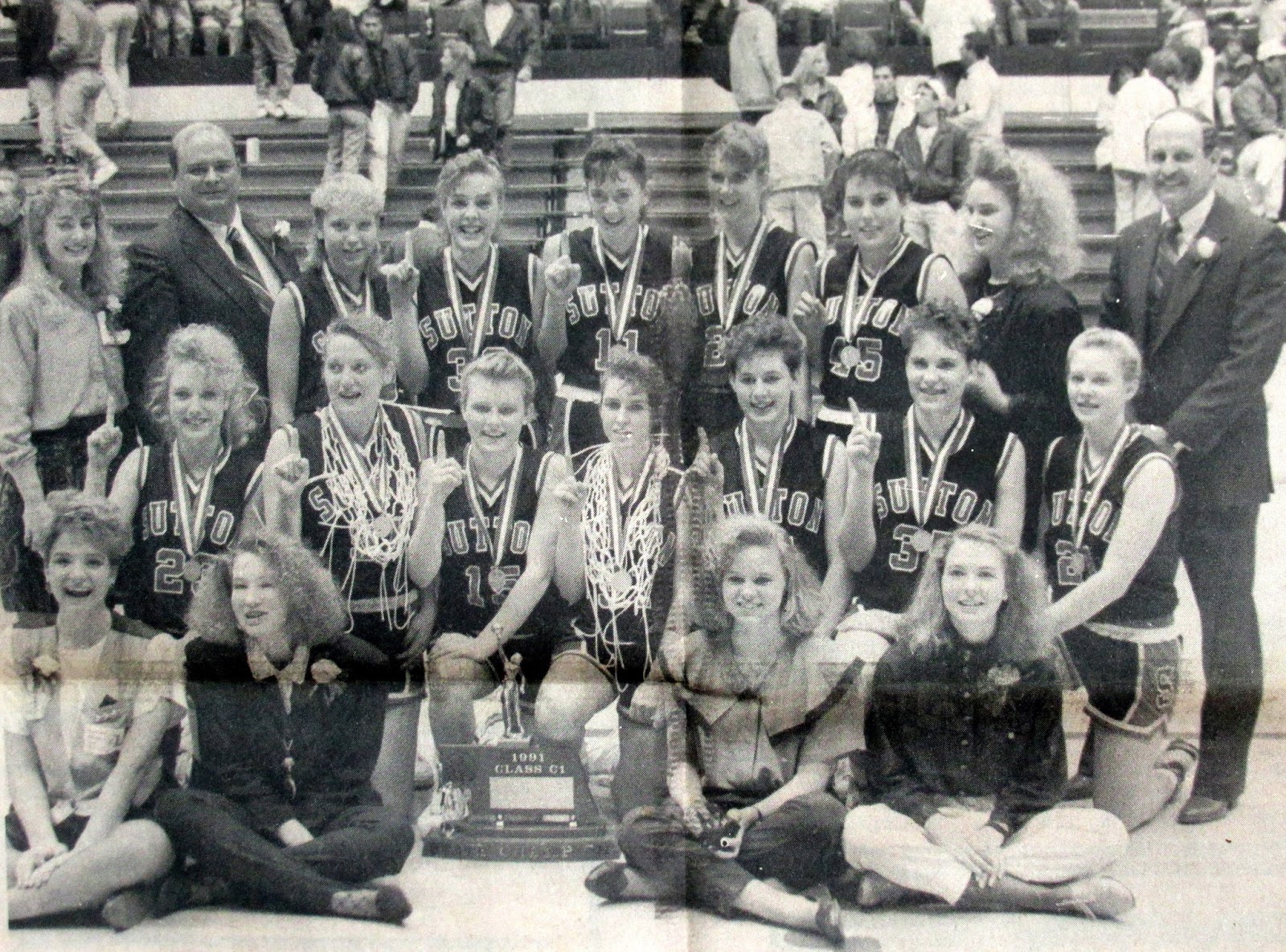
Two Clay Co. State Championship Teams - 1991


Clay County 1991 State Champs


Twenty-five years ago in 1991 Clay County girls' basketball teams dominated Class C. The Sutton Fillies were undefeated for the season and won the Class C-1 championship with a 40-38 win over Crofton. It was the first state championship for the Sutton program coming after two previous trips to the final game where the Fillies had lost both times to Battle Creek.


The 1991 Class C-1 State Champs - Sutton Fillies

The 1991 Class C-1 State Champion Sutton Fillies basketball team: Front row, left to right: Heather Johansen (stats), Sarah Maser (stats), Jeni Hust (stats), and Lynn Wuger (photographer); Middle row: Meredith Figi, Janelle Drudick, Laurel Stoehr, Mindy Smith, Kristie Cronin, Darla Scheierman and Kim Bergen; Third row: April Bottorf (stats), Tom Newman - Assistant Coach, Denise Saathoff, Candice Bottorf, Tara Johansen, Jennifer Trautman, Amanda Liska, Crystal Nunnenkamp (stats) and Head Coach John Schoneberg.

The Sandy Creek Lady Cougars defeated Overton 56-44 to win the Class C-2 championship. Their semi-final win over Lincoln Christian included a comeback from a 14-point deficit. Sandy Creek had only two losses in the regular season, one of them to Class C-1 champs Sutton. It was Sandy Creek's first trip to the state tournament.


The 1991 Class C-2 State Champs

The Sandy Creek Lady Cougars


The Sandy Creek 1991 Class C-2 State Championship team. Front row, left to right: Chris Engel, Jenni Frager, Laurie Herbek, Kima Johnson, Lisa Shunkwiler, Tonya Wilson, DeAnne Wenske. Back row: Head Coach Russ Ninemire, Sara Cosler, Jennifer Lipovsky, Jennifer Schliep, Julie Herbek, Janet Lipovsky and Loralyn O'Kief, Assistant Coach.


Tuesday, February 9, 2016

Sutton Post #19 of The Grand Army of the Republic


General George C. Meade Post No. 19


The early settlement of Sutton happened just six years after the end of the Civil War. As soldiers went back home in 1865 they often found stiff competition for farm land or businesses. The lure of the open west was attractive and west they came, many to south central Nebraska.

One of our first settlers in 1871 was the family of Hosea Gray, Captain of Company A of the Iowa 6th Infantry. The Clark brothers were in Sutton shortly, Dr. Martin Clark of the Ohio 7th Infantry and Isaac Clark, quartermaster of the Ohio 25th.

A high percentage of early Sutton settlers were these Civil War vets. The Sutton Museum is fortunate to have a large display poster from Sutton’s chapter of the Grand Army of the Republic (G.A.R.), the General George C. Meade Post No. 19. Forty members of the post are pictured and best of all, a key identifies each.
This display of the Sutton GAR chapter pictures 40 of its members and ribbons from several events.

The G.A.R. was founded right after the end of the Civil War in 1866. The founders envisioned the organization to be an arm of the young Republican Party. G.A.R. members were credited, perhaps justifiably for the successes of the party in the elections of 1868. But as beneficial as their work was for the Republican Party, it was disastrous for the G.A.R. as loyal Democrats and many members with other notions of the purpose of a veterans organization left, perhaps 40% of the membership.

The turmoil destroyed the early G.A.R. In many parts of the country, no post survived longer than two years until a reorganization and re-direction happened.

Sutton’s G.A.R. Post #19 was organized on May 27, 1879 with Philip Schwab as commander, Martin (or Markus) Wittenberg, vice commander and Isaac Clark as quartermaster. Meetings were held the 2nd and 4th Tuesdays of each month.

Post numbers were assigned sequentially by state. That is, the Sutton post was the 19th in Nebraska. Each post selected a name. Back east, posts were generally named after some local veteran, often a casualty of the war. Other chapters took on the name of a famous person. There were Abe Lincoln posts in most states. The Sutton chapter chose General George C. Meade, the commander of the Union Army of the Potomac. General Meade had an illustrious career even before his appointment to head the Army of the Potomac only three days before it met Lee’s army at Gettysburg.

G.A.R. members met in “encampments” for departments (state), districts or county. The host for a department encampment in Nebraska was expected to provide 240 acres of ground and food and water for 3,000 horses and 30,000 people. Encampments lasted from three to six days. Our display has ribbons from several encampments. 

The encampment was a big deal. When my great grandfather moved his family from a rented farm near Edgar to a Hoxie, Kansas wheat farm, he timed the trip to stop in Grand Island on the way for a department encampment, likely August 31 – September 5, 1886. He would have had his wife and eight kids with him including a 2-month old baby – camping 19th century style.

We have not dated the photos in our display but that should be doable. There was likely only a few months when all 40 of these fellows were residing in Sutton.

Someone in the distant past performed that noble task of identifying the individuals in the photo. That didn’t always happen. We’ve received several boxes of photos, real nice photos from people in the community but with no names associated with the folks in the pictures and no one left around to tell us who those people were.

Rarely are we able to make an identification of these anonymous people – it is very satisfying when that happens but we’ve generally spent a huge amount of time getting there. Take a lesson. Collect your old photos and write on the back – who is it, when was the picture taken, where, etc. That will be a great gift to someone, someday.

Our helpmate on these photos did a great job, with one exception. There are numbers written lightly on the men’s chests in the photos and an accompanying key with names of the fellows. Unfortunately, not all of the numbers are clear and the sequence is almost always sequential, almost. One fellow, B. Isley seems to be associated with two guys in different pictures who don’t look alike. We’ll take “close” in this case.

So who are these 40 guys?

Several of them are well known to us today. H. W. Gray was Sutton’s first attorney and with his son John started a lumber yard on the site of our museum.


J. C. Merriill was an early merchant with his brother. I. N. Clark had a hardware store, the first business on Saunders Avenue and with his brother Dr. Martin Clark (Sutton’s first physician) developed the Clark Addition in the northwest part of town.

John Dinsmore was the first banker. A.A. Corey was an early homesteader northwest of town and later a merchant. P. T. Walton ran hotels. Markus Wittenberg was from Hungary and became an early merchant in Sutton with a confectionary business – candies, cigars, etc. For a time, he had two stores, dry goods and a grocery.

William Keller was a blacksmith by trade but in Sutton was in the grain business, ran stores with general merchandise, then a drug store, then a jewelry store and real estate. He organized a local military unit called the Governor’s Guards and was the commander of the First Regiment of the Nebraska National Guard with a Lieutenant Colonel’s commission.

Jacob Steinmetz and C. W. Walther, both in this crowd, ran a McCormick & Co. implement dealership in Sutton. Jacob’s wife Elizabeth and infant daughter were the first burials in Sutton Cemetery. Mr. Steinmetz later moved to McCook.

We have an ongoing project at the Sutton Museum to research and write biographies for these folks whose names pop up in various places. Several of the fellows in these photos did not leave deep tracks and have slipped by our attention before.

John W. Shirley was from Iowa and went to California in 1849 at the age of sixteen. We’d guess his goal was gold. He stayed there 22 years mining and later growing hops. His Civil War service was with a California unit in Apache Country mainly at a post northeast of Phoenix. It counted for G.A.R. qualifications.

Which brings us to the criteria for admission to the G.A.R. and similar organizations. The modern organization is the Sons of Union Veterans of the Civil War which was created by the G.A.R. They set their own rules.

The Daughters of the American Revolution and the men’s equivalent organization for instance, admit not only the descendants of active duty, uniform-wearing soldiers in the Revolutionary War but descendants of anyone who contributed to the cause. If one of your ancestors sold a couple of hogs or sacks of grain to revolutionary war soldiers, and you can prove it, you just may be in.

Other fellows were learned a bit about with this project include Joel Longstreth who ran a restaurant in town and was the constable. He moved to Ogden, Utah and died there in 1923. He’s buried in the Sutton Cemetery.

I. D. Evans founded The Sutton Register newspaper in February, 1880 later buying and merging the Clay County Globe into his paper. He sold the paper in 1886 to F. M. Brown who operated it into the 1940’s.

A. B. Lucore is not well known in Sutton today, but he was in town for the G.A.R. photos as a rep of the 20th Iowa Infantry. A bit of research finds his name was Alonzo Billings Lucore and the topic of a few message boards threads on genealogy websites. He died in 1905 and is buried in a GAR cemetery in Multnomah County, Oregon.

Longstreth, Evans, Lucore and thousands of others have lived in Sutton, contributed to the community and many moved on leaving only a few shallow tracks, if that. Every now and then we turn out attention to some resource that has been sitting nearby in plain sight. Such was this G.A.R. display. Close to half of them were familiar to those of us who have spent some time on the topic of Sutton history but 15 or 20 of them, not so much. Think of it as a puzzle.

We’d like to…

How does one finish that sentence? We’d like to recognize these 40 Civil War vets who posed for these three pictures one day. We’d like to recognize the other Civil War vets with Sutton connections who weren’t here that day. We’d like to recognize the Sutton-connected vets from World War I and II, Korea, Vietnam, Gulf Wars and vets who served at times and in places that didn’t involve conflicts that generated big books – even the Cold War – my era.

And why just vets? Sutton Historical Society members have worked on several projects, even completing one or two, to tell the story of the people who founded, developed and contributed to the Sutton community. It’s a bit of work, but it’s good work. Entertaining work. Work that soon can become play. A few years ago, this was hard. With the overwhelming wealth of online resources, it’s doable with just a bit of cleverness you pick up quickly.

Care to try it? Give us a call. This posting is not complete, there is always more to learn.
 
This article first appeared in the November, 2015 issue of Sutton Life Magazine. Contact Jarod Griess at mustangmediasales@gmail.com for more information about this publication.


Wednesday, January 13, 2016

Bob Oates and the 1930 Sutton Semi-Pro Football team.


 Sutton fielded a Semi-pro football team in 1930.


Sutton's semi-pro football team was the Nuss Team. Players are identified in the article below.


This article appeared in January, 1991 on the occasion of Bob Oates' death.

J. C. Merrill - early Sutton businessman


The name of J. C. Merrill is one of four names of Sutton pioneers that appear on the upper face of the Central Block in the southwest quadrant of downtown Sutton.


John C. Merrill was born in Fulton County, Ohio on November 19, 1843; his parents had come from Maine. John and his wife Hattie arrived in Sutton in May, 1871 and lived here until moving to Lincoln.


John and his brother Russell were veterans of the 130th Ohio Infantry Regiment. They jointly ran a merchandising store in Sutton for several years.


Corporal John C. Merrill died on January 7, 1932 and is buried in Wyuka Cemetery in Lincoln. His wife Hattie (1841-1922) is buried beside him.


J. C. Merrill

Mrs. Hattie Merrill

Biography of J. C. Merrill from The Sutton Register

in 1894


J. C. Merrill's name in Downtown Sutton, etched in stone.


A view of Sutton - 1880


 This view of Sutton in 1880 was published in The Sutton Register on January 20, 1916.


???

Marker space

The American Bald Eagle


The bald eagle is the National Bird

of the United States


Did you every wonder why it is always photographed in profile?


John Roberts & Phillip Schwab Biographies

The biographies of residents form one of the most important pieces of the history of a community. We were recently able add several early Sutton biographies to the collection at the Sutton Museum.

The family of the late James R. Griess donated material to the Museum including bound copies of The Sutton Register from 1890, 1894 and 1900. For several weeks at the start of 1894 publisher F. M. Brown included short biographies of Sutton residents, mostly local businessmen. We’ll take a look at the information in those biographies and flesh out the stories of those men for this article.

John Roberts (1836-1929)

John Roberts was a pioneer grocer in Sutton. He was born in Beaufort, Wales in April, 1836 and educated at Ebbw Vale National schools. Yes, the Welsh have a special way with spelling. The neigboring town to Ebbw Vale is Brynmawr and those are easy ones.

John and his brother William had a grocery story in the Opera House Block on the north end of downtown Sutton, west side.


 John was apprenticed to the clothing and dry goods trades from 1857 through 1861. John and his brother William joined 35 others in 1862 to make their fortune in the gold mines in the rugged mountains of the Caribo Region between Kamloops and Prince George, British Columbia.

The group contracted travel for 120 British pounds but the company failed as they reached St. Paul, Minnesota. That, and an Indian massacre at New Ulm interrupted their trip. The group  retreated to New York and booked travel to British Columbia by way of Nicaragua, this time for another 300 pounds. The arrived thirteen months later in June, 1863 where John Roberts mined for about a year before becoming manager of a firm engaged in general mechandise.
The Roberts brothers dissolved their grocery partnership at the end
of 1890. John continued in the business.

Roberts returned to England in 1878 as an agent for the mechandise firm then went into business for himself in 1870, still in England.

In the fall of 1879, John Roberts and his brother William came once again to the United States and opened their grocery store in Sutton. Their first Sutton store was in a building later occupied by Mrs. Braistch’s millinery store – do not know where that was. But when the Opera House was completed, the Roberts brothers moved into that building.

Why Sutton? How did John and William Roberts find their way to Sutton? We don’t know. The skimpy tracks that the pioneers left tell us what they did but very little about why. That story awaits someone running across a diary or an account of a conversation or some other clue. The reason why the Roberts’ ended up in Sutton could well be the best story about their lives. We’ll likely never know.

William Roberts retired in December, 1890 dissolving the Roberts Bros. firm, John continued in the grocery business. W. D. Roberts ran ads in 1894 for his bicycle shop located in the Roberts grocery store.

John Roberts married Elizabeth Davies at Llangattock church in Wales in 1870. Four children were born in England between 1871 and 1879: Margaret, William, Ernest, and Agnes. Leonard and Charlotte (aka Mary) were born in Sutton. All were living with their parents in Sutton in 1900. Margaret and Agnes were school teachers and William was with his father in the grocery store. Ernest was listed as a bookkeeper, possibly also in the business. Ernest and Charlotte were Sutton High grads (Classes of 1892 and 1900). John Roberts was on the Sutton Board of Education.

Four years after leaving the grocery
business, William was back in his
brother's store with his bicycle
business.
John and Elizabeth were members of the Methodist Church where Mr. Roberts was frequently called to conduct services. John Roberts appeared as a “Local Preacher” in Sutton in the Hastings District in the 1904 annual report Methodist Church.

The 1894 newspaper bio lists John Roberts as a reliable, liberal and popular business man and mentions that the Roberts family “…own and occupy a commodious, comfortable home in North Sutton.” It also identifies him as a republican.

For quite a long time about a century ago, a man’s political affiliation was an important public identificaton. Party affiliation was often included in obituaries. Newspapers identified with one of the political parties and openly endorsed and supported specific candidates while exposing the sins of the opposition. One fun newspaper item in that era suppliments those observations.

Two state republican officials came to Sutton where a couple of local fellows were to meet their train. No one appeared on the platform so the two visitors headed north from the depot to the Oakland Hotel which was located on the south bank of School Creek and the west side of Saunders Avenue. The men checked into the Oakland and settled in their rooms. The local fellows tracked their visitors down and informed them of their mistake. The Oakland Hotel was a democratic hotel. The men immediately checked out and walked south across the tracks to the Occidental Hotel located where the American Legion is now located. The Occidental was Sutton’s republican hotel.

 We’ve not yet identified the party affiliation of the hotel later called the Carson that was located where the Co-Op (I’m sorry, the CPI) store is now.

The Roberts family is buried in the Sutton cemetery.
For all of their early-life wanderings, the Roberts family became long time fixtures of the community and today rest in a large plot in Section 02S of the Sutton Cemetery. John died in 1929; Elizabeth (Davies) in 1917. None of their three daughters appear to have married and are all buried in Sutton: Agnes died in 1902 at the age of 23, Margaret died in 1945, Charlotte in 1966. William died in 1957 and Ernest in 1946, both with Sutton Cemetery gravestones though there may be some evidence that Ernest’s stone is actually a cenotaph (gravestone of one whose remains are elsewhere). A few researchers conflate the grave of Ernest Robert in Olympia, Washington with this fellow. Leonard Charles Roberts served in World War I, was married to Nellie and died May 28, 1944. He is buried in Peoria County, Illinois.

William D. Roberts died in 1905 and is buried locally with his brother’s family.


Phillip H. Schwab (1841-1930)

Phillip Schwab was born in Germany on June 29, 1841 to Henry and Margaret (Kuhl) Schwab. The family immigrated to Sublette Illinois when Phillip was five years old.

Henry Schwab took up farming hauling his grain and hogs 93 miles to market in Chicago. Phillip attended local schools and worked on his father’s farm until September 17, 1861 when he enlisted in Co. B, 52nd Illinois Infantry with the first call for troops a few months after the shelling of Fort Sumner.

Phillip Schwab's Civil War cap and hat are at the Sutton Museum.
Both are distinctive hat wear, and spiffy too.
Phillip Schwab saw action with Grant’s Army of Tennessee in at least 23 battles including Fort Donelson, Shiloh and the siege of Corinth. He was with General Sherman in battles around Atlanta and in the march to the sea. He was wounded several times including in the left arm and knee.


He returned to Illinois and farmed for several years but remained a soldier in the state militia as a first lieutenant with Company F, 4th Illinois Infantry from 1878 to 1885. He married Mary Agnes Schaette in Washington, Illinois on January 28, 1868, the day before my grandmother was born – not sure why I told you that, just deal with it.

Phillip Schwab sold his Illinois farm and resigned his 1st Lt. Commission in 1885. He arrived in Sutton on October 14, 1885, purchased land in Clay County and soon went into business with August Grosshans in a grain and coal elevator on the Burlington railroad in Sutton.

Grosshans and Schwab moved their elevator to the K.C. & O tracks when that railroad came to Sutton about 1887. That was the Kansas City & Omaha railroad, originally affiliated with, or a branch of the Union Pacific and later sold to the Burlington and was locally known as the “Pook Eye.” for some reason. Grosshans and Schwab later dissolved that firm and Mr. Schwab bought the elevator at Lushton on the K.C. & O. line.

Schwab also purchased elevators in Clay Center and Norman on the St. Joseph & Grand Island railroad. (The 1894 news article puts the Norman elevator near Minden on the St. J. & G.I. railroad – an opportunity for more railroad history research, but not today).
Bill and Katharynne Johnson (Class of '58 and '62) donated
their great, grandfather Schwab's uniform to the
Sutton Museum.

Phillip Schwab was one of eight children of Henry and Margaret but only Phillip and a sister Margaret (Schwab) Beard of California survived to full adulthood.

Phillip and Mary Agnes Schwab had five children all born in Illinois and buried in the Sutton Cemetery. Oldest daughter Selina died in 1922. John Schwab died November 30, 1889 just months after graduating from Sutton High in the Class of ’89. Laura married Albertis H. Lewis, long-time Sutton jeweler. She died in 1955. Reuben died in 1926. Nellie married William F. Hoerger, a local real estate agent.

The Schwabs were active in the Methodist Church. He was a member of the I. O. O. F. and served as commander of Sutton’s Geo. C. Meade Post No. 19 of the Grand Army of the Republic.

Schwab was on the Sutton City Council for two years, the Clay County Board of Supervisors for four and served on the Sutton Board of Education. He was a republican. He had farms in Eldorado Township, Harlan and Hitchcock counties.

Like the Roberts family, Phillip and Mary Schwab lived in North Sutton.

Our original intent was to feature four or five of the fellows featured in those Sutton Register newspapers in early 1894, but long-windedness won out and we’ll cease here with two fellows. The other men in this set included Dr. John Birkner, A. C. Burlingame, Rev. Jacob Flook, Joel Swearingen, Joseph Grice, Luther French, William Reuter and Edward Ihrig. A few others are Samuel Carney, George Honey, Fred Hoerger, John C. Merrill and E. W. Woodruff, all who warranted having their names “etched in stone” on buildings on the west side of downtown.

This story now becomes another project as we’ll plug away at these biographies. Do you find the stories of Sutton pioneers to be of interest? Do you realize that researching these folks is not only interesting but is also involves some fun and at the end, a feeling of accomplishment?

Members of the Sutton Historical Society have been collecting and preserving the artifacts and information about the Sutton community for ten years now. We’ve made a dent in what could be done. Those who know us should realize that the probability that this same group will still be doing this ten years from now is somewhat less than 100%. We not only would appreciate some help, but this is an existential question for the Sutton Museum.

The Phillip Schwab family is buried in Section 03S of the Sutton Cemetery.
So if you have ever considered someday, maybe, thinking about getting involved in the preservation of Sutton’s story, how about giving us a call? Contact Jerry Johnson at 773-0222 or at jjhnsn@windstream.net to find out more. No obligation, no pressure. Start out slow or jump in with both feet. We would appreciate the help.

This article first appeared in the Sutton Life Magazine. For more information about this publication contact Jarod Griess at mustangmediasales@gmail.com


Thursday, January 7, 2016

Button Ad from T. Hartnett's Bar - 1910ish


Here is an artifact from a one-time Sutton business.

This advertises "T. Hartnett's" of Sutton, Neb. It is a metal "button" 2" in diameter with a mirror on the back.

Timothy Hartnett was the son of an Irish farmer in Sutton Township in 1880 named Joseph Hartnett. There were multiple Hartnett's around. An Anna Hartnett graduated from Sutton High in 1899.

Timothy was born in Ontario in 1860, they came to the US in 1871, By 1885, Timothy was tending bar for William Ryan in Sutton and was listed as bartender in 1900 and 1910 censuses. He must have had his own bar when this button was struck. He was married to Veronica and had a daughter Alice (b. 1903). Timothy died in Palm Beach, FL in 1926.

But the bigger question is, "Who is the lady?" She does not look like my grandmother. Yours?